
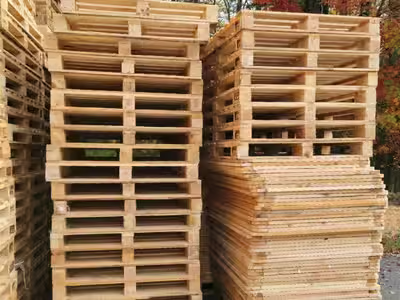
A heat treated pallet (often stamped HT) is a wooden pallet that’s been heated to a core temperature of 56°C (133°F) for at least 30 minutes to kill any wood-borne pests living inside the lumber. It’s a phytosanitary requirement — not a strength or durability claim. If your pallet crosses an international border, it almost always has to be HT.
This guide covers the ISPM-15 standard, what the stamp means, when you need an HT pallet, the cost premium, and how to verify a pallet is legit before you ship.
Key takeaways
- What it is: wood heated to 56°C core for 30+ minutes to kill pests
- Standard: ISPM-15 (International Standards for Phytosanitary Measures No. 15)
- When required: almost all international wood packaging — exceptions are rare
- The stamp: IPPC wheat logo + country code + certification number + “HT”
- Cost premium: ~$1–$3 over a standard 48 × 40 GMA pallet
What is ISPM-15?
ISPM-15 is the international standard for treating wood packaging material (WPM) to prevent the global spread of wood-borne pests like the emerald ash borer, pinewood nematode, and asian longhorned beetle. It’s published by the IPPC (International Plant Protection Convention) under the UN’s FAO and is enforced by ~180 countries.
ISPM-15 covers all solid wood packaging used in international trade — pallets, crates, dunnage, bracing, and skids that travel across borders. Wood-based panel materials (plywood, OSB) and engineered woods are exempt.
Approved treatments
ISPM-15 recognizes two approved treatments. Heat is the dominant one in the U.S.; methyl bromide fumigation is being phased out globally for environmental reasons.
Treatment | Stamp suffix | How it works | Notes |
|---|---|---|---|
Heat treatment | HT | Wood heated to 56°C core for 30+ min in a kiln or chamber | Most common; doesn’t change pallet color or smell |
Dielectric heating | DH | Microwave-style heating to 60°C core for 1 minute | Newer, faster process; same effect as HT |
Methyl bromide fumigation | MB | Chemical fumigation in sealed chamber | Phased out in EU; banned in 60+ countries; rare in U.S. |
Kiln-dried (KD) | (supplemental) | Lumber dried for moisture, not pests | KD alone is NOT ISPM-15 compliant — must be paired with HT |
How to read the HT stamp
The IPPC stamp has four required elements:
The wheat logo (IPPC mark): the international plant symbol, always on the left
Country code: 2-letter ISO country code (e.g.,
US,CA,MX)Producer / treatment provider number: a unique registration number assigned by the country’s plant health authority (in the U.S., the ALSC — American Lumber Standard Committee)
Treatment code:
HTfor heat treatment,DHfor dielectric heating,MBfor methyl bromide
The stamp must appear on at least two opposite sides of every pallet, ideally the side stringers, in a contrasting color (usually black ink on natural wood or white on darker wood).
When do you need an HT pallet?
Short answer: any time wood packaging crosses an international border, unless an explicit exemption applies.
Shipment type | ISPM-15 required? | Notes |
|---|---|---|
Domestic U.S. shipping | No | ISPM-15 governs international trade only |
International export (any country) | Yes | Even Canada and Mexico require it |
U.S. → EU | Yes | Strict enforcement; pallets without HT stamps are returned at the buyer’s expense |
U.S. → Australia / NZ | Yes + extras | Additional fumigation may be required at port of entry |
Empty container repositioning | No | Container moves don’t require ISPM-15 unless wood is inside |
Plywood / OSB / engineered wood | No | Composite materials are exempt — they’re manufactured at temperatures that already kill pests |
Domestic but customer requires it (food, pharma) | Customer-driven | Some U.S. food and pharma buyers require HT for cleanliness reasons, not regulation |
Heat treatment vs. fumigation
Heat is winning. Methyl bromide is being phased out under the Montreal Protocol because it depletes ozone, and the EU banned it in 2010 for ISPM-15 use. Today, more than 95% of new HT pallets in the U.S. are heat-treated, not fumigated.
Factor | Heat treatment | Methyl bromide |
|---|---|---|
Process time | 30 min at temperature (3–5 hour total cycle) | 16–24 hours |
Environmental impact | Low — just heat energy | High — ozone-depleting gas |
Residue | None | Trace fumigant; some buyers refuse |
Cost | $1–$3 over standard pallet | $3–$5 over standard pallet |
Regulatory status (2026) | Standard | Banned in EU, restricted globally |
What does HT cost vs. a standard pallet?
The premium is small and worth it if you need it:
Recycled HT pallets are a thing — once a pallet is HT-stamped, the stamp stays valid as long as the pallet hasn’t been repaired with unstamped wood. If a recycler swaps in a new deckboard during refurbishment, the new board must also be HT before the pallet can ship internationally again. Reputable recyclers maintain HT certification and re-stamp repaired pallets.
Common questions about heat treated pallets
Heat treatment is sometimes confused with related-but-different concepts. Quick clarifications:
HT pallets are not chemically treated. No preservatives, no insecticides, no chemicals at all. Just heat.
HT pallets are food-safe by default. The treatment is purely thermal — nothing to leach.
HT does not make a pallet stronger. Strength depends on construction (stringer thickness, wood species, grade) — see our standard pallet sizes guide for the spec details.
HT pallets can still mold. Heat kills pests, not fungi or moisture. For mold-sensitive cargo, ask for kiln-dried HT pallets (KD-HT) — moisture content under 19% plus ISPM-15.
Frequently asked questions
What does HT mean on a pallet?
HT stands for “heat treated.” The pallet was heated to a core temperature of 56°C for at least 30 minutes to kill any wood-borne pests, satisfying the ISPM-15 international phytosanitary standard.
Are heat treated pallets safe for food?
Yes — heat treatment is purely thermal, with no chemicals or fumigants involved. HT pallets are commonly used in food-and-beverage supply chains. For direct food contact, look for HT pallets that are also kiln-dried (KD-HT) to control moisture and reduce mold risk.
Do I need HT pallets for domestic U.S. shipping?
Not typically. ISPM-15 only governs international trade. However, some U.S. food, pharma, and electronics buyers require HT internally for cleanliness and pest-control reasons — check your customer’s receiving spec.
How can I tell if a pallet is heat treated?
Look for the IPPC wheat logo + country code + producer number + “HT” stamped on at least two opposite sides of the pallet. If the stamp is missing or faded, the pallet is not certified regardless of how it was actually manufactured.
Is kiln-dried the same as heat treated?
No. Kiln-dried (KD) describes moisture content, typically below 19%. Heat treated (HT) describes the ISPM-15 thermal process: 56°C core for 30 minutes. KD lumber is not automatically ISPM-15 compliant — most KD cycles run at lower temperatures.
Can heat treated pallets be reused?
Yes. The HT stamp remains valid as long as no untreated wood is added during repair. If a pallet is repaired with new deckboards, those boards must be HT-stamped before the pallet can ship internationally again. Reputable recyclers maintain certification and re-stamp repaired pallets.
Are plastic pallets ISPM-15 compliant?
Plastic pallets are exempt from ISPM-15 because the standard only applies to solid wood packaging. Plastic, metal, corrugated, and engineered wood (plywood, OSB) pallets ship internationally without any phytosanitary stamp.
How much extra does an HT pallet cost?
Typically $1–$3 more than an equivalent untreated pallet. A Grade A 48 × 40 HT pallet runs $11–$19 vs. $10–$16 untreated. Recycled HT pallets are available for $2–$8 each.
Bottom line
If you ship anywhere outside the U.S., your wood packaging needs to carry an HT stamp. The premium is small ($1–$3) and the consequences of skipping it are large — customs holds, returned shipments, and potential fines from the destination country. Domestic-only? You almost certainly don’t need it, unless your customer’s spec says otherwise.