
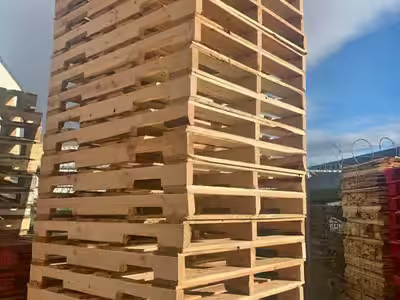
The standard pallet size in North America is 48″ × 40″ — the GMA pallet. It accounts for roughly 30% of all wooden pallets in U.S. circulation and is the workhorse of every truckload, every warehouse rack, and every retail backroom. But “standard” varies by region and industry: ISO recognizes six pallet sizes worldwide, Europe runs on the 800 × 1200 mm EUR pallet, and dozens of specialty sizes serve dairy, automotive, beverage, and chemical supply chains.
This guide gives you every dimension, weight, and use case in one place — plus the trade-offs that decide which size you actually need.
Key takeaways
- Standard U.S. pallet: 48″ × 40″ (1219 × 1016 mm) — the GMA pallet
- Standard EUR pallet: 800 × 1200 mm (31.5″ × 47.24″)
- Empty weight: 30–48 lbs for a 48 × 40 GMA
- Max load: ~4,600 lbs dynamic, ~7,500 lbs static
- Pallets per 53′ trailer: 26 straight, up to 30 turned loaded positions; 480–680 stacked empties (up to 660 on 5-inch stock, 680 only at 23 high on 4.75-inch)
Common pallet sizes — the full chart
These are the U.S. pallet sizes you’ll encounter day to day, with how many fit in a standard 53-foot dry van trailer at single-stack height.
Size (in) | Size (mm) | Common industry | Per 53′ truckload | Notes |
|---|---|---|---|---|
48 × 40 | 1219 × 1016 | Grocery, general (GMA) | 26 straight · 30 turned | The U.S. standard |
42 × 42 | 1067 × 1067 | Telecom, paint | 30 | Square — 360° rotation friendly |
48 × 48 | 1219 × 1219 | Drums, chemical | 26 | Holds four 55-gal drums |
40 × 48 | 1016 × 1219 | Military, retail | 26 turned | Same as GMA, rotated |
48 × 42 | 1219 × 1067 | Chemical, IBC totes | 28 | Common with 275–330 gal IBCs |
40 × 40 | 1016 × 1016 | Dairy | 30 | Sized for milk crates |
48 × 36 | 1219 × 914 | Beverage, shingles | 26 / 34 turned | Narrower for beverage cases |
36 × 36 | 914 × 914 | Beverage | 34 | Most pallets per truck |
44 × 44 | 1118 × 1118 | Drums, pharma | 28 | Heavy-duty block pallet |
What is a “standard” pallet?
In the United States, “standard” almost always means the 48″ × 40″ GMA pallet (sometimes called a “stringer pallet” or “grocery pallet”). The Grocery Manufacturers Association — now the Consumer Brands Association — standardized it in the 1960s to align grocery distribution. Today every major retailer, broker, and 3PL is built around its footprint.
Internationally, “standard” depends on where you ship. ISO 6780 recognizes six approved sizes; Europe uses the EUR pallet (1200 × 800 mm) under the EPAL pool; Asia uses 1100 × 1100 mm. If you ship globally, no single size is “the” standard — your destination decides.
Standard U.S. pallet sizes by industry
Different industries have settled on different defaults — usually because the pallet matches the case dimensions of whatever they’re shipping.
Grocery / general freight — 48 × 40 (GMA): The default. Anything that doesn’t need a specialty size ships on this.
Beverage — 48 × 36 or 36 × 36: Narrower footprint matches case dimensions for soft drinks, beer, and bottled water.
Dairy — 40 × 40: Square pallet sized to milk crates.
Drums / chemical — 48 × 48 or 44 × 44: A 48 × 48 holds exactly four 55-gallon drums; 44 × 44 is heavy-duty for pharma.
Pharmaceutical — 44 × 44 (block): Sterile-compatible, four-way entry, racking-friendly.
Automotive — 48 × 45: Sized for parts bins on assembly lines.
Telecom / paint — 42 × 42: Square, easy to rotate, fits cable spools and 5-gallon paint pail layers.
Military / DoD — 40 × 48: Effectively a GMA, rotated. Spec’d in MIL-STD-1660.
Aerospace — 88 × 108: The unit load device (ULD) footprint used in cargo aircraft.
ISO and international pallet sizes
ISO 6780:2003 defines six approved pallet dimensions for international shipments. If your freight crosses an ocean, your pallet should match one of these — and it must be heat-treated to ISPM-15.
ISO size (mm) | Inches | Used in |
|---|---|---|
1219 × 1016 | 48 × 40 | North America |
1000 × 1200 | 39.37 × 47.24 | Europe, Asia |
1165 × 1165 | 45.9 × 45.9 | Australia |
1067 × 1067 | 42 × 42 | North America, Europe, Asia |
1100 × 1100 | 43.3 × 43.3 | Asia |
800 × 1200 | 31.5 × 47.24 | Europe — the EUR / EPAL pallet |
Standard pallet height
A pallet by itself is shorter than most people think. The empty deck height is typically 4.5″ to 6.5″. With a load, total stacked height is what matters for warehouse racking and trailer clearance:
Empty pallet height: 4.5–6.5″ (recycled stringer pallets about 5″, new GMA stringer pallets up to 6.5″)
Single-stack loaded height: 48″–60″ — the most common ceiling
Double-stacked in a 53′ trailer: up to 100″ (interior trailer height is 108–110″)
Warehouse rack pick height: 48″, 72″, or 84″ depending on rack configuration
How much does a pallet weigh?
Weight matters for two reasons: trailers have a 45,000-lb cargo limit, and warehouse racking is rated by load.
Empty pallet weight
Pallet | Empty weight | Notes |
|---|---|---|
48 × 40 GMA | 30–48 lbs | Varies with stringer thickness, wood species, and grade |
42 × 42 | 35–45 lbs | Square footprint, 3 stringers |
48 × 48 | 55–70 lbs | Heavier-duty drum pallet |
EUR (800 × 1200 mm) | 44–55 lbs (20–25 kg) | Block pallet, 9 feet |
Loaded pallet weight
A typical loaded 48 × 40 pallet weighs 1,500–4,500 lbs in the field. Beverage pallets push the upper end; case goods sit closer to 2,000 lbs.
How pallet dimensions are written
Pallet sizes are written stringer length first, deckboard length second — so a “48 × 40” pallet has 48-inch stringers (the boards that run along the bottom, perpendicular to forklift entry) and 40-inch top deckboards. In most warehouse and freight contexts:
First number: the side a forklift enters from
Second number: the side that faces the trailer doors when straight-loaded
Stringer vs. block pallets
The two main construction styles are stringer pallets and block pallets. The U.S. defaults to stringers; the rest of the world defaults to blocks.
Feature | Stringer pallet | Block pallet |
|---|---|---|
Forklift entry | 2-way (4-way if notched) | 4-way |
Typical empty weight | 30–48 lbs | 50–75 lbs |
Strength | Good for static + dynamic loads | Higher capacity, racking-friendly |
Cost | Lower | Higher |
Common use | U.S. domestic grocery / GMA | Europe, automotive, heavy industrial |
Stringer pallets have three to four parallel stringers running between the top and bottom decks. They allow forklift entry from two sides (the stringer ends), or four sides if the stringers are notched. Most U.S. 48 × 40 GMA pallets are stringer pallets.
Block pallets have nine solid wood blocks at the corners and middle of the pallet, allowing forklift entry from all four sides. They’re stronger and racking-friendly but cost more. The EUR pallet is a block pallet.
GMA pallet specifications
The GMA pallet has tight published tolerances — and most reputable U.S. pallet recyclers will hit them on a Grade A pallet:
Footprint: 48″ L × 40″ W
Deck height: 4.5–6.5″ total (about 5″ recycled, 6.5″ new)
Boards: 7 top deckboards, 5 bottom deckboards, 3 stringers
Stringer dimensions: 48″ × 4″ × 1.375″, with two notches for 4-way entry
Wood: hardwood (oak, maple) or southern yellow pine
Empty weight: 30–48 lbs
Max load: ~4,600 lbs dynamic, ~7,500 lbs static
Heat-treated stamp: required for international shipping under ISPM-15
The dimensions aren’t arbitrary — two 40″ pallets side by side measure 80″, comfortably under a 53-foot dry van’s 98–101″ interior width.
How many pallets fit in a 53-foot trailer?
Using standard 48 × 40 pallets, the orientation and stack pattern decide everything:
Read the full breakdown in our guide on how to load a full truckload of wooden pallets onto a trailer — including pinwheel diagrams, weight-distribution math, and OSHA stacking limits.
Pallet quality grades
Size is only half the story. Pallets also come in grades, and the grade decides price as much as condition:
Grade A (#1): like new — straight, no broken boards, repairs only with new components. The premium tier.
Grade B (#2): 1–2 repaired boards, may have minor stains or weathering. The most common reused tier.
Grade C (#3): more visible repair, structurally sound but not for export-grade or aesthetic-sensitive shipments.
Grade A 48 × 40 pallets typically run $10–$16; Grade B sit $4–$8; Grade C $2–$4. For current pricing across regions, see our recycled wooden pallet pricing trends report.
Heat-treated pallets and ISPM-15
Inside the U.S., heat treatment is optional, but food and pharma buyers increasingly require it.
How to choose the right pallet size
Three questions decide it:
What’s your product’s footprint? Match the pallet to the case dimensions — a beverage case is 12 × 16 inches, so a 48 × 36 pallet fits 9 cases per layer perfectly. Picking the wrong size means wasted cube and unstable stacks.
Where does it ship? International? You’re locked into ISO sizes, with the EUR pallet (800 × 1200 mm) the safest European bet. Domestic only? GMA 48 × 40 is the default.
What does your customer accept? Big-box retailers, food distributors, and automotive OEMs each spec their own pallet sizes. Ask the receiving dock before you ship — a rejected pallet is more expensive than the right one.
If you’re stuck choosing between pallet types (stringer vs. block, hardwood vs. softwood, new vs. recycled), read our guide on how to choose the right pallet type for your shipping needs.
Frequently asked questions
What is the standard pallet size in inches?
48 × 40 inches in North America (the GMA pallet). Internationally, the EUR pallet is 31.5 × 47.24 inches (800 × 1200 mm).
What's the standard pallet size in centimeters?
The U.S. GMA pallet is 121.9 × 101.6 cm. The EUR pallet is 80 × 120 cm.
How tall is a standard pallet?
An empty 48 × 40 GMA pallet is 4.5 to 6.5 inches tall: the common recycled stringer pallet is about 5 inches, and a new GMA stringer pallet runs to 6.5 inches. A loaded pallet is typically 48–60 inches tall single-stacked, up to 100 inches when double-stacked in a 53′ trailer.
How much does a pallet weigh?
An empty 48 × 40 GMA pallet weighs 30–48 lbs depending on grade and wood species. A typical loaded pallet weighs 1,500–4,500 lbs.
How many pallets fit on a 53-foot trailer?
26 straight, up to 30 turned single-stack, and loaded pallets hit the 45,000-lb payload first: at 2,000 lb each that is 22 positions, at 4,500 lb only 10. Stacked empties depend on pallet thickness: about 5-inch stock gives 520–660, from 26 straight stacks x 20 up to 30 turned stacks x 22, with 28 pinwheeled stacks x 22 = 616 between; 6.5-inch new pallets stack 16 high for 480 on 30 stacks; thin 4.75-inch stock reaches 680 with 20 of 30 stacks at 23 high and 10 at 22. Across all stock that is 480–680. Dry empties run out of floor space and height first: 680 x 48 lbs is about 32,600 lbs against a 45,000-lb cargo cap, and only soaked or dense hardwood stock hits weight before space.
Are pallets always made of wood?
No — plastic, metal, and corrugated pallets all exist. But wood pallets (oak, maple, southern yellow pine) account for roughly 95% of U.S. pallet volume.
What's the difference between a pallet and a skid?
A skid is technically a pallet without a bottom deck — just stringers. In practice, the terms are used interchangeably across most of the industry.
Can I buy a single pallet?
Most pallet companies sell in truckload quantities (480–680 pallets per load, typically 520–660). For smaller quantities, look for a local pallet recycler — or request a quote on Repackify for any size, grade, or location.
What's the most common pallet size in the U.S.?
The 48 × 40 GMA pallet — by a wide margin. Roughly 30% of all U.S. pallets in circulation are this size, and it's the default for grocery, retail, and general freight.
Bottom line
The “standard” pallet is the 48 × 40 GMA — and 90% of U.S. shippers will never need anything else. But if you ship overseas, run a specialty industry, or need to squeeze every cubic foot out of a trailer, the right size depends on your case dimensions, your destination, and your buyer’s spec.