
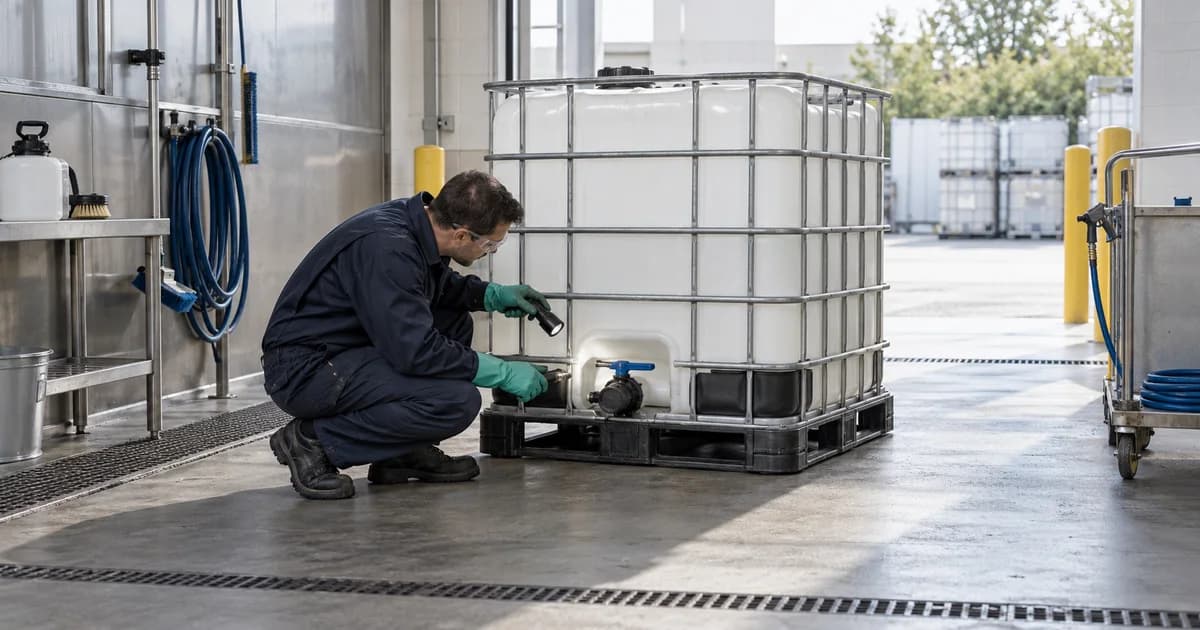
A used IBC tote can be cleaned and returned to service many times over — that's the whole point of a reusable intermediate bulk container. But “clean” is not one thing. A tote that held a benign non-hazardous liquid and a tote that held a corrosive or a regulated chemical demand completely different handling, and the difference is a safety decision, not a convenience one. This checklist walks the work in the order an experienced operator actually does it: confirm what was in the tote first, clean to the level the next use requires, then inspect every component before you trust it with a fresh load.
Key takeaways
- Identify the prior contents and get the SDS before you touch anything. If the previous product was hazardous, unknown, or unlabeled, do not DIY — send the tote to a professional reconditioner.
- Match the cleaning level to the next use: a triple rinse for non-critical industrial reuse, hot-water detergent washing for general reuse, and professional food-grade reconditioning for anything potable or food-contact.
- Inspect the bottle, cage, pallet, valve, and gasket separately — each fails in a different way, and a sound cage can hide a cracked or sun-degraded bottle.
- Document the prior contents, cleaning method, and inspection result. A traceable history is what lets the next user trust the tote.
Step 1 — Confirm prior contents and pull the SDS
Everything downstream depends on this. Read the existing label, the UN/DOT markings, and any batch or product stamp on the bottle. Track down the Safety Data Sheet for the prior product and read sections 7 (handling and storage), 8 (exposure controls and PPE), and 13 (disposal) before you plan the job. If you're unsure what an SDS is or how to read one, see our guide to SDS sheets for used packaging. A tote with a missing, illegible, or mismatched label is treated as unknown — route it to a reconditioner.
Step 2 — Set up PPE and a safe work area
Even for a benign prior product, residue concentrates as it dries. Work outdoors or in a well-ventilated bay, never inside the tote, and never with the lid sealed while agents are reacting. Minimum PPE for a confirmed non-hazardous tote:
Chemical-resistant gloves and splash goggles or a face shield — residue and rinse water will splash.
An apron or coveralls and closed footwear; upgrade to chemical suits per the SDS if anything stronger than detergent is used.
Respiratory protection if the SDS calls for it or if you're using caustic or steam.
Step 3 — Depressurize, drain, and dispose of residue legally
Relieve any internal pressure slowly through the lid vent before opening. Drain the remaining product through the valve into an approved container. Residue is not yours to pour down a drain. Even small heels of a non-hazardous product can violate local sewer and stormwater rules; hazardous residue is regulated waste. Dispose of it per the SDS section 13 and your local authority — collect it, label it, and hand it to a licensed waste handler when in doubt.
Step 4 — Clean to the right level
Climb the cleaning ladder only as far as the next use requires. Each rung is more aggressive, more costly, and needs more equipment and training.
Triple rinse. Three successive flushes of clean water (or warm water), each agitated and fully drained, with rinse heads reaching the top corners. Adequate for many non-critical industrial reuses of the same or compatible product.
Hot water and detergent wash. A heated wash with a compatible detergent and a rotary spray ball, followed by a clear-water rinse. The default for general industrial reuse where the next product differs from the last.
Caustic or steam for stubborn residue. Baked-on, polymerized, or oily residue may need a caustic wash or steam cleaning. This requires trained handling, neutralization, and careful disposal — it is where many operations hand off to a pro.
Professional food-grade reconditioning. Validated cleaning, sanitizing, and often a new inner bottle, performed by a certified reconditioner. Required for anything food, beverage, or potable-water grade. See reconditioning vs. recycling for when a tote is worth reconditioning versus retiring.
Step 5 — Final rinse and neutralize
After any detergent or caustic step, rinse with clean water until the runoff is clear and pH-neutral — test it if you used a caustic. Trapped cleaning agent left in the bottle will contaminate the next load just as surely as the original residue would. Drain completely and let the interior air-dry before sealing; a sealed wet tote grows odor and biofilm.
Step 6 — Inspect every component
A tote is a system: an HDPE bottle, a steel cage, a pallet base, and the valve assembly. Inspect each one — a sound cage routinely hides a failed bottle.
Bottle: look for cracks, stress whitening at the corners, bulging, and crazing. Check for UV degradation — chalky, brittle, or faded plastic from outdoor storage is a reject. Shine a light through the wall to spot residue film, and smell for retained odor.
Cage: inspect welds at every intersection, look for dents, bent bars, and rust-through. A bent or sprung cage no longer restrains the bottle under a full load.
Pallet: steel, composite, or plastic — check for cracks, broken feet, and fork-pocket damage. The pallet carries the whole stacked load.
Valve and gasket: open and close the valve; it should seat fully with no weep. Inspect the gasket/O-ring for swelling, cracking, or chemical attack, and replace it if there's any doubt — gaskets are cheap, leaks are not.
Fittings and lid: confirm the lid gasket, vent, and any adapters are intact and that threads are clean and undamaged.
Step 7 — Pressure / leak check and document
Before returning the tote to service, fill it with water and let it stand to confirm the valve, bottle seams, and lid hold without weeping. Then record it: the prior product, the cleaning level performed, the gasket/valve replacements, the inspection result, and the date. That record is what makes a used tote trustworthy to the next user — and it's the difference between selling a graded, documented container and an unknown one.
Cleaning level | What it's good for |
|---|---|
Triple rinse | Non-critical industrial reuse of the same or compatible product; internal site reuse |
Hot-water detergent wash | General industrial reuse where the next product differs; broad resale as a washed tote |
Professional food-grade reconditioning | Food, beverage, and potable-water use; certified, validated, often with a new inner bottle |
Cleaning level vs. what it qualifies the tote for
For the full lifecycle picture — how IBCs are collected, washed, reconditioned, and rebottled at scale — see the IBC recycling and cleaning process, and the IBC tote buying guide for grades, capacities, and what to look for when buying used.
Frequently asked questions
Can I clean an IBC tote myself?
Only if you can positively identify the prior contents and confirm from the SDS that they were non-hazardous. A confirmed-benign tote can be triple-rinsed or detergent-washed on site with proper PPE and ventilation. If the prior product was hazardous, unknown, or unlabeled — or if the tote is destined for food or potable use — send it to a professional reconditioner instead.
How do I clean an IBC tote for food or drinking water?
You don't do it with a dock rinse. Food, beverage, and potable-water use requires professional food-grade reconditioning: validated cleaning and sanitizing, and often a new inner bottle, performed by a certified reconditioner. A rinse removes visible residue but does not make a container food-safe or provide the traceability food-safety programs require.
What does triple rinsing an IBC tote mean?
Three successive flushes with clean water, each one agitated so the rinse reaches the top corners and seams, and each fully drained before the next. It's adequate for non-critical reuse of the same or a compatible product, but it is not a substitute for a detergent wash when the next product differs, and never a substitute for reconditioning on food-grade work.
What should I inspect on a used IBC tote before reuse?
Inspect each component separately: the bottle for cracks, bulging, UV degradation, residue film, and odor; the steel cage for weld integrity, dents, and rust; the pallet for cracks and broken feet; and the valve and gasket for full seating and a leak-free seal. Finish with a water-fill leak check and replace the gasket if there's any doubt.