
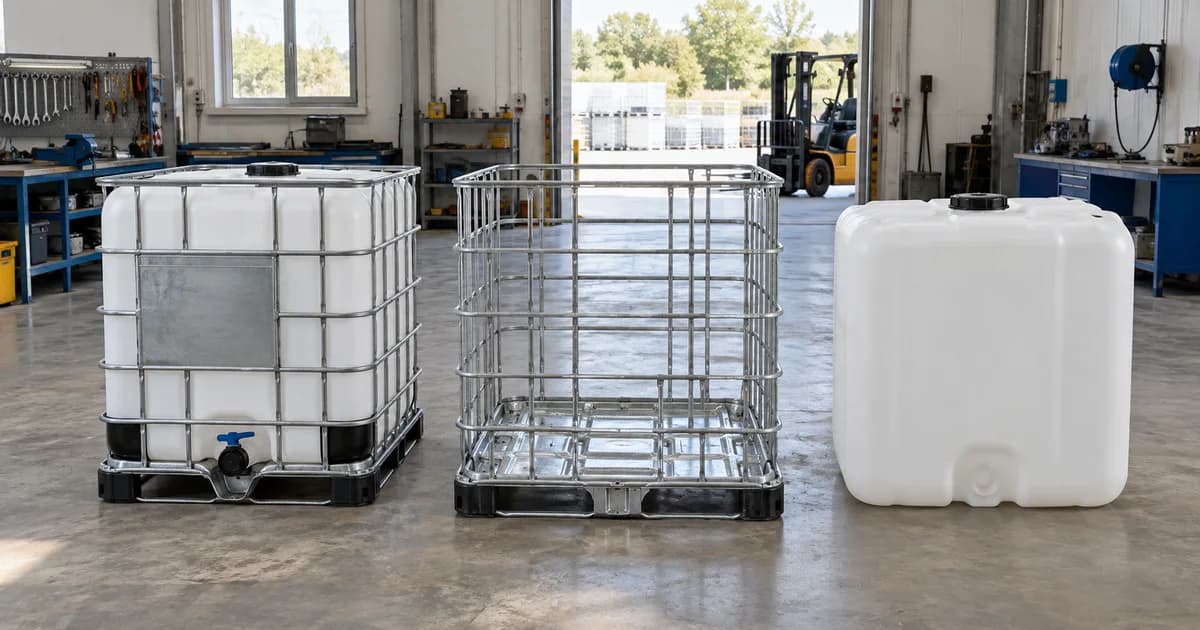
An intermediate bulk container (IBC) is a single deliberate assembly: a molded HDPE bottle of roughly 275 or 330 gallons, a welded steel tubular cage, and a steel or composite pallet base, fitted with a discharge valve and a top fill cap. When a tote reaches the end of its current service life, the question is never simply “keep or scrap.” The right call follows a value hierarchy: keep it in service if you can, recondition or rebottle it if the parts are sound, and recycle the materials only when the container can't be safely returned to liquid service.
Key takeaways
- Reuse beats recondition beats recycle. Every step down that ladder destroys more embodied value, so the inspection exists to push the tote as high up it as is safe.
- Reconditioning cleans, tests, and returns the original bottle to service; rebottling drops a new HDPE bottle into a reused cage and pallet when the bottle is spent but the frame is sound.
- Recycling is the floor, not the default — the bottle is ground to HDPE regrind and the cage is scrapped as steel only when damage or residue rules out reuse.
- Prior contents and the SDS decide more than visible condition does. Unknown or hazardous residue sends a tote straight to recycling regardless of how good the cage looks.
The value hierarchy
A reusable tote that's emptied, cleaned, and put back into the same kind of service retains nearly all of its value — no new plastic, no new steel, no reprocessing energy. Reconditioning and rebottling recover most of it: the cage, pallet, and (for reconditioning) the bottle stay in circulation. Recycling recovers the least — you get HDPE regrind and scrap steel, both worth a fraction of an assembled, sellable tote. The entire end-of-life inspection is built to keep each container as high on this ladder as is safe and documentable.
Reconditioning vs. rebottling vs. recycling
These three terms get used loosely in the field, but they describe genuinely different processes with different inputs and outputs:
Path | What happens | When it applies | Value recovered |
|---|---|---|---|
Recondition | Original bottle is washed, pressure/leak tested, and inspected; cage, valve, and gaskets serviced. Tote returns intact. | Bottle is structurally sound, cleans fully, and prior contents allow reuse. | Highest — entire assembly stays in service. |
Rebottle | Spent bottle is removed and recycled; a new HDPE bottle is fitted into the reused, inspected cage and pallet. | Cage and pallet are sound but the bottle is cracked, UV-brittle, or won't clean. | High — steel frame and pallet reused, only the bottle is new. |
Recycle | Bottle is granulated into HDPE regrind; cage and pallet are separated and sold as scrap steel. | Bottle damaged beyond reuse, or residue is hazardous/unknown, or the cage is bent or corroded through. | Lowest — material value only, no assembled container. |
The three end-of-life paths for an IBC tote
The inspection that decides the path
Which path a tote takes comes down to a structured inspection of four things. Failing any one of them moves the container down the hierarchy.
Bottle condition — stress cracks (especially at the corners and around the discharge fitting), chalky or brittle surfaces from UV exposure, ballooning or permanent deformation, and residue or staining that won't come clean. A sound, cleanable bottle can be reconditioned; a compromised one means rebottle or recycle.
Cage integrity — bent, cracked, or rusted-through tubing, broken welds, and a warped footprint that won't stack or seat on a forklift. A straight, solid cage supports either reconditioning or rebottling; a failed cage usually means the whole unit is scrapped.
Valve and fitting condition — the discharge valve, gaskets, and cap. These are consumable and routinely replaced during reconditioning, so a worn valve alone rarely disqualifies a tote — but a seized or cross-threaded outlet that's damaged the bottle is a different story.
Prior contents — the single most important input. Documented food-grade or benign industrial liquids keep options open; aggressive chemicals, anything that permeated the HDPE, or an unknown history close them down.
When recycling is the only option
Some totes don't get a choice. Send a container to recycling — not reconditioning or rebottling — when:
the bottle is cracked, punctured, heavily UV-degraded, or permanently deformed;
prior contents were hazardous, regulated, or unknown, and the SDS history can't be established;
residue has permeated the HDPE or won't clean to a verifiable standard;
the cage is bent, corroded through, or has failed welds that make the assembly unsafe to fill and move.
At that point the bottle is granulated into HDPE regrind (useful for a wide range of secondary plastic products) and the cage and pallet are separated for the steel scrap stream. Both materials stay out of the landfill — recycling is the floor of the hierarchy, not a failure of it.
UN/DOT marking and reconditioner requirements
IBCs used for regulated liquids carry a UN marking molded or stamped on the bottle and cage, and they're subject to periodic inspection and testing requirements before they can re-enter regulated service. Reconditioning a tote for that service isn't a wash-and-resell job — it's done by reconditioners who test, document, and re-mark the container to the applicable standard. If your tote needs to carry a regulated commodity again, the path runs through a qualified reconditioner, not a pressure washer in the yard. Treat the specific marking and test intervals as something to confirm against current regulations and the reconditioner's certification, not from memory.
Selling reusable totes recovers value
The highest-value end-of-life outcome is often not something you do in-house at all: a clean, sound, documented tote is worth real money to a buyer who needs exactly that. Rather than scrapping a container that would still pass inspection, selling it keeps it at the top of the hierarchy and puts cash against what would otherwise be a disposal cost. For how the resale market values different conditions, see the IBC tote price index.
For the broader specs that determine whether a tote is worth keeping in the first place, start with the IBC tote guide. The recycling and cleaning process walks through how reconditioners actually wash and test a bottle, and the IBC cleaning checklist is the practical pre-reuse inspection you can run before deciding a path.
Frequently asked questions
What is the difference between reconditioning and rebottling an IBC tote?
Reconditioning returns the original HDPE bottle to service after washing, testing, and inspection, with the cage and valve serviced as needed. Rebottling removes a spent or damaged bottle and fits a new HDPE bottle into the reused, inspected cage and pallet. Reconditioning keeps the whole assembly; rebottling replaces only the bottle.
When does an IBC tote have to be recycled instead of reused?
When the bottle is cracked, punctured, badly UV-degraded, or deformed; when prior contents were hazardous, regulated, or unknown; when residue has permeated the plastic or won't clean to a verifiable standard; or when the cage is bent, corroded through, or has failed welds. In those cases the bottle is ground to HDPE regrind and the cage is scrapped as steel.
Can a used IBC tote be reused for food or drinking water?
Only if its full history is documented as food-grade and it has been processed by a qualified reconditioner. Never return a tote to food or potable-water service based on appearance alone — HDPE can absorb prior contents that no longer show on the surface. If the contents history is unknown, treat the tote as unsuitable for food service.
Why do prior contents matter more than how clean the tote looks?
HDPE is permeable enough that some chemicals soak into the bottle wall and can't be fully washed out, so a tote can look spotless and still be unsuitable for reuse. The safety data sheet for the prior contents — not a visual inspection — is what determines whether the tote can be reconditioned, must be rebottled, or has to be recycled.