
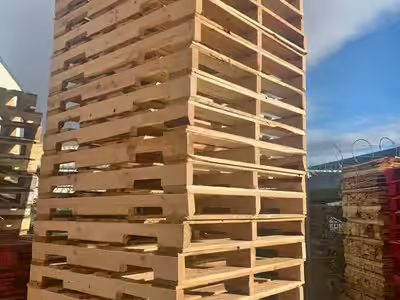
A skid is a platform with no bottom deck — just a top surface sitting on runners (the “stringers”). A pallet is a skid plus a bottom deck, which adds rigidity, spreads load across racking, and lets it be stacked. That bottom deck is the entire difference.
In day-to-day warehouse talk the two words are used interchangeably, and most people calling something a “skid” are actually describing a standard 48″ × 40″ pallet. But the distinction is real, it’s historical, and it occasionally matters — here’s when.
Key takeaways
- Skid: top deck + stringers, no bottom deck
- Pallet: top deck + stringers/blocks + bottom deck
- Skids came first — pallets are the 1920s–40s evolution once forklifts arrived
- Use a skid for heavy machinery, permanent bases, or ground-drag moves; use a pallet for racking, stacking, and freight
- “Standard skid size” is the same 48 × 40 as the GMA pallet
Skid vs. pallet, side by side
Skid | Pallet | |
|---|---|---|
Bottom deck | No — open underside | Yes — closed bottom |
Stability | Lower; can wobble loaded | Higher; rigid base |
Stackable | Not safely | Yes |
Rack-friendly | No (no bottom support) | Yes |
Forklift / jack | Forklift; pallet jack struggles | Both |
Best for | Heavy machinery, permanent mounts, drag moves | Freight, racking, retail, stacking |
Cost | Slightly less (less material) | Standard |
What exactly is a skid?
A skid is the older design — essentially a top deck nailed onto runners, with nothing underneath. Because there’s no bottom deck, a skid sits flush on the floor and can be dragged or skidded along a surface (hence the name). Skids predate the forklift: before powered material handling, goods sat on simple runner platforms that could be levered and slid into place.
Skids are still preferred in a few specific cases:
Heavy machinery & equipment: a single sturdy skid base is easier to bolt equipment to and won’t collapse under a point load.
Permanent or semi-permanent bases: generators, HVAC units, and industrial tooling often ship and live on a skid.
Ground-level handling: with no bottom deck, a skid clears uneven surfaces and can be winched or dragged.
What makes it a pallet?
Add a bottom deck and you have a pallet. That deck does three things a skid can’t:
The bottom deck lets the unit rest on warehouse beam racking without the load sagging through, supports stacking another loaded pallet on top, and stiffens the whole structure so it survives repeated forklift handling. That’s why virtually all freight, retail, and pooled logistics runs on pallets, not skids.
Standard skid sizes
Because “skid” usually means “pallet” in practice, standard skid sizes mirror standard pallet sizes — the 48 × 40 GMA footprint is the default.
Size (in) | Common use |
|---|---|
48 × 40 | The standard — same as the GMA pallet |
48 × 48 | Drums and chemical loads |
42 × 42 | Square footprint, easy rotation |
36 × 36 | Beverage and compact loads |
Custom | Machinery skids built to the equipment footprint |
For the single most common footprint and how it’s graded, see our guide to the 48 × 40 GMA pallet.
Which should you use?
Default to a pallet. It’s rack-compatible, stackable, and what every downstream dock, 3PL, and retailer expects. Reach for a skid only when you’re mounting heavy equipment to a permanent base, shipping something that will never be racked or stacked, or need to drag the load across a surface. For everything else — freight, distribution, storage — a pallet wins.
Frequently asked questions
What is the difference between a skid and a pallet?
A skid has no bottom deck — just a top platform on runners. A pallet adds a bottom deck, which makes it stackable, rack-compatible, and more rigid. In everyday warehouse use the terms are often used interchangeably.
Is a skid cheaper than a pallet?
Slightly, because a skid uses less lumber (no bottom deck). But the savings are small and a pallet's rack/stack compatibility usually outweighs it for general freight.
What is the standard skid size?
48 × 40 inches — the same footprint as the standard GMA pallet, since "skid" and "pallet" are used interchangeably in most contexts.
Can you stack skids?
Not safely. Without a bottom deck, a loaded skid lacks the rigid base needed to support another unit on top. Use pallets for stacking.
Why is it called a skid?
Because with no bottom deck it sits flush on the floor and can be dragged or "skidded" along a surface — the design predates the forklift.
Bottom line
The difference is the bottom deck: skids don’t have one, pallets do. That makes pallets the default for anything that gets racked, stacked, or shipped, and reserves skids for heavy, permanent, or drag-it-into-place loads. When in doubt, you want a pallet.