
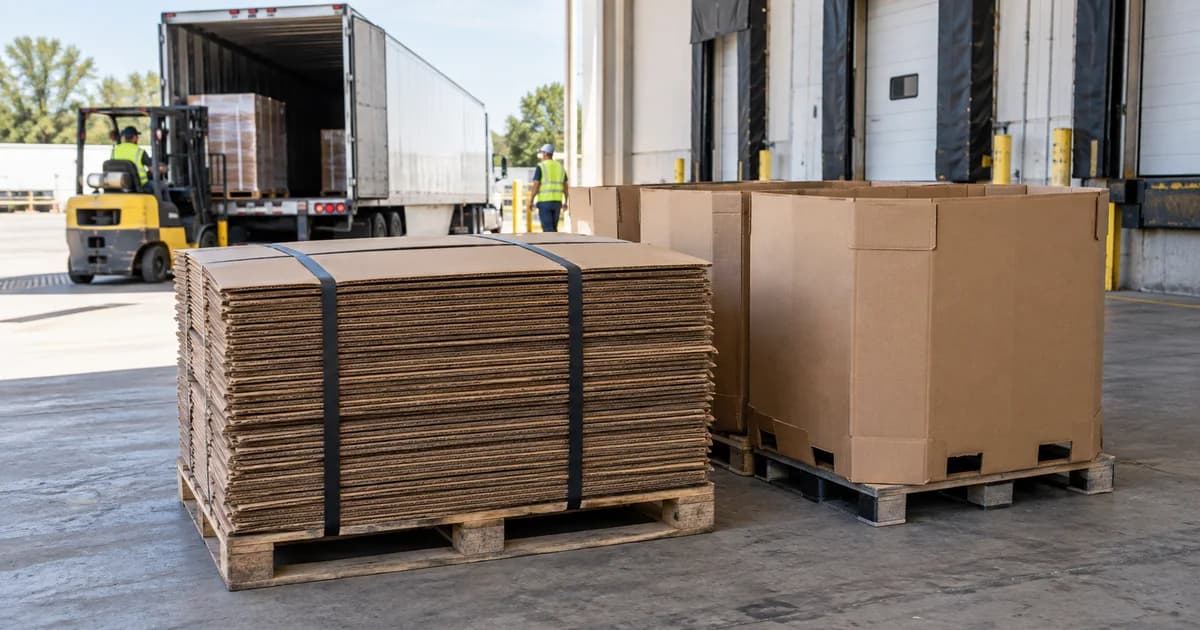
Most facilities don't generate gaylord boxes one at a time — they accumulate. A receiving dock, a returns line, or a production cell empties bulk boxes faster than anyone deals with them, and within a few weeks there's a corner stacked with assembled, half-crushed, and damp boxes nobody has sorted. How you prep that pile decides whether it leaves as a check (resale) or a cost (recycling pickup) — and whether a truck can take it in one trip or three. This guide walks the prep the same way an operator would: sort first, protect the value, then densify the rest.
Key takeaways
- Sort before you touch anything. Sound, dry, full-flap boxes are resale inventory; crushed, wet, or contaminated ones are OCC scrap. The two piles get handled completely differently.
- Don't bale boxes you could sell. Reuse value is many times the per-pound scrap price — a baler turns a sellable box into the cheapest commodity there is.
- Empties ship flat. Reusable boxes carefully flattened and palletized fit far more per trailer than assembled ones, which is what makes a truckload pickup pay.
- Stage for the forklift and the truck. Banded, labeled, counted pallets near a dock door turn a vague pile into a load a driver can grab and go.
Step 1: Sort reusable from recycle-only
This is the single decision that drives everything downstream, and it gets made box by box. Pull each one and judge it on four things: structure, dryness, flaps, and contamination.
Reusable (keep) | Recycle-only (OCC) | |
|---|---|---|
Structure | Walls square, no collapsed corners or blowouts | Crushed, blown-out corners, delaminated walls |
Moisture | Dry, no water staining or soft spots | Wet, water-stained, or soft — strength is gone |
Flaps | Bottom flaps intact, top flaps usable | Torn-off or shredded flaps |
Contamination | Clean inside; liner removable | Product residue, wax coat, heavy soiling, odor |
What you do with it | Keep assembled or flatten gently — resell | Break down and bale — OCC scrap |
Sorting gaylords: keep vs. recycle
Sort by wall count and size while you're at it. Buyers want uniform lots — fifty 48″ × 40″ double-wall boxes is a sellable unit; a mixed jumble of sizes and wall counts is much harder to move. Keep the certificate stamp (the round or rectangular manufacturer mark on a bottom flap) visible; it's how a buyer verifies wall count and rated capacity. If you're unsure what you're looking at, the gaylord box buying guide breaks down walls, grades, and bottom styles.
Step 2: Protect the reusable boxes
Reusable boxes only hold their value if they leave in the condition you sorted them in. Two ways to stage them:
Keep them assembled when you have the floor space and the buyer wants ready-to-use boxes. Nest them where you can, but never jam a box so tight it bows the walls.
Flatten them gently to ship more per trailer. Open the bottom flaps and collapse along the existing fold lines — don't crush, don't stomp the corners, don't fold across a panel. A clean flat re-erects into a usable box; a crushed one is scrap with extra steps.
Either way, pull the poly liner before staging. A liner left in a stacked box traps moisture and can take a dry box down a grade. Liners that are clean and dry are sometimes resalable themselves; otherwise they go to film recycling, not the OCC bale.
Step 3: Break down the recycle-only boxes
Everything in the scrap pile gets flattened for OCC (old corrugated containers) baling. Density is the whole game here — a mill or hauler pays by weight and won't take loose, air-filled boxes economically. Before anything goes in the baler, strip the contaminants:
Remove liners — poly bag liners are not OCC and contaminate the bale.
Pull tape, labels, and banding — excessive tape and any plastic strapping should come off.
Knock out staples and metal — stitched seams, corner staples, and any hardware.
Empty all product residue — pellets, dust, loose material. Residue downgrades or rejects a bale.
Flatten and bale by type — collapse along the folds and bale clean corrugated together.
For the mechanics of running clean, dense bales, see how to bale cardboard boxes.
Step 4: Stage for dense, single-stop pickup
Whether boxes are leaving as resale inventory or scrap, the loading math is the same: empties stacked flat ship far more per trailer than assembled boxes, and a truck that can grab clean pallets at one staging point is a truck that quotes you a better rate.
Put the staging area where a forklift can work it and a truck can reach it — near a dock door or a clear drive approach, not buried at the back of the building. Keep the reusable pallets separate from the OCC bales so the two never get loaded together by mistake. A labeled, counted, accessible stage is the difference between a quoted truckload and a driver who shows up, can't load it, and leaves.
Still deciding whether a given box should be resold or recycled at all? The reuse vs. recycle guide walks through where that line falls and why reuse almost always wins on value when the box can take it.
Frequently asked questions
Should I flatten gaylord boxes I want to resell, or keep them assembled?
Both work, as long as you flatten gently along the existing fold lines and never crush the corners. Flattened reusable boxes ship far more per trailer, which makes a truckload pickup pay. Some buyers prefer ready-to-use assembled boxes, so check what the buyer wants — but a clean flat re-erects into a usable box, while a crushed one is scrap.
Can I put wax-coated cardboard in my OCC bale?
No. Wax-coated corrugated isn't OCC-recyclable — the wax ruins the repulping batch and most mills reject it. The same goes for boxes with heavy product residue, oil, or strong odor. Keep them out of the bale; they go to waste or a specialty wax-board stream if your hauler offers one.
What has to come off a box before it goes in the baler?
Strip the contaminants: pull poly liners, remove excess tape, labels, and any plastic banding, knock out staples and metal hardware, and empty all product residue. Clean corrugated bales dense and clean; contaminated material downgrades or rejects the bale.
How should I stage gaylord boxes so a truck can pick them up in one stop?
Stack flattened boxes on pallets, banded and grouped by size and wall count, with the box count labeled on each pallet. Keep reusable pallets separate from OCC bales, and put the staging area near a dock door or clear drive approach so a forklift can work it and a truck can reach it.