
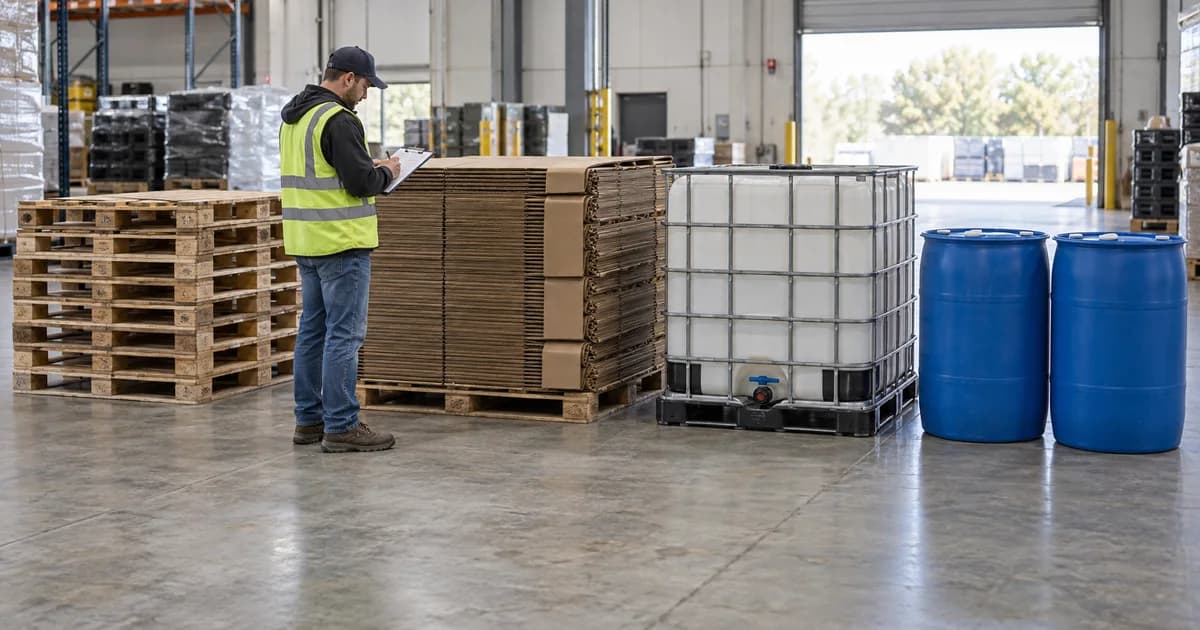
If you generate surplus packaging — used pallets, gaylord boxes, IBC totes, steel or poly drums, bulk bags — the first question is always the same: what is it worth? The honest answer is that “used packaging” has no single price. The same Grade B pallet that a recycler down the road pays $4 for might be worth $9 to a reconditioner two states away, and nothing at all to a hauler who has to drive 80 miles for a half-load. Value is set at the intersection of a handful of concrete drivers. Get them right and surplus becomes a recovery line on your P&L; get them wrong and you pay to have it taken away.
Key takeaways
- Reuse value beats scrap value, often several times over. A reusable container is worth what it saves the next buyer; scrap is worth only its commodity weight.
- Volume drives everything. Truckload quantities command real money; small mixed lots frequently cost you more in pickup than they return.
- Standard, clean, sorted, and uniform loads sell. Oddball sizes, contamination, and mixed grades push you toward scrap pricing — or no bid at all.
- Freight eats thin margins. Proximity to a buyer and how densely the load ships can matter more than the item itself.
Reuse value vs. scrap value
The single biggest lever is whether your packaging can be reused or only recycled. A reusable item is priced against what a buyer would otherwise spend on a new one — so a sound 48″ × 40″ pallet, a once-used gaylord, or a rinsed food-grade IBC tote carries a real bid because the buyer avoids buying new. Scrap is priced against commodity weight alone: a crushed pallet becomes ground wood mulch, a punctured tote becomes regrind resin, a dented drum becomes shredded steel. Those commodity markets pay pennies on what the intact item is worth. Everything below is really a question of which side of that line your load falls on.
The value drivers
Buyers weigh the same handful of factors on every load. Here is how each one moves the price:
Factor | Raises value | Lowers value |
|---|---|---|
Volume | Full truckload or recurring weekly lots | Onesies, partial pallets, one-time small piles |
Condition / grade | Reusable, structurally sound (Grade A/B) | Broken, delaminated, leaking (scrap only) |
Standardization | 48×40 GMA pallets, standard 275/330 gal totes, 55 gal drums | Oddball footprints, custom sizes, no buyer pool |
Contamination | Clean, dry, odor-free, residue removed | Wet, oily, chemical residue, labels for hazmat |
Location & freight | Near buyers/recyclers; dense, stackable loads | Remote site; bulky, low-density, hard to load |
Consistency | Sorted, uniform type and grade per load | Mixed types and grades jumbled together |
What raises and lowers the value of surplus packaging
Volume: the threshold that flips the math
Used packaging moves by the truckload. A buyer who sends a trailer and a crew wants it filled — a full load of one item amortizes the freight and labor across hundreds or thousands of units, so the per-unit bid is at its highest. Drop below a full load and the fixed cost of the pickup doesn't change, so the buyer's effective cost per unit climbs and your payout falls. Below a certain floor, the bid goes negative: the pickup costs more than the material returns.
Condition and grade
Within the reusable tier, grade sets the price. The grading language differs by product, but the logic is identical: how close is this to a new unit, and how much rework does the next buyer have to do? A Grade A pallet needs no repair and resells immediately; a Grade B pallet is sound but cosmetically worn; a “core” or repair-grade pallet needs board replacement before resale and is priced accordingly. A once-used IBC tote with an intact cage and valve far outsells one with a cracked bottle. See pallet grades explained for how the A/B/recycled ladder works in practice.
Standardization
Standard sizes have a deep buyer pool; oddball sizes have almost none. The 48″ × 40″ GMA pallet is the most traded footprint in North America, so it always finds a bid. The same goes for 275- and 330-gallon IBC totes, 55-gallon drums, and standard bulk-bag dimensions — these match equipment, racking, and shipping systems everywhere, so a reconditioner or reuser can absorb them by the thousand. A custom 44″ × 44″ pallet or a one-off tote size has no natural second home; it usually clears only as scrap.
Contamination
Clean, dry, and odor-free is the dividing line between a reuse bid and a disposal cost. Wet pallets grow mold and lose strength; totes and drums that held oils, solvents, or food residue need cleaning the buyer has to pay for — and anything that held a hazardous material may be legally restricted from reuse entirely. Residue, strong odors, and stuck-on labels all push a load down toward scrap or out of the market. The cheapest value you can add is keeping surplus under cover, draining and rinsing liquid containers, and not letting it sit out in the weather.
Location, freight, and timing
Used packaging is low value per pound relative to its bulk, so freight is a large share of the delivered cost — and it comes out of your number. Proximity to a buyer or recycler is a real price driver: a load 30 miles from a reconditioner nets more than the identical load 300 miles out. Load density matters too — packaging that nests, folds, or stacks flat ships more units per trailer and carries better economics than bulky, air-filled loads.
Finally, timing moves with the commodities your packaging tracks. Wood pallet pricing follows lumber; poly drums, totes, and bulk bags track resin; corrugated and gaylords follow OCC (old corrugated containers). When the underlying commodity is high, new packaging is expensive and demand for reusable surplus rises with it; when commodities are soft, reuse bids soften too. You can watch these cycles on the Repackify Price Index, and the pallet price index tracks recycled wood pallet movement specifically.
Why a marketplace beats a single local recycler
The same load is worth different amounts to different buyers, because each one's freight lane, reuse demand, and rework cost is different. A single local recycler gives you one bid — and if reuse isn't their business, that bid is a scrap number. A marketplace routes your load to whoever values it most: a reconditioner who can resell it intact, a reuser in your region with a short freight lane, or a recycler only as a last resort. That competition is what separates a real payout from a haul-away fee. For who actually buys surplus and how to reach them, see who buys pallets and where to sell.
Frequently asked questions
How much can I get for used pallets, totes, or drums?
It depends almost entirely on volume, condition, sizing, and location, so there's no single price. Reusable, standard, clean items in truckload quantities near a buyer earn real money; broken, oddball, or contaminated material in small lots usually clears only as scrap or costs you a disposal fee. The fastest way to know is to get a quote on your specific load.
Why won't anyone pay for my small quantity?
Used packaging moves by the truckload, and the cost of sending a truck and crew is roughly the same whether it leaves full or half-empty. Below a load minimum, that fixed pickup cost exceeds what the material returns, so the realistic outcome is a haul-away fee rather than a payout. Accumulating surplus until you have a full, sorted load flips that math.
Is reuse really worth more than recycling?
Usually, yes — often several times more. A reusable item is priced against what a buyer saves by not buying new, while recycling pays only the commodity weight (ground wood, regrind resin, shredded steel). Keeping packaging clean, dry, and intact is what keeps it on the higher-value reuse side of that line.
Does where I'm located affect the price?
Yes. Used packaging is bulky and low value per pound, so freight is a big share of the delivered cost and comes out of your payout. A load near a reconditioner or reuser nets more than the identical load far from any buyer. A marketplace helps by matching your load to the buyer with the shortest freight lane and the highest reuse demand, not just the one recycler nearest you.