
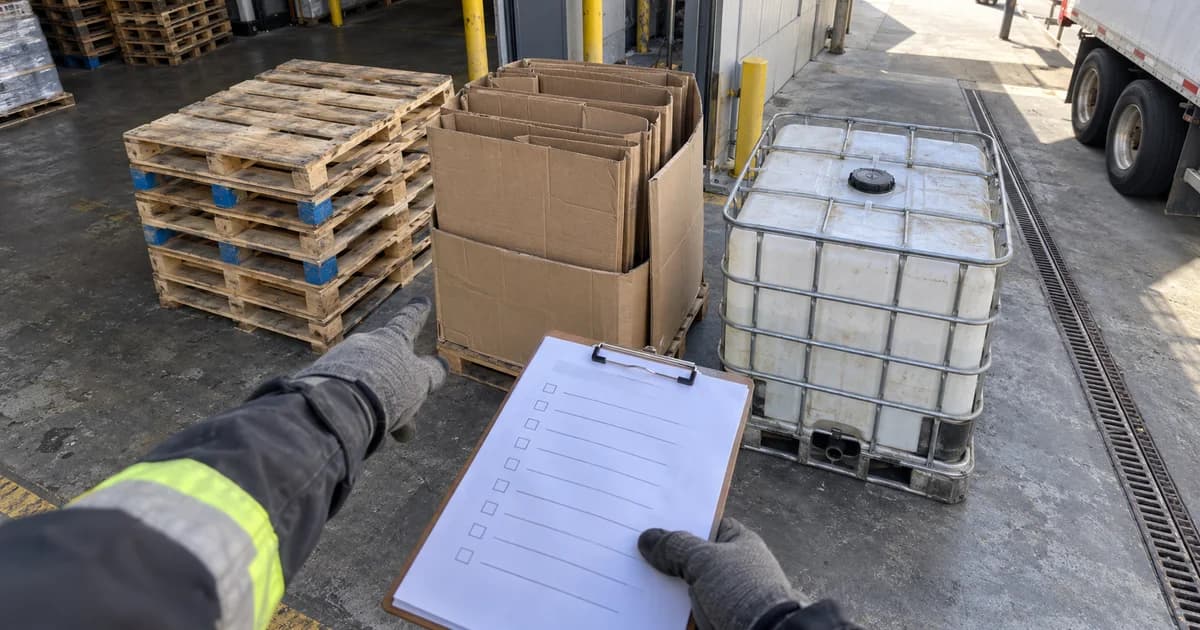
Most facilities treat outbound packaging as a disposal problem — a line item on the hauler invoice and nothing more. But the same dock that ships product out is also pushing pallets, totes, drums, and corrugated out the back, and a meaningful share of it is reusable or resalable. A packaging recycling audit is a structured walk-through that quantifies each stream, prices what you currently do with it, and separates the genuine scrap from the assets you're paying to throw away. You can run a first pass in an afternoon with a clipboard and a scale.
Key takeaways
- Inventory every packaging stream leaving the building before judging any of it — you can't recover value you haven't counted.
- For each stream, capture both the disposal cost (hauler, pull fees, tipping) and the recovery value (resale, rebate, reuse savings).
- The biggest miss is almost always reusable pallets and IBC totes going to landfill or being given away for free.
- Contamination and poor segregation turn recoverable material into mixed scrap — the cheapest fix is usually a second container and a label.
Step 1 — Inventory every stream
Walk the dock, the baler, the compactor, and the back lot. List every distinct packaging material that leaves the building and put a rough monthly volume on each. Don't worry about precision yet — a defensible estimate (pallets per week × 4, totes per shipment × shipments) is enough to rank streams. Common ones:
Wood pallets — count by week; note GMA 48×40 vs. odd sizes, and stringer vs. block
Gaylords / OCC (old corrugated containers) — loose, baled, or compacted; weigh a typical bale
IBC totes — 275 and 330 gal; track caged vs. stainless and what was in them
Steel and plastic drums — 55 gal open- vs. closed-head; note residue
Bulk bags (FIBCs) — one-loop vs. four-loop, food- vs. industrial-grade
Film and shrink wrap — LDPE stretch film, often the most contaminated stream
Step 2 — Record current disposition and cost
Next to each stream, write down what actually happens to it today and what that costs. Pull the last few hauler invoices; the real number is usually higher than people assume once you add pull fees, tipping, and the labor to move material to the compactor.
Stream | Volume signal | Reuse / resale potential | Where value leaks |
|---|---|---|---|
Wood pallets | Pallets per week | High — sound 48×40 sell or core back | Given away or hauled as wood waste |
Gaylords / OCC | Bales or yards/month | Medium — OCC has a commodity bid | Compacted with trash instead of baled |
IBC totes | Totes per month | High — rinsed totes resell well | Landfilled or paid to dispose |
Drums | Drums per month | Medium — reconditioners buy back | Treated as haz/scrap by default |
Bulk bags | Bags per month | Low–medium if clean | Contaminated, so all go to landfill |
Film / shrink | Pounds/month | Low — needs clean LDPE | Mixed with OCC, fails the bale |
Where value leaks, stream by stream
Step 3 — Assess condition
Recoverable value lives in condition. Sort each stream into rough buckets: reusable / resalable (sound, clean, standard spec), recyclable (broken but the material has a market), and true scrap. A stack of cracked, odd-size pallets is firewood; a stack of sound 48×40 GMA pallets is inventory. The same logic applies to totes (cage intact, valve present, no chemical residue) and drums (no dents, removable lids, non-hazardous prior contents).
Step 4 — Find contamination and segregation gaps
Contamination is what collapses a recoverable stream into mixed scrap. Look for the classic failures: stretch film thrown into the OCC baler (it fails the cardboard grade), totes and drums with unrinsed residue (no buyer will touch them), and a single “trash” compactor that swallows pallets, cardboard, and shrink because there's no second container nearby. Each gap is usually a cheap fix — a labeled gaylord or a second roll-off — that converts a cost into a rebate.
Step 5 — Identify the quick wins
Quick wins are streams that are both high-volume and currently mishandled — where a small change captures real money this quarter. They almost always come from Steps 3 and 4:
Sound pallets you give away — redirect to resale or a core program instead of the wood-waste pile.
Totes and drums you pay to dispose — rinse, segregate, and sell to a reconditioner; the disposal fee disappears and a rebate replaces it.
OCC going into the compactor — bale it separately to capture the cardboard commodity bid.
Film mixed into OCC — pull it out so the cardboard bales clean and grades higher.
Step 6 — Estimate recoverable value
For each stream, total two numbers: the disposal cost you avoid (the hauler line you stop paying) and the recovery value you gain (resale proceeds, rebates, or the cost of new packaging you no longer buy because you reused it). Reuse savings are easy to overlook but often the largest: a tote you rinse and refill is a tote you didn't purchase.
Step 7 — Prioritize and assign
Rank the streams by recoverable value and effort, then assign an owner and a date to each. The audit only pays off if someone is accountable for the change — rerouting pallets to resale, adding a labeled container by the baler, setting up a tote pickup. Put a recurring cadence on the back of it: a quarterly re-walk catches new streams (a product line that switched to bulk bags, a supplier that started shipping on drums) before they quietly start costing you again.
For turning these findings into a standing program — containers, pickups, and rebate tracking — see facility program setup. To understand what actually drives the price you're paid for recovered material, read recycling payout factors. And if a formal third-party audit is on the table, what to expect in a corporate waste audit walks through how an outside assessor approaches the same dock.
Frequently asked questions
How long does a packaging recycling audit take?
A first-pass walk-through takes an afternoon: inventory each stream, estimate monthly volume, and note current disposition. Pricing the streams against hauler invoices and recovery options is another half-day. The point of the quick version is to rank streams and surface the obvious quick wins, not to be perfect.
Which packaging stream usually hides the most value?
Reusable wood pallets and IBC totes, by a wide margin. They are high-volume and high-value, yet most facilities landfill them or give them away for free. Before chasing pennies-per-pound on film or cardboard, count the sound pallets and rinsable totes leaving your dock.
What's the difference between recyclable and reusable in an audit?
Reusable means the item is sound and standard enough to be sold or reused as-is — a 48×40 GMA pallet, a caged 275-gal tote, a closed-head drum. Recyclable means the item is broken but its material still has a commodity market, like cracked pallets going to mulch or mixed OCC going to a paper mill. Reusable is almost always worth more, so grade for it first.
Do I need a third party to run the audit?
No. The internal walk-through described here is something your own dock and operations staff can run with a scale and a clipboard. A third-party waste audit adds rigor, benchmarking, and an outside set of eyes, and is worth it for larger or multi-site operations — but it shouldn't be a prerequisite for capturing the obvious quick wins.