
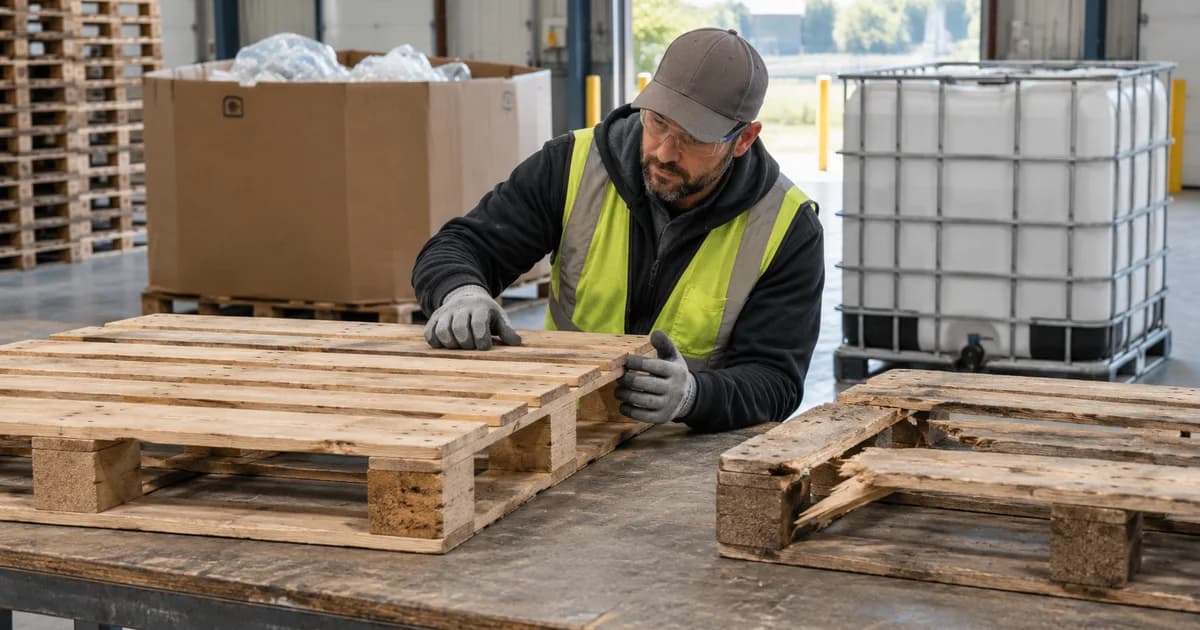
Before any used container is resold, recycled, or hauled away, somebody has to grade it. The fastest way to lose money on a load is to ship product a buyer rejects on the dock, or to send something to a recycler that they bounce as contaminated. This guide sorts the five most-traded packaging types into three buckets: accepted for reuse/resale, recycle-only (the unit is spent, but the material has value), and reject (no reuse, no recycling stream will take it). The criteria below are the ones reconditioners, brokers, and end users actually inspect for.
Key takeaways
- Grade on three things in this order: structural integrity, cleanliness/odor, and prior-contents history. A unit can be physically perfect and still be a reject on contamination alone.
- “Recycle-only” is not failure — wood, steel, HDPE, and woven PP all hold scrap or feedstock value. The mistake is landfilling a unit that a recycler would have paid for.
- Any hazardous, food, or chemical residue with no SDS is an automatic reject for reuse, regardless of how clean the unit looks.
- Photograph defects and keep the prior-contents record. Honest grading up front prevents dock rejections, chargebacks, and return freight.
The quick reference
Use this as a first-pass sort. Each type has nuances covered below, but most units fall cleanly into one column on sight.
Type | Accepted for reuse | Recycle-only | Reject |
|---|---|---|---|
Pallets | Sound stringers/blocks, all deckboards present, no protruding nails, dry and clean | Repairable cores, broken deckboards, split stringers (chipped to mulch or repaired) | Rot, mold, chemical soak, fire/char, heavy infestation |
Gaylord boxes | Square corners, intact full flaps, dry, no odor, single- or low-use | Crushed/delaminated walls, torn flaps (baled as OCC fiber) | Wet pulp, mold, oily soak, unknown chemical residue |
IBC totes | Crack-free bottle, sound cage, working valve, documented prior contents | Cracked/UV-brittle bottle or bent cage (HDPE bottle reground, steel cage scrapped) | Prior hazardous/unknown contents, no SDS, persistent residue |
Drums (steel/poly) | No rust-through or deep dents, sound chime, gaskets intact, prior contents known | Dented/rusted bodies, frozen closures (steel to scrap, HDPE reground) | Hazmat residue without SDS, pitting/leaks, swollen poly |
Bulk bags (FIBC) | Multi-trip rated, no UV chalking, seams/loops intact, clean, documented prior fill | UV-degraded or torn single-trip bags (baled as woven PP) | Contaminated, food/chemical residue, frayed lift loops |
Acceptable condition by packaging type
Pallets
The load-bearing members — stringers (or blocks on a block pallet) — decide a pallet's fate. A single cracked or plugged stringer can still be a Grade B repair; a split that runs through the fork opening is structural and pulls it out of the reuse stream.
Accepted (Grade A/B): All deckboards present and nailed, stringers intact or cleanly repaired, no nails protruding above the deck, dry, no visible mold or chemical staining. A standard 48″ × 40″ GMA pallet with one or two replaced boards still grades B.
Recycle-only: Missing or broken deckboards, split stringers, or units too worn to repair economically. These become repair cores, get dismantled for usable boards, or are ground into landscape mulch and boiler fuel — all real outlets.
Reject: Rot, active mold, chemical or oil soak, fire char, or visible pest infestation (live insects, frass, exit holes). Infested or contaminated wood can't enter the reuse or mulch stream.
For the full A/B/recycled breakdown and what each grade is worth, see pallet grades explained and the pallet buying guide.
Gaylord boxes
Corrugated forgives less than wood. Once fiber loses its structure it can't be restored, so a gaylord is either reusable as-is or it's recyclable fiber.
Accepted: Square corners, full flaps present and uncrushed, walls free of delamination (the liner separating from the fluting), dry, and odor-free. Single-use or low-use boxes with the manufacturer certificate still legible grade highest.
Recycle-only: Crushed corners, delaminated or soft-spot walls, torn flaps, or boxes that have lost their stacking strength. These go out as old corrugated containers (OCC) for baling.
Reject: Wet or pulped board, mold, oily or greasy soak-through, or unknown chemical staining — contaminated fiber is rejected even by recyclers.
Box construction and grading basics are in the gaylord box buying guide.
IBC totes
An IBC is three parts that fail independently: the bottle (usually HDPE), the steel cage, and the valve. Grade each, then take the worst result.
Accepted: No cracks or stress-whitening on the bottle, no UV embrittlement (chalky, brittle plastic from sun exposure), cage square and un-corroded, valve operates and seals, and the prior contents are documented. Food-grade reuse requires a verified food-grade prior fill.
Recycle-only: Hairline cracks, UV-brittle bottles, or bent cages. The HDPE bottle is reground and the steel cage and pallet base go to scrap — valuable, but not reusable as a vessel.
Reject: Prior hazardous or unknown contents with no SDS, persistent residue or odor that won't triple-rinse out, or any sign the bottle was previously cleaned of an incompatible product.
Before reselling a tote, it has to be cleaned and verified — walk the IBC cleaning checklist and the IBC tote guide.
Drums — steel and plastic
Drum grading splits on head type and metal vs. plastic. Open-head (removable lid) drums are reusable for a wider range of products and easier to clean; closed-head (bung)drums are tied to liquids and harder to verify clean inside.
Accepted: Steel — no rust-through, no deep dents in the chime or rolling hoops, gaskets and closures intact. Plastic — no cracks, no swelling or deformation, sound bungs. Prior contents known and compatible with the next fill.
Recycle-only: Dented bodies, surface rust or minor rust-through, frozen or stripped closures, sun-faded poly. Steel goes to scrap; HDPE drums are reground.
Reject for reuse: Hazmat or unknown residue without an SDS, leaks, deep pitting, swollen or stress-cracked poly. These route to a permitted reconditioner or hazardous-waste handler — not resale.
Specs and material trade-offs are in the steel drum guide and plastic drum guide.
Bulk bags (FIBC)
The single most important question on a bulk bag is single-trip vs. multi-trip. A bag built and rated for one trip (typically a 5:1 safety factor) should never be reused for product; a multi-trip bag (6:1) can be inspected and refilled.
Accepted: Multi-trip rated, lift loops and seams intact, no UV chalking or fading, no tears or abrasion holes, clean inside, and documented prior contents. Food or pharma reuse needs a verified compatible prior fill.
Recycle-only: Single-trip bags, UV-degraded fabric, or bags with tears or weakened loops. Clean woven polypropylene bales for recycling.
Reject: Contaminated fabric, chemical or food residue that won't clear, frayed or cut lift loops, or any structural doubt about the loops — a failed loop on a filled bag is a safety event.
See the bulk bag guide for construction types and safe-working-load basics.
Grade on three things, in order
Frequently asked questions
What automatically makes a used container a reject for reuse?
Contamination. Any container that held a hazardous, toxic, food, or unknown product and can't be matched to a Safety Data Sheet (SDS) is not reusable — regardless of how clean it looks. Visible residue, a chemical odor, leaks, or structural failure of a load-bearing part (a split stringer through the fork opening, a cracked IBC bottle, a frayed bulk-bag lift loop) also fall here. These units go to a qualified reconditioner or to disposal, not back into service.
What's the difference between recycle-only and reject?
Recycle-only means the container is finished as a vessel but its material still has value: wood becomes mulch or repair stock, steel goes to scrap, HDPE drums and IBC bottles are reground, and woven polypropylene bulk bags are baled. Reject means no reuse and no recycling stream will accept it — usually because of contamination, rot, mold, or hazardous residue. The practical rule: don't landfill something a recycler would have paid for, and don't resell something a recycler would reject.
Do I need documentation of what was previously in it?
For anything that held liquids or food — yes. IBC totes, drums, and food-grade bulk bags should come with a record of prior contents, ideally backed by an SDS. Reusing a container for a product incompatible with its last fill is a contamination and safety risk. For dry, inert goods in pallets or gaylords, prior-contents history matters less, but odor and residue still get inspected.
Can a structurally perfect unit still be rejected?
Yes. Condition grading is independent of contamination. A drum with no dents and intact gaskets is still a reject for reuse if it held an unknown chemical with no SDS, and a spotless IBC is a reject if its prior fill can't be verified. Grade structure, cleanliness, and history separately — the worst of the three sets the outcome.