
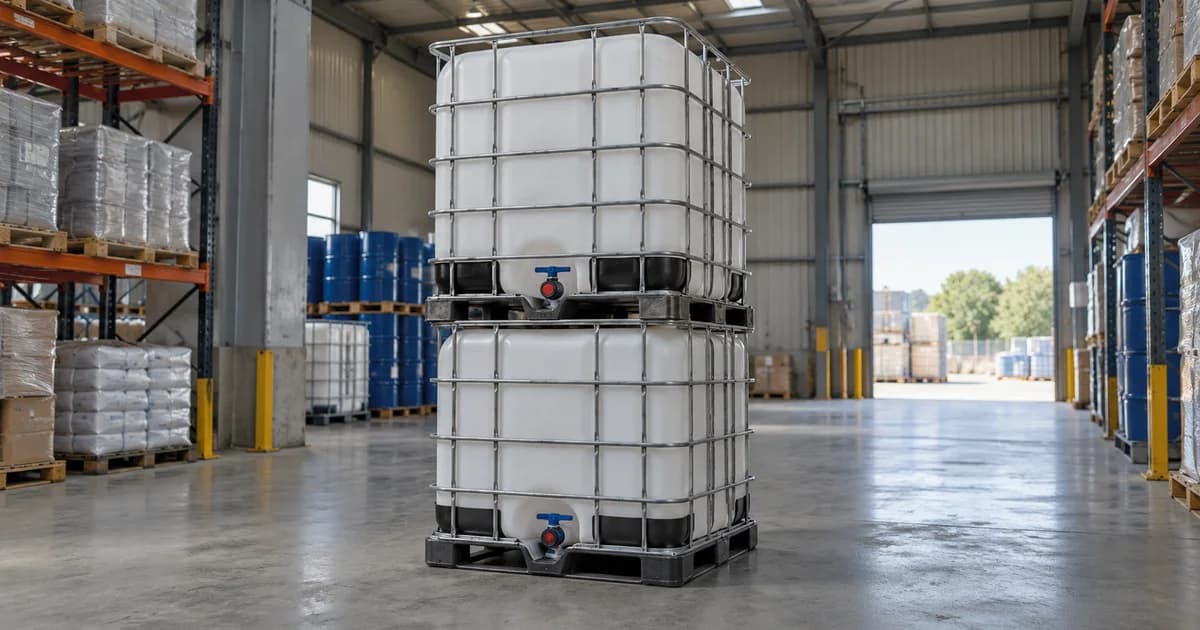
Yes, IBC totes can be stacked — the cage is designed for it. The useful question is how many, and that depends on four things: whether they are full, what the data plate says, what condition the cage is in, and how long they are going to sit like that.
Short answers before the detail:
Empty: typically 4–5 tiers
Full: generally 2 tiers
Full, long-term storage: 1 tier is safer, for reasons covered below
Used tanks: one tier lower than the equivalent new tank, in every case
Quick answer table
Scenario | New | Grade A–B | Grade C |
|---|---|---|---|
Empty, storage | 4–5 | 3–4 | 1 |
Full, short-term | 2 | 2 | 1 |
Full, long-term storage | 1–2 | 1 | Do not stack |
Full, transport | 2 | 1 | Do not stack |
These are working guidance. The governing figure for any specific tank is on its data plate — how to read that is the next section, and it matters more than any table.
Can you stack IBC totes full?
The short answer
Generally two tiers, provided the cage is sound, the base is level, and the load is within what the plate permits. This is standard practice across warehousing.
The conditions are not decorative. Each one is a genuine constraint and the failure modes below trace back to one of them being ignored.
The cage carries the load, not the bottle
Every stacking question reduces to this. The plastic bottle has no structural role in supporting weight from above — it holds liquid and nothing else. All stacking load transfers through the steel frame to the pallet and down to the tank below.
Two consequences follow directly. Cage condition determines stacking capacity, not bottle condition. And a tank with a pristine bottle and a damaged frame is a tank you do not stack, regardless of how good it looks.
Full of water specifically
Water is the reference case and the most common one. A 275-gallon tote filled with water weighs roughly 2,400 lb (1,090 kg) including the tank itself — full figures in IBC tote weight and dimensions.
Stack two of those, and the bottom unit's cage is carrying about 2,400 lb on top of its own contents. That is well within the design capacity of a sound cage and outside the capacity of a compromised one.
Denser liquids change the arithmetic
The load scales directly with the density of the contents, and this catches people out because the tanks look identical.
Contents | Approx. specific gravity | Weight of one full 275 gal tote |
|---|---|---|
Diesel | 0.85 | ≈2,085 lb |
Water | 1.00 | ≈2,430 lb |
Glycol | 1.11 | ≈2,680 lb |
Concentrated acid | 1.84 | ≈4,355 lb |
A stack of two acid totes puts nearly twice the load on the bottom cage that a stack of two water totes does. If your plate permits two tiers of water, it does not automatically permit two tiers of something 80% denser. Calculate rather than assume.
Why transport is stricter than storage
In transit, the load is not static. Braking, cornering, and road vibration all generate dynamic forces, and IBC totes have no internal baffles — the liquid moves freely inside the bottle and arrives against the wall with force when the vehicle decelerates.
The result is impulse loading rather than steady weight, and it can substantially exceed the static figure. Full tanks in transit are commonly restricted to a single tier for this reason. See securing totes for transport for the securement requirements that go with it.
How to read the stacking load on the data plate
This is the part that gets misapplied most often, and the good news is that on any reasonably modern tank there is a simple answer.
Look for the stacking symbol
On IBCs manufactured from 2011 onwards, the marking includes a graphic stacking symbol — a pictogram showing one container on top of another, with a figure in kilograms beside it.
That figure is your working number. It is the maximum permitted stacking load in use, and it already accounts for the safety margin. Read it, use it, no arithmetic required.
Tanks that cannot be stacked carry a different symbol showing a crossed-out container.
Why the text line shows a different figure
The alphanumeric UN marking also contains a load value, and it is not the same thing.
The figure in the text line is the stacking test load — the load applied during design-type testing. The test regime deliberately applies far more than the tank will bear in service, as a proving margin, and it is not a working limit.
The two are related: the permitted load in use is the test load divided by 1.8. But you do not need to perform that division, because the stacking symbol already displays the result. The 1.8 factor belongs to the testing regime, not to your calculation.
Confusing the two is the common and dangerous error — the test figure is nearly twice the working figure, and taking it as a working limit means stacking to almost double what the tank is rated for.
Older tanks without a stacking symbol
Containers made before 2011 may carry only the text-line figure. In that case, and only in that case:
Permitted working load = stacking test load ÷ 1.8
Do not apply this division to a figure taken from a stacking symbol — that would apply the margin twice and cost you a tier for no reason.
Converting load to tiers
Once you have the permitted working load:
Permitted tiers above = permitted stacking load ÷ gross weight of one loaded tote
Round down, always. Then apply the condition adjustment in the grading section below.
If the labelling is ambiguous, treat the lower interpretation as correct. The cost of caution is one fewer tier; the cost of the other error is a collapse.
When the plate is missing or illegible
You have no permitted load figure, which means you cannot calculate a legitimate stack height. A tank with no legible plate should not be stacked when full. It also cannot be used for regulated transport, and it cannot be graded above the lowest condition category — the plate is one of the twelve points on a standard field inspection for exactly this reason.
How high can you stack IBC totes?
Empty totes
Typically 4–5 tiers. The limiting factor is usually not strength but stability and available headroom — an empty tote is light, and a tall stack of light objects becomes a toppling risk before it becomes a crushing one.
Full totes
Two tiers is the practical standard, subject to the plate figure and the condition adjustment.
Never stack a 330 on a 275
Both standard sizes share the same 48 × 40 inch footprint, which creates a false impression that they are interchangeable in a stack. They are not.
A 330-gallon tote is seven inches taller and around 500 lb heavier when full. Placing one on top of a 275 raises the centre of gravity of the stack while increasing the load on the unit below — a combination that makes the stack measurably less stable. Keep sizes consistent within a stack, and put the larger size on the bottom if you must mix.
Mixed stacks
Do not place a full tote on an empty one. The empty unit's cage is carrying load it was never intended to bear in that configuration, and the weight distribution is wrong in every respect. Heaviest at the bottom, without exception.
Limits beyond load capacity
Even where the plate permits more, other constraints usually bind first:
Forklift reach — you have to be able to retrieve the top unit safely
Sprinkler clearance — fire regulations specify minimum clearance below sprinkler heads
Building height and rack beam spacing
Site rules — many facilities impose their own maximum stack heights regardless of equipment ratings
Are IBC totes stackable? Design and standards
The steel cage exists to make stacking possible. Without it, the bottle alone would deform under any load at all.
Cage construction varies between manufacturers, particularly in the number and gauge of horizontal members in the frame. This affects both rated capacity and resistance to deformation under sustained load, and it is one reason tanks from different sources should not be assumed to have identical stacking behaviour even at the same nominal capacity. Check the plate on each.
The design-type stacking test itself is more demanding than it might sound. For composite IBCs with plastic components bearing the load, the test load is applied for 28 days at 40°C — a sustained high-temperature soak, chosen because polymers creep under long-term load in a way steel does not. Other constructions are tested for 24 hours. That 28-day condition is the reason a sound cage tolerates stacking at all, and also a hint about why long-term storage deserves its own treatment, below.
Weld fatigue: why long-term storage is different
Counterintuitive, and the reason the guidance table above is stricter for storage than for short-term stacking.
Static load accumulates damage
Sustained compressive load causes fatigue in the welded joints of the cage carrying it. The damage does not occur at the moment of loading — it accumulates over weeks and months of a tank sitting underneath another one.
The failure, when it comes, is therefore not obviously connected to anything that just happened. Nobody dropped anything. The stack simply gave way under a load it had carried without incident for months.
Storage is harder on a cage than transport
Most people assume the opposite, because transport feels more violent. For this specific failure mode it runs the other way: a journey subjects the cage to high forces briefly, while long-term storage subjects it to moderate force continuously, and continuous is what drives fatigue.
A tank that has spent six months as the bottom of a stack has accumulated damage that no visual inspection at the start of that period would have predicted.
Practical rule
Where full tanks are being stored long-term, single-tier if the floor space allows. Where it does not:
Inspect the bottom tier on a defined schedule, focusing on welds along the lower band
Rotate stock so no unit spends indefinite time at the bottom
Keep the soundest cages on the bottom tier
Reduce the stack for anything denser than water
What weld fatigue looks like
Separation at the welded joints, most commonly along the lower horizontal band where load concentrates. Look also for progressive loss of square in the frame, which indicates the cage is deforming under load rather than carrying it.
How cage condition changes load capacity
Published ratings apply to new cages. A cage that has been through several handling cycles and a winter outdoors does not carry the same load, and there is no published figure that tells you what it does carry.
Weld integrity. Failures start at welded joints, not in the middle of a tube. The lower band is where stacking load concentrates and where inspection should focus.
Corrosion. Surface rust is cosmetic. Through-corrosion of a load-bearing member removes structural capacity that cannot be assessed by eye — treat any perforated member as a reason not to stack the tank.
Frame geometry. Uprights that are no longer parallel mean load is no longer distributed evenly across the frame. A dent in a horizontal member without sharp edges is acceptable; loss of square is not.
Pallet condition. The pallet is beneath everything and frequently fails before the cage does. Rot in a wooden pallet is progressive, largely hidden, and takes the whole stack with it.
Stacking limits by grade
Grade | Full | Empty |
|---|---|---|
A | As marked on the plate | 4–5 |
B | One tier below plate rating | 3–4 |
C | Single tier only | 1 |
Reject | Do not stack | Do not stack |
Grade definitions are set out in the 12-point inspection checklist, and tanks that grade out as Reject should not be stacked at all — see options for totes past service. The principle behind the adjustment is simply that the plate rating describes a new cage, and a used cage has less margin than the figure assumes.
Safe stacking practice
Level, solid ground. No slope, no soft surface, no uneven paving. A stack out of plumb loads one side of the cage disproportionately.
Align pallet to pallet. No overhang. The upper unit's pallet should sit fully within the footprint of the one below.
Soundest tanks on the bottom. Obvious and routinely ignored during a busy unload.
Do not stack full tanks through a freeze. Expanding contents plus stacking load is a combination worth avoiding entirely — see how long IBC totes last on freeze damage and winter practice.
Inspect after handling operations. Most cage damage occurs during a routine move that nobody recorded.
Dismantle from the top, one unit at a time. Never attempt to withdraw a lower unit from a loaded stack.
Floor loading and warehouse limits
A single full water tote places roughly 180 lb per square foot on the floor — 2,400 lb over a 13.3 square foot footprint. Two tiers doubles that to around 360 lb/sq ft.
A ground-floor industrial slab handles this comfortably. Mezzanines, upper floors, and older buildings frequently do not, and the failure mode there is not a toppling stack but a floor. Confirm the rating of the structure before storing full tanks anywhere other than at grade, and recalculate for anything denser than water using the figures in IBC tote specifications.
Frequently asked questions
Can you stack IBC totes?
Yes — the steel cage is designed for it. How many tiers depends on whether the tanks are full, what the data plate permits, the condition of the cage, and how long they will remain stacked.
Can you stack IBC totes full?
Generally two tiers, with a sound cage, a level base, and a load within the plate rating. Long-term storage and transport are both more restrictive than short-term stacking.
Can you stack IBC totes full of water?
Yes, typically two tiers. The bottom unit carries around 2,400 lb from the tank above it.
How high can you stack IBC totes?
Empty, 4–5 tiers, usually limited by stability and headroom rather than strength. Full, generally two. Used tanks should be stacked one tier lower than the equivalent new tank.
How many IBC totes can you stack?
Take the figure from the graphic stacking symbol on the plate — that is the maximum permitted load in use — divide by the gross weight of one loaded tote and round down, then reduce by one tier for used tanks in Grade B condition or lower. Do not use the load figure in the alphanumeric UN marking; that is the test load and it is around 1.8 times higher.
Can you stack a 330 gallon tote on a 275?
No. They share a footprint, but the 330 is seven inches taller and heavier when full, which raises the stack's centre of gravity while increasing load on the unit below. Keep sizes consistent, or put the larger size at the bottom.
Is it safe to stack full totes long-term?
Less so than short-term stacking. Sustained static load causes fatigue in the cage welds of the bottom unit, accumulating over months. Single-tier storage is preferable; where that is not possible, inspect the bottom tier regularly and rotate stock.