
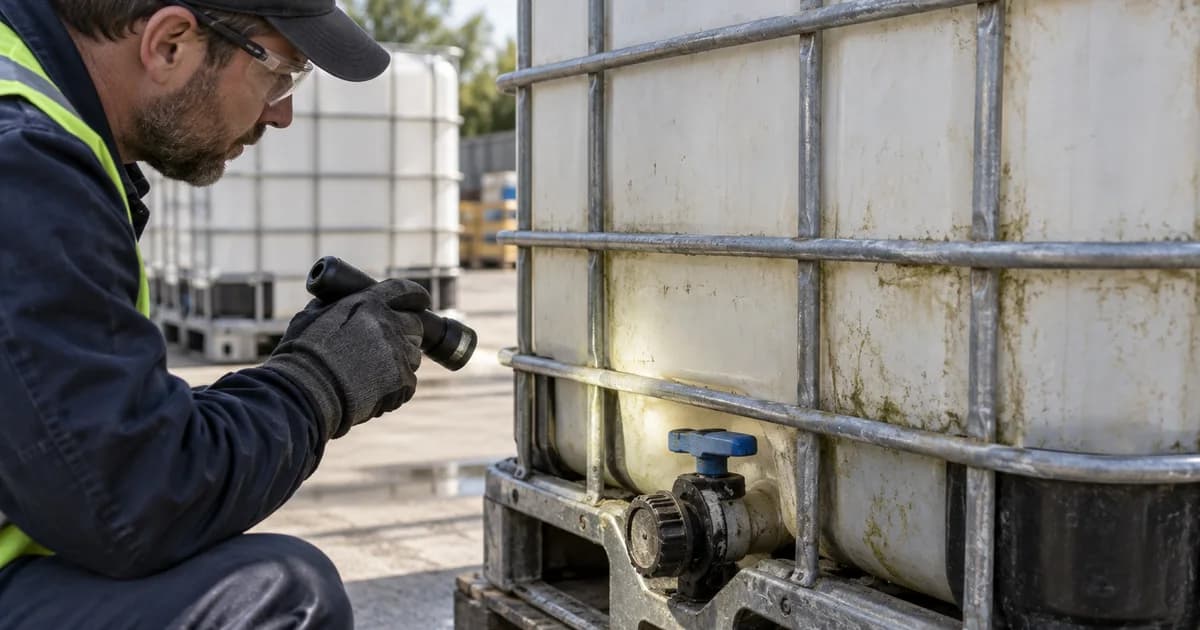
There is no single answer, and that is not a dodge — it is the actual structure of the problem. An IBC tote is three separate components that age at different rates for different reasons, wrapped in one regulatory limit that has nothing to do with physical wear at all.
A tote stored indoors holding a mild detergent can stay in service for well over a decade. The same tote left in full sun holding rainwater may be visibly degraded in three summers. And a tote used to transport regulated liquids typically comes off the road at around five years no matter how good it looks — for reasons that have more to do with industry practice than with the tank itself.
This guide covers all three clocks, what shortens each one, and how to tell when a tank is finished.
The short answer: three different clocks
Component | Typical service life | What ends it |
|---|---|---|
HDPE bottle | 5–10 years outdoors, 15+ years sheltered | UV degradation, freeze cycling, chemical attack |
Steel cage | 10–20 years | Weld fatigue, corrosion, impact damage |
Pallet (wood) | 3–7 years | Moisture, rot, forklift damage |
Alongside these sits a fourth constraint that has nothing to do with wear at all. Totes used to transport regulated liquids are, in practice, withdrawn from that service at around five years from their date of manufacture — regardless of condition. That five-year figure is not a US federal prohibition, and where it actually comes from is worth understanding, because it explains most of the used-tote market.
The practical consequence is worth stating plainly, because it explains most of the used-tote market: a tote that is finished for regulated transport is very often in excellent physical condition for everything else.
What the data plate tells you
Every certified IBC carries a marking with the information you need to date it. Learning to read it takes about a minute and it is the single most useful skill in assessing a used tank.
Decoding the UN marking
The marking runs as a sequence separated by slashes. A composite IBC — a plastic bottle inside a steel cage, which is what most people mean by "IBC tote" — begins with a code such as 31HA1:
31 — designed for liquids
H — plastic inner receptacle
A — steel outer casing
1 — rigid construction
What follows is the packing group letter, then the month and year of manufacture, the country of authorization, a manufacturer identifier, and figures for stacking load and maximum gross mass.
The date is the part that matters here. A marking reading 03 25 means March 2025. That single figure lets you calculate remaining regulated service life, estimate how many winters the tank has seen, and sanity-check whatever a seller has told you.
Stacking figures on the plate deserve their own explanation. Two different load values can appear — a graphic stacking symbol showing the working limit, and a figure in the text line showing the test load, which is around 1.8 times higher. Mixing them up is a serious error, and the difference is covered in the guide to stacking load limits.
The inspection cycle for regulated service
Totes used to transport regulated liquids sit inside a defined inspection regime under US regulations:
Every 2.5 years (30 months): external inspection and a leakproofness test
Every 5 years: internal inspection of the plastic receptacle, alongside the same external checks
Both of these are testing intervals, not expiry dates. A tank that passes its periodic retest continues in service. The UN marking itself certifies a design type and does not lapse on a schedule either.
Where the "five year life" actually comes from
This is the part that gets stated wrongly almost everywhere, including by sellers.
US regulations do not prohibit using a plastic inner receptacle older than five years. The five-year figure in the federal rules is the internal inspection interval — not a service life limit.
The five-year service life comes from two other places:
The European ADR agreement, which sets a five-year service life for the plastic inner receptacle of a composite IBC, measured from its date of manufacture, after which it cannot be used for regulated goods
Manufacturer and reconditioner policy, which works to the same limit and replaces the bottle thereafter — the practice known as rebottling
Because manufacturers, reconditioners, and international operators all work to that limit, it functions as a practical boundary in the US market even though the federal rules do not spell it out. Tanks come off regulated transport at around five years because the industry retires them, not because a US regulation forces it.
The distinction matters if you are buying: a six-year-old tank is not federally disqualified from anything. It is simply outside the window most of the supply chain works within.
Why an "aged out" tote is often perfectly good
Once a tank passes that five-year boundary, it leaves regulated transport service in practice. It does not stop holding liquid.
For irrigation water, wash water, non-regulated industrial fluids, static storage, and dozens of other uses, a five-year-old tank with an intact cage and a clear bottle has years of life left. This is precisely why sound used totes reach the secondary market in volume: they age out of one application while remaining entirely serviceable for others.
The reverse trap is worth naming too. A tote can be well inside its five-year window and still be unfit for use — cracked from a forklift strike, chalked white by two summers on a roof, or contaminated by something that never comes out. Age is one input. It is not the assessment.
Lifespan by use case
Capacities, dimensions and weights for each format: IBC tote specifications.
Potable and drinking water storage
Sheltered, a food-grade tote holding water can run 10–15 years. Outdoors the limiting factor is rarely the plastic — it is biological growth, which forces repeated sanitising cycles and gradually degrades gaskets and valve components.
Note that suitability for drinking water depends on the tank's documented contents history, not on its condition or age. That is a separate question with its own rules — see how to verify food grade status.
Rainwater harvesting and irrigation
Realistically 5–8 years, and UV exposure is almost always what ends it. A tote used for rainwater is by definition outdoors, usually unshaded, usually translucent. Shade or a cover roughly doubles the figure.
Chemical storage
Entirely dependent on compatibility. HDPE handles most acids, bases, and salt solutions well. It handles aromatic and chlorinated solvents badly — they cause the polymer to swell and can trigger environmental stress cracking, where the wall fails under load at stresses it would otherwise tolerate indefinitely.
With a compatible chemical and indoor storage, 10+ years is normal. With the wrong one, failure can come in months.
Regulated and hazmat transport
Around five years from the date of manufacture in practice, with the 30-month and 5-year inspection cycle above running throughout. The five-year boundary is industry and international practice rather than a US federal prohibition — but it governs the supply chain regardless.
Static indoor storage
The gentlest duty there is. No UV, no freeze cycling, no road vibration, no repeated handling. Totes in this service routinely pass 15 years, and the pallet usually gives out before the bottle does.
How sunlight shortens tote life
This is the most underestimated factor in tote lifespan, and the one that most reliably surprises people.
Are IBC totes UV resistant?
Only to a limited degree. Natural translucent HDPE — the standard bottle material — contains no significant UV protection on its own. Sunlight drives photo-oxidative degradation, breaking down the polymer chains that give the wall its strength.
Some bottles are produced with UV stabilisers or carbon black pigment, which changes the picture substantially. Most standard totes are not.
Will an IBC tote degrade in the sun?
Yes, and faster than most owners expect. A single unprotected summer outdoors can cost a tank one to two years of service life. Look for:
Chalking — a white powdery residue that transfers to your finger when you rub the sun-facing side. This is the clearest field indicator of photo-oxidative degradation and it means the wall has lost strength, not just appearance.
Yellowing and clouding, particularly on the south-facing panel
Loss of flexibility — the wall feels rigid and brittle rather than giving slightly under pressure
Micro-cracking at corners and around the reinforcing ribs, where stress concentrates
Chalking is worth learning to check for, because it is the one degradation sign that requires no tools and no expertise, and it is a reliable indicator that a tank has dropped into the lowest usable condition grade.
The algae problem
Translucent walls pass light, and light plus water plus warmth grows algae. Beyond the nuisance, established biofilm is genuinely difficult to remove and returns faster after each cleaning than it originally established. How to clean algae from a tote covers the procedure.
The fix is the same as for UV: block the light. Covering a tote solves both problems at once.
Painting an IBC tote for UV protection
Painting comes up constantly as a UV solution, and it works — provided you handle the one thing that makes it awkward.
Why paint doesn't stick to HDPE
Polyethylene has low surface energy. Ordinary paint beads, sits on top, and peels off in sheets within a season. The material is chemically designed not to bond with things, which is exactly why it makes good chemical containers and bad painted surfaces.
Doing it properly
Degrease thoroughly. Any mould release residue or handling film will guarantee failure.
Abrade lightly. A scuff with fine abrasive gives the primer mechanical grip.
Use a plastic-specific primer or adhesion promoter. This is the step that determines whether the job lasts one year or five. Standard primer will not do it.
Choose a light colour. Dark paint absorbs heat and warms the contents, which accelerates both chemical degradation and biological growth — you can solve the UV problem and create a thermal one.
Do not paint a tank intended for drinking water without confirming the coating is rated for that application.
Why a cover usually beats paint
A fitted cover or a simple shade structure achieves the same UV protection, costs less in labour, does not add heat load, comes off for inspection, and can be moved to the next tank when this one is retired. Paint is permanent and hides the wall from view — which means it also hides cracking, staining, and the chalking you would otherwise be checking for.
For a fleet, shade is almost always the better answer. For a single tank in a fixed position, paint is reasonable.
Cold weather and freeze damage
Will an IBC tote freeze in winter?
Yes. There is nothing special about a tote that prevents it. Water expands roughly 9% on freezing, and a 275-gallon tank holds enough of it to generate serious force.
What actually breaks first
Not the bottle, in most cases — the valve.
Ice forms from the bottom, and the ball valve at the outlet contains a small enclosed cavity around the ball itself. Water trapped in that cavity freezes, expands, and splits the plastic valve body. The tank can be otherwise undamaged and still be unusable until the valve is replaced.
This is the single most common cold-weather failure, and it is almost entirely preventable.
How to keep an IBC tote from freezing
Leave the valve partially open on empty tanks. Setting the valve roughly midway through its travel prevents residual water being sealed into the ball cavity. It costs nothing and prevents the most common winter failure there is.
Leave headspace on full tanks. Never fill to the brim going into freezing weather — expanding ice needs somewhere to go. Fill rules for transport set their own limits, but for freeze protection specifically, leave considerably more room than any regulation requires. Water expands about 9% on freezing, so err generously.
Insulate. Wrapping the tank, particularly the lower third and the valve assembly, slows heat loss considerably. Purpose-made insulated jackets exist; a tarp plus rigid insulation board achieves much the same thing.
Add heat if the application requires it. Immersion heaters and heated blankets rated for the tank are available where freezing cannot be tolerated.
Keep it moving. Circulation dramatically raises the temperature at which water will freeze in practice. If the tote is part of a system, running a pump on a timer during cold snaps is often enough on its own.
Drain if the tote is not in use. The most reliable freeze protection is having nothing in there to freeze.
Freeze-thaw cycling and long-term embrittlement
Beyond the immediate risk of a split valve, repeated freeze-thaw cycles fatigue the plastic. Each cycle flexes the wall as contents expand and contract. A tank that has been through five winters outdoors has less remaining wall strength than its age alone suggests — and combined with UV chalking on the sun-facing side, an outdoor tote can age remarkably quickly.
Warning signs it's time to retire a tote
Any one of these means stop using the tank for anything that matters:
Bulging or deformation of the wall — the bottle has yielded and will not recover
Chalking — powdery residue on the surface, indicating the polymer has degraded
Cracking at corners, ribs, or around the fill opening — stress concentration points fail first
Broken welds on the cage, especially along the lower band, which carries stacking load
Through-corrosion of load-bearing cage members — surface rust is cosmetic, perforation is not
Frame out of square — bent uprights mean load no longer distributes evenly
Pallet rot or split boards — the pallet fails before anything above it does
Persistent leaking at the valve or flange after the valve has been replaced
Any solvent or petroleum odour that will not clear after cleaning
These signs map onto the standard condition grading used across the industry — Grade A, B, and C, with anything showing structural failure classed as unusable. If you are assessing a tank in the field, the 12-point inspection checklist walks through each point in order.
Extending the life of your totes
Most of what shortens tote life is avoidable:
Store under cover. This is by far the highest-return change available. Shade addresses UV degradation and algae growth simultaneously.
Do not stack full totes through a freeze. Frozen contents expanding under stacking load is a combination worth avoiding entirely.
Rinse immediately after emptying. Residue that dries in place is dramatically harder to remove later, and some of it never comes out at all.
Leave valves partially open on empty tanks in winter.
Log dates. Record the manufacture date from each plate when a tote enters your fleet. Knowing the age of your tanks turns replacement from a surprise into a schedule.
Inspect after handling. Forklift damage is the most common cage injury and it usually happens during a routine move that nobody logged.
Frequently asked questions
How long do IBC totes last?
Typically 5–10 years outdoors and 15+ years under cover, depending on contents and handling. Tanks used to transport regulated liquids are generally retired from that service at around five years from manufacture — a limit set by international rules and industry practice rather than by US federal regulation, which specifies inspection intervals instead.
Are IBC totes UV resistant?
Only to a limited extent. Standard translucent HDPE has no meaningful built-in UV protection and typically shows chalking and embrittlement within 3–5 unprotected seasons. Bottles produced with UV stabilisers or carbon black perform substantially better.
Will an IBC tote freeze in winter?
Yes. The most common failure is not the tank but the valve — water trapped in the ball cavity freezes and splits the valve body. Leaving valves partially open on empty tanks prevents this.
Will an IBC tote degrade in the sun?
Yes. Sunlight causes photo-oxidative degradation, visible as yellowing, clouding, and chalking, and it weakens the wall rather than only marking it. A single unprotected summer can cost a tank one to two years of service life.
Can you paint an IBC tote?
Yes, with proper surface preparation and a plastic-specific primer or adhesion promoter — ordinary paint will not bond to HDPE. Choose a light colour to avoid adding heat load, and consider whether a removable cover would serve better, since paint permanently hides the wall from inspection.
How do I tell how old an IBC tote is?
Read the month and year of manufacture from the UN marking on the data plate. A tank with a missing or illegible plate cannot be dated, cannot be used for regulated transport, and should be treated with corresponding caution.