
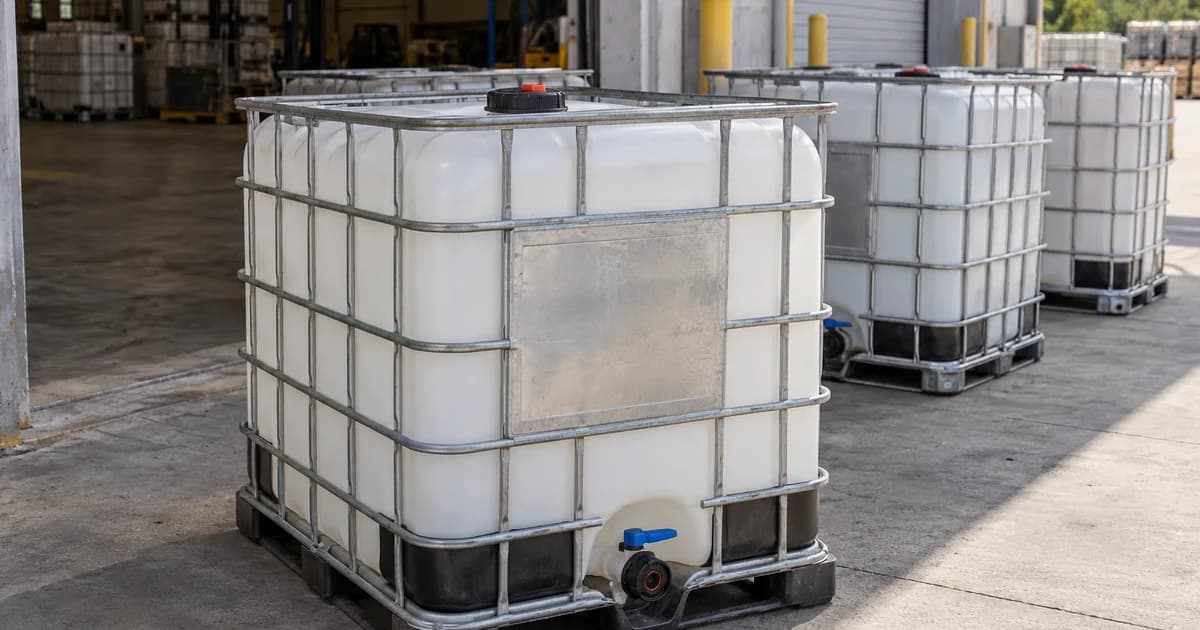
There are five things you can do with a surplus IBC tote. Only one of them costs you money.
That is worth knowing before you start, because "how do I get rid of this" is the question most people ask first, and disposal is the most expensive answer available. It is sometimes the right answer — there are cases below where nothing else will do — but it should be the conclusion of the process rather than the starting assumption.
Option | Cash flow | Suits |
|---|---|---|
Disposal | Cost, driven by regulatory status | Contaminated tanks, regulated residue |
Recycling | Near zero; scrap value offsets handling | Failed bottle, sound cage |
Reuse in-house | Saves the cost of buying new | You have an internal need |
Rebottling | Returns more than selling as-is | Sound cage, failed bottle |
Selling | Income, varies with grade and history | Grade B and above |
Which one applies depends less on the condition of the tank than on one other thing.
Start here: what was in the tote?
Previous contents determine which options are open to you. Condition only determines how much you get within them.
Food-grade and inert contents. All five routes available. This is the best position to be in and the documentation that proves it is worth more than the tank.
Industrial but non-hazardous. Cleaning resolves the practical question, but the tank does not return to food or potable service afterwards — that status is lost permanently once a non-food product goes in — see verifying food grade status. Resale, reuse, rebottling and recycling all remain open.
Regulated or hazardous materials. One route. Licensed handling, with the documentation to match. Containers that held acutely hazardous waste require a documented rinsing procedure before they can be treated as empty at all, and without that paperwork the tank is not tradeable.
Unknown contents. Treated as regulated. What you can and can't store sets out which applications remain open. If the data plate is gone and nobody can say what was in it, the tank cannot be upgraded into any contact application no matter how good it looks. It has value as non-contact storage or as material, and that is the ceiling.
This is the honest version and it rules out selling in a meaningful number of cases. Worth establishing before anyone quotes you a number.
The cost of disposal depends on one thing
Not on condition. Not on size. On whether the tank meets the regulatory definition of empty.
What "empty" means legally
The everyday meaning — nothing pours out when you tip it — is not the operative one. Under federal waste regulations, a container above 110 gallons counts as empty when the residue remaining is no more than 0.3% by weight of the total capacity. Every standard IBC is above that threshold, so this is the test that applies. Below 110 gallons the allowance is 3%, which is why drum figures look far more generous.
What about the one-inch rule?
The regulations also allow a residue of no more than one inch in the bottom of a container as an alternative to the percentage limit, and this alternative is not restricted by container size — so it is formally available to an IBC.
In practice it does you no good. Across a 48 × 40 inch footprint, one inch of liquid is roughly 8 gallons. The 0.3% limit on a 275-gallon tote works out at well under a gallon. Anyone applying the one-inch alternative to an IBC is holding an order of magnitude more residue than the percentage test permits, and an inspector will treat the container as anything but empty.
The alternative also carries its own condition: it applies only after all conventional means of removal — draining, pumping — have been used. For a container with this much floor area, the percentage test is the one to work to.
Below the threshold versus above it
Meet the criterion, and the tank is handled as ordinary waste — straightforward, cheap, minimal paperwork.
Miss it, and a container that held a regulated substance is itself regulated waste. That means licensed transport, manifested handling, and a fundamentally different cost structure. Professional hazardous waste disposal is priced per container plus transport, and an IBC is roughly five times the volume of a drum.
The practical consequence
Your disposal cost is largely decided at the point you empty and rinse the tank, not at the point you call someone to collect it. A thorough rinse immediately after emptying is the cheapest money you will spend on the whole exercise — and it also happens to be what preserves resale value, if you decide to go that way instead.
When disposal is genuinely the right call
Residue that cannot be removed — solvents, pesticides, anything absorbed into the wall
Structural failure: cracked bottle, broken welds, through-corrosion
Specific regulatory requirements attaching to the substance the tank held
Unknown contents combined with a missing plate, where the tank has no verifiable path back into service
Option 1 — Disposal
Most landfills will not take a complete IBC. The standard requirement is separation into components, which you can do yourself:
Bottle — HDPE, recyclable if clean, waste if not
Cage — steel, has scrap value, goes separately
Pallet — wood, plastic or steel, disposed of or recycled by material
Doing this separation yourself converts a disposal cost into something close to break-even, because the cage is worth something as scrap. If a company is collecting the tank for free, this is usually why.
Where the tank held a regulated substance and does not meet the empty criterion, none of this applies — it goes to a licensed handler intact, with documentation.
Option 2 — Recycling
What processors want. HDPE resin code #2, clean, free of residue, often granulated. A rinsed bottle is a commodity; an unrinsed one is a problem they will decline or charge for.
The cage is worth more than the bottle. Steel scrap prices per tonne substantially exceed what recovered HDPE fetches, and the cage is the heavier component. This is the economics that makes free collection of dead totes viable at all — the scrap covers the logistics.
Manufacturer take-back. Several manufacturers operate programmes accepting their own containers back at end of life. Worth checking the plate for a maker's mark before assuming you need to find a processor yourself.
Finding a processor. Ask specifically whether they accept HDPE #2 rigid containers, whether they require the bottle cut or granulated, and what documentation they need regarding previous contents. That last question is the one that determines whether the conversation goes anywhere.
Option 3 — Reuse within your operation
Before anything leaves site, the obvious question: is there somewhere else in the business this tank could work?
Common industrial reuses include non-potable water storage, rainwater capture for washdown, buffer and holding capacity in process lines, ballast, and fire-suppression water reserve. A tank that has held industrial chemicals is unsuitable for anything contacting product, but is entirely serviceable for these.
The saving is the cost of a tank you now do not need to buy. For a Grade B tote that is not a trivial number, and it requires no transaction at all.
Option 4 — Rebottling
The option most people do not know exists, and the right answer in one specific and fairly common situation: the bottle has failed but the cage is sound.
What rebottling is
The steel cage is inspected, straightened, and cleaned, then fitted with a new factory-made HDPE bottle. The result performs as a new tank.
When it makes sense
Chemical damage, stress cracking, persistent contamination, or UV embrittlement typically kill the bottle long before the cage is finished — cages routinely last 10–20 years, as covered in how long IBC totes last. Where that has happened, rebottling recovers most of the tank's value rather than writing it off.
Why the cage matters more than you would think
The cage never contacts the product. It carries no contents history of its own. That means a rebottled tank built on a cage that once surrounded an industrial chemical can be used for food applications, because the new bottle is the only thing the product touches.
This is the one route back into food-grade service for a tank whose history disqualified it — and it is why rebottled tanks command close to new-tank prices while costing substantially less.
Not a grade, a different product
Rebottled tanks sit alongside the A/B/C condition scale, not inside it. Do not read the term as a step below Grade C.
Option 5 — Selling used totes
A note on prices
Specific figures depend on region, batch size, and the current state of the secondary market, so there are no universal numbers here that would still be true where you are. What follows is what determines where in the range your tanks land.
What determines value
In order of impact:
Documented contents history. The only factor capable of changing the price by a multiple rather than a margin. A tank with proof of food-only service is a different product from an identical tank without it.
Condition grade. Bottle clarity, cage geometry, weld and corrosion status. See the inspection checklist for the criteria.
Data plate legibility and date. An illegible plate rules out regulated transport and makes stacking limits indeterminable.
Valve function and cap presence. Cheap to fix, but a missing cap or split valve is visible evidence of neglect and gets priced accordingly.
Pallet type and condition. Steel and composite pallets are worth more than wood; rotted wood is a deduction.
Batch size. Buyers price per unit differently for one tank than for twenty, because the transport cost barely changes.
Region and season. Agricultural demand is seasonal; so is the supply of freeze-damaged tanks.
Why history outweighs condition
This is counterintuitive and it is the thing most sellers get wrong. A scuffed, stained tank with documentation showing it only ever held food products is worth more than a flawless one with an unknown past — because the first can enter food service and the second cannot, permanently and regardless of cleaning.
If you have paperwork, find it before you get a quote. If you do not, do not claim you do; a buyer will price the tank as unknown-history either way, and the claim only costs you credibility.
Who buys used totes
Reconditioners — process, grade, and resell; take volume, including tanks needing work
Used container dealers — buy and resell, generally want tanks already in serviceable condition
Agricultural operations — buy directly for water and non-food use, usually small quantities
Private buyers — via local listings; best per-unit price, most effort
Private sale versus bulk buyer
Selling privately gets more per tank. It also requires listing, storage while you wait, fielding enquiries, and dealing with people who want to inspect at the weekend. For one or two tanks that is fine.
A bulk buyer pays less per unit and takes everything in one movement, including the tanks nobody wants individually. Where the transport cost is being spread across a load — see securing totes for transport if you are delivering the batch yourself — that arithmetic usually turns in your favour somewhere in the range of five to ten units — below that, the collection cost eats the difference.
Which option fits your situation
If... | Then |
|---|---|
Regulated residue, no rinse documentation | Licensed disposal |
Unknown contents, no plate | Non-contact reuse, or recycling |
Bottle failed, cage sound | Rebottling |
Bottle and cage both failed | Recycling — separate and sell the steel |
Sound tank, industrial history | Sell, or reuse for non-contact applications |
Sound tank, documented food history | Sell — this is the highest-value case |
Sound tank, you have an internal need | Reuse; you save more than you would earn |
Frequently asked questions
How do you dispose of an IBC tote?
Separate it into HDPE bottle, steel cage, and pallet — most landfills will not accept a complete unit. Where the tank held a regulated substance and does not meet the regulatory definition of empty, it must go to a licensed handler intact with documentation.
Can IBC totes be recycled?
Yes. The bottle is HDPE #2 and the cage is steel scrap, handled separately. Processors require the bottle to be clean and may require it cut or granulated.
Who buys used IBC totes?
Reconditioners, used container dealers, agricultural operations, and private buyers. Reconditioners take volume and will accept tanks needing work; private buyers pay more per unit but take one or two at a time.
What is a used IBC tote worth?
It depends primarily on whether contents history is documented, then on condition grade, plate legibility, valve condition, and batch size. Documented food-only history affects price by a multiple; everything else affects it by a margin.
Is it better to sell or recycle an IBC tote?
Sell if the cage is sound and the history is known. Recycle if the bottle has failed and rebottling is not worth the freight. Between those, rebottling is often the option that recovers most value.
What is rebottling?
Fitting a new factory bottle into an inspected and reconditioned cage. It suits tanks where the bottle has failed but the cage — which typically lasts far longer — is still sound, and it restores the tank to food-capable service.
Should I clean a tote before selling it?
Yes, in almost all cases. Rinsing immediately after emptying protects resale value, reduces disposal cost if you go that route instead, and is far easier than removing residue that has dried in place.