
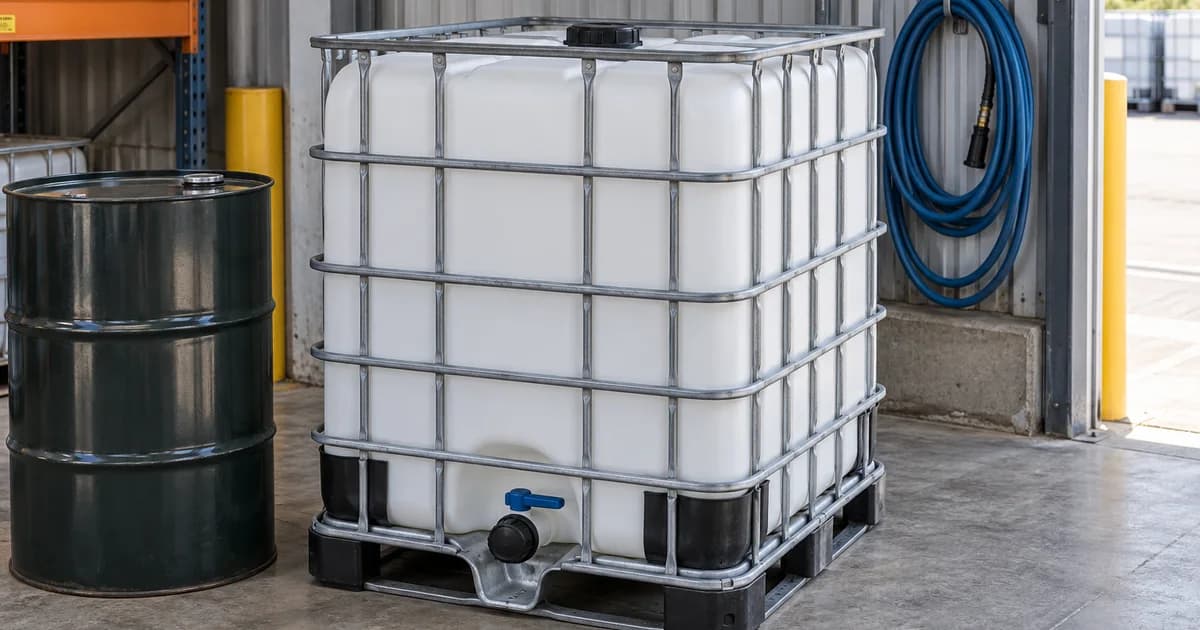
Two questions dominate this subject and they sound like the same question. They are not, and they have opposite answers.
Gasoline: no. A standard plastic IBC is not suitable or permitted for it. Diesel: usually yes, subject to conditions.
The dividing line is not the word "fuel". It is flash point — the temperature at which a liquid gives off enough vapour to ignite. Gasoline's flash point is well below room temperature, which places it in the most hazardous class of flammable liquids. Diesel's is above 100°F, making it a combustible liquid under an entirely different set of rules.
That distinction explains the whole article, and it is why two liquids that both go in vehicles are treated so differently.
Quick reference: what goes in an IBC tote
Contents | Standard plastic IBC | Conditions |
|---|---|---|
Non-potable water | Yes | — |
Potable water | Yes | Food-grade bottle, documented history, potable-rated fittings |
Diesel, heating oil | Usually | Check local limits, containment, and separation requirements |
Gasoline | No | Requires equipment listed for Class I liquids |
Motor and lubricating oils | Yes | — |
Acids and alkalis | Depends | Check HDPE compatibility for the specific substance |
Aromatic and chlorinated solvents | Generally no | Cause swelling and stress cracking |
Food products | Yes | Food-grade bottle with documented food-only history |
Potable water and food service both turn on documented history rather than condition: food grade verification.
Can you store gasoline in an IBC tote?
The short answer
No. Not in a standard plastic IBC, and this is not an abundance of caution — it is both a code requirement and a genuine physical hazard with a well-understood mechanism.
Flash point and liquid classification
Fire codes classify flammable and combustible liquids by flash point — the temperature at which a liquid gives off enough vapour to ignite.
Class | Flash point | Examples |
|---|---|---|
Class IA and IB | Below 73°F (23°C) | Gasoline, ethers, acetone |
Class IC | 73–99°F | Turpentine, some solvents |
Class II and III | Above 100°F (38°C) | Diesel, kerosene, heating oil |
Class I as a whole covers flash points below 100°F. Gasoline sits in Class IB — it produces ignitable vapour well below room temperature, meaning any container holding it has a flammable vapour space above the liquid essentially all the time.
Under NFPA 30, non-metallic IBCs are not permitted for Class I liquids outside of narrowly defined arrangements with protection measures that do not exist in any ordinary storage situation. Diesel, as a combustible rather than flammable liquid, sits under different provisions — which is why the answers diverge.
There are two separate mechanisms behind that prohibition, and both are worth understanding.
Mechanism one: what happens in a fire
This is the failure mode the fire code is written around, and it is the more consequential of the two.
A composite IBC is a plastic bottle inside a steel cage. Expose it to fire and the steel heats while the polyethylene bottle melts within minutes. The container does not leak progressively or fail at a seam — it loses its containment wholesale.
The result is 275 gallons of burning fuel released at once onto the floor. That produces a spreading pool fire, which is the scenario sprinkler systems are least able to handle: the fire area expands faster than suppression can cover it, and adjacent containers are then exposed to the same failure.
A metal tank in the same fire deforms, vents, and may eventually fail — but it does not disappear in minutes. That difference is the whole basis for restricting Class I liquids to metal containers and listed tanks.
Mechanism two: static electricity
The second mechanism explains why the danger exists even without an external fire — and why "it worked fine last time" is not evidence of safety.
Liquid flowing through a hose and against a container wall generates static charge by friction. This happens with any liquid and any container — it is unavoidable physics of fluid transfer.
In a metal container, the charge has somewhere to go. Metal is conductive, the container is bonded and grounded, and accumulated charge dissipates to earth continuously as it is generated.
Plastic cannot be grounded. HDPE is an insulator — see IBC tote specifications on bottle materials. Charge generated during filling or dispensing accumulates on the container and in the liquid itself with no path to earth. Bonding the steel cage does not help, because the cage is not what holds the charge. Potentials in the tens of thousands of volts are achievable during transfer operations.
Now consider what surrounds that charge. A tank holding gasoline contains a vapour space above the liquid, and at ordinary temperatures that space sits within the flammable range — enough fuel vapour mixed with air to ignite.
The energy required to ignite gasoline vapour is remarkably small: on the order of 0.2 millijoules. A static discharge from an accumulated charge on a plastic container can exceed that by orders of magnitude.
So the arrangement is: an ignition source that cannot be eliminated, inside a vessel that cannot dissipate it, surrounded by a vapour mixture sitting in its ignitable range. The failure is not a matter of carelessness. It is a matter of when the discharge happens to occur in the right place.
Vapour permeation
A second, quieter problem. HDPE is permeable to hydrocarbon vapour — molecules migrate slowly through the wall itself. Over time this means measurable product loss, and in an enclosed space it means accumulating fuel vapour outside the tank as well as inside it.
Metal does not do this. It is one of several reasons fuel storage equipment is built the way it is.
"But people do it anyway"
They do, and they report no problems, and both of those statements are true. It is worth addressing directly rather than pretending otherwise.
Static ignition is probabilistic, not deterministic. Every transfer generates charge; whether a discharge occurs across the vapour space at sufficient energy depends on humidity, flow rate, fill level, grounding of surrounding equipment, and chance. A given operation might be performed hundreds of times without incident.
The absence of an incident does not indicate the absence of risk — it indicates that the risk has not yet resolved against you. And the outcome when it does is not a leak or a spill. It is a vapour space ignition in a container holding 275 gallons of fuel.
This is also why the fire code position is categorical rather than conditional. Codes are written from incident history, and this particular incident history exists.
What to use instead
Listed portable fuel containers for small quantities
Steel tanks and UL-listed above-ground fuel storage for bulk, with the bonding, grounding and venting the application requires
Certified fuel transport equipment where the fuel needs to move
A licensed fuel supplier delivering to a fixed installation, which for most operations is cheaper than building compliant storage
Can you store diesel in an IBC tote?
The short answer
Usually yes. Diesel is a combustible liquid with a flash point above 100°F, and it does not produce an ignitable vapour space at ordinary temperatures. The static mechanism described above requires that vapour space to be within its flammable range — with diesel at ambient temperature, it is not.
This is a genuine physical difference, not a regulatory technicality.
Conditions that still apply
"Usually yes" is doing real work in that sentence:
Quantity limits. Fire codes and local ordinances restrict how much fuel may be stored, where, and in what.
Secondary containment. Bunding or a containment tray is commonly required and is good practice regardless.
Separation distances from buildings, boundaries, ignition sources, and drains.
Local approval. Requirements vary considerably between jurisdictions, and agricultural, commercial, and domestic situations are often treated differently.
Not indoors without specific provision. Enclosed spaces change the assessment entirely.
Check locally before committing. This is one of the areas where the rules genuinely differ from one county to the next.
Transport is a separate question
Storing diesel and transporting it are governed by different requirements. Moving fuel in an IBC in any quantity that engages transport regulations requires a container with valid UN marking, within its inspection cycle, and in practice within the five-year window the industry works to for the plastic bottle — see how long IBC totes last on reading the marking and where that window comes from.
A tank that is fine as a static farm tank may not be acceptable on a public road. If the tank is going to move while full, verify that separately.
Fuel-specific problems
Diesel stored in an IBC brings issues that have nothing to do with fire:
Water contamination. Condensation forms in the vapour space through temperature cycling and collects at the bottom — which is exactly where the outlet is. Water in diesel causes injector damage and filter blocking.
Microbial growth. Diesel supports bacterial and fungal growth at the fuel-water interface, producing the sludge known as diesel bug. It blocks filters and is genuinely difficult to eliminate once established. The water contamination above is what enables it.
UV degradation of the fuel. Diesel degrades with light exposure, and IBC bottles are translucent.
UV degradation of the tank. Separately, the tank itself degrades in sunlight.
All four argue the same conclusion: keep the tank covered and out of direct sun, and consider a water-separating filter on the outlet.
Farm and off-road use
Bulk diesel in IBCs is common in agriculture and often entirely legitimate. If you are going this route: keep the tank shaded, on level solid ground, within containment, with the outlet protected, and check what your jurisdiction requires for the quantity involved.
There is also a federal threshold that catches a surprising number of operations — covered next.
Storage volume thresholds: when SPCC applies
This is the requirement most commonly missed by people storing fuel in IBCs, and the threshold is lower than almost anyone expects.
The 1,320 gallon trigger
Under federal oil pollution prevention rules, a facility needs a Spill Prevention, Control and Countermeasure (SPCC) plan once aggregate above-ground oil storage exceeds 1,320 gallons, where there is a reasonable expectation that a discharge could reach navigable waters.
Two details make this bite harder than it looks:
Every container of 55 gallons or more counts toward the aggregate. There is no exemption for portable containers — each IBC is fully included in the calculation.
"Oil" is broad. It covers diesel, gasoline, used and unused motor oils, hydraulic fluids, and even animal and vegetable oils. It is not limited to petroleum fuels.
Run the arithmetic and the consequence is stark:
Five standard 275-gallon totes = 1,375 gallons. Threshold exceeded.
An SPCC plan is an engineered document, and compliance normally includes secondary containment sized to hold the largest single container plus freeboard for rainfall.
The farm exemptions
Agricultural operations get substantial relief here, introduced by the Water Resources Reform and Development Act of 2014. A farm for these purposes is land devoted to growing crops or raising animals that produces at least $1,000 of output a year — a low bar that captures most working operations.
The thresholds work in three bands:
Aggregate storage | Requirement |
|---|---|
Up to 2,500 gallons | No SPCC plan required |
2,500–6,000 gallons, no reportable discharge in the preceding three years | No SPCC plan required |
6,000–20,000 gallons, no single container over 10,000 gallons, no reportable discharge history | Plan required, but the farm may self-certify without engaging a professional engineer |
Above those bands, or where the discharge history condition is not met, the full requirement applies including certification by a professional engineer.
The practical difference is substantial. A farm running eight to twenty totes of diesel may have no plan obligation at all. A commercial construction site with five totes — 1,375 gallons — is already over the general threshold and gets none of these concessions.
What to do about it
Count what you actually have on site, including containers you may not think of as storage — waste oil drums, hydraulic fluid, the tote behind the workshop. If the aggregate approaches the applicable threshold, the requirement is triggered whether or not anyone has mentioned it to you.
Secondary containment is worth building regardless of thresholds. It is the single measure that turns a burst tank from an environmental incident into a cleanup.
Local permits are a separate question entirely
The federal thresholds above are not the whole picture, and assuming they are is a common way to get caught out.
Most municipalities adopt the International Fire Code, and local amendments frequently require an operational permit for storing flammable or combustible liquids — often at quantities far below the federal SPCC trigger, and in some jurisdictions for effectively any quantity above a small exempt allowance. Local codes also commonly set their own rules on setbacks from property boundaries, restrictions on open-yard storage, and spill response requirements.
These sit alongside the federal requirements rather than replacing them. You can be well below 1,320 gallons and still need a permit from your fire code official.
The only reliable way to establish what applies is to ask them directly, before the tanks arrive rather than after.
Chemical compatibility
Beyond fuel, the general question of what HDPE tolerates.
Generally compatible: most inorganic acids and alkalis at typical concentrations, salt solutions, alcohols, most aqueous solutions, detergents, and fertiliser solutions. This broad compatibility is why IBCs are used across the chemical industry at all.
Generally not compatible:
Aromatic hydrocarbons — toluene, xylene, benzene. Cause the polymer to swell and absorb deep into the wall.
Chlorinated solvents — similar behaviour.
Strong oxidisers — attack the polymer and promote stress cracking.
Some ketones and esters — depends heavily on concentration and temperature.
Environmental stress cracking
Worth understanding because it is not intuitive. Some substances do not visibly attack HDPE but dramatically reduce its resistance to cracking under stress. A tank holding such a liquid can appear entirely normal for months and then crack at a stress concentration — a corner, a rib, the flange — under load it would otherwise carry indefinitely.
The mechanism is why "it hasn't leaked yet" is a weak indicator of compatibility. Failure is delayed rather than absent.
Always consult a compatibility chart for the specific substance, at the specific concentration and temperature. Manufacturer and chemical supplier charts are the appropriate source; a substance being "a mild acid" is not enough to go on.
Special considerations for used totes
Everything above concerns the material. Used tanks add two further constraints.
Previous contents can react with new ones. Residue absorbed into the wall is not visible and not removable — how to clean an IBC tote sets out what cleaning can and cannot reach. A tank that held an oxidiser and now holds something incompatible with it has a reaction happening inside the wall structure, not in the bulk liquid where you would notice it.
Aged bottles have reduced chemical resistance. UV degradation and freeze cycling both create micro-cracking, which increases surface area for absorption and provides initiation sites for stress cracking. A five-year-old outdoor tank does not tolerate what a new one does, even in the same chemical.
The practical rule: the more aggressive the substance, the more the tank's history matters. For water, buy on condition, working the 12-point inspection checklist. For anything chemically demanding, buy on documentation — and if the history is unknown, restrict the tank to benign contents regardless of how good it looks.
Frequently asked questions
Can IBC totes hold gasoline?
No. Gasoline is a Class I flammable liquid and standard plastic IBCs are not permitted or suitable for it. Two mechanisms drive the prohibition: in a fire, the polyethylene bottle melts within minutes and releases the entire contents as a spreading pool fire; and during transfer, static charge accumulates on a container that cannot be grounded, inside a vessel with an ignitable vapour space above the liquid.
Can you store gasoline in an IBC tote?
No — the same answer applies to storage as to transport. Use listed portable containers for small quantities or UL-listed steel tanks for bulk.
Can you store diesel in an IBC tote?
Usually yes. Diesel is combustible rather than flammable and does not form an ignitable vapour space at ordinary temperatures. Local quantity limits, containment, and separation requirements still apply, and requirements vary by jurisdiction.
Can IBC totes be used for diesel fuel?
Yes, subject to those conditions. For transporting rather than storing, the tank needs valid UN marking and to be within its inspection cycle. Practical issues to manage are water condensation, microbial growth, and UV exposure — keep the tank covered.
How many totes of diesel can I keep before extra rules apply?
Federal spill prevention rules are triggered at 1,320 gallons of aggregate above-ground oil storage — around five standard totes — counting every container of 55 gallons or more. Qualified farms are treated differently: no plan is required up to 2,500 gallons, or up to 6,000 gallons with no reportable discharge in the preceding three years. Between 6,000 and 20,000 gallons a farm may self-certify its plan rather than engaging an engineer, provided no single container exceeds 10,000 gallons.
What can't you store in an IBC tote?
Gasoline and other Class I flammable liquids, aromatic and chlorinated solvents, strong oxidisers, and anything a compatibility chart rules out for the specific concentration and temperature involved.
Why is diesel allowed but not gasoline?
Flash point. Gasoline gives off ignitable vapour below room temperature; diesel does not until above 100°F. Both mechanisms behind the prohibition depend on that vapour space — the static discharge risk, and the fire behaviour when a plastic bottle melts and releases its contents at once.
Can you store used motor oil in an IBC tote?
Materially, yes — oils are compatible with HDPE, and IBCs are commonly used for this. Used oil is a regulated waste in most jurisdictions: containers must be clearly labelled "Used Oil", kept in good condition, and provided with secondary containment. Note also that used oil counts toward the SPCC aggregate threshold, and that a tank which has held it will not return to food or potable service.