
Where can I recycle pallets near me? Local pallet recyclers are your best option for rate and free pickup. Repackify matches your location and volume to recyclers and buyers nearby - start a pallet recycling request.
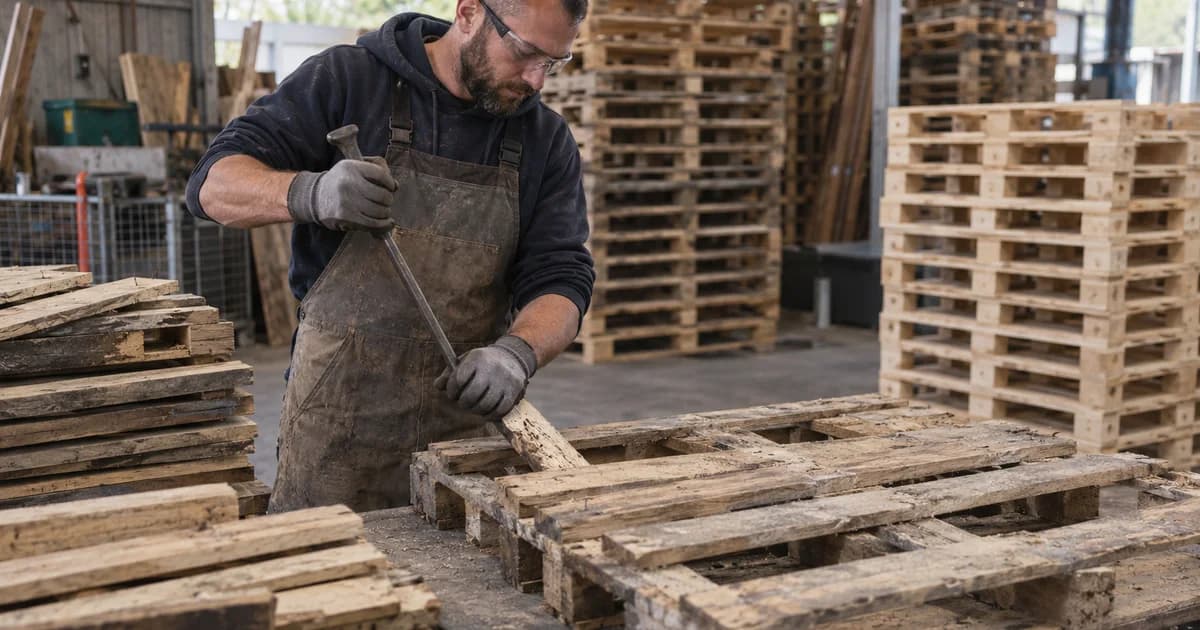
Pallet recycling is the collection, repair and reuse of used wood pallets - and for most businesses it's the difference between paying to throw pallets away and getting paid to have them hauled off. Recyclers inspect incoming pallets, repair the salvageable ones back into Grade A or Grade B stock, and grind the rest into mulch, animal bedding or fuel. Almost nothing is landfilled.
This guide covers how the process works, whether pallets can go in a dumpster or to the dump, what you can expect to be paid, and how to set up pickup. If you specifically want to sell surplus pallets for cash, see our guide on who buys pallets and where to sell them.
Key takeaways
- Recyclers pay for sound pallets: a Grade A 48 × 40 brings $4–8 from a recycler, Grade B $2–5, Grade C $0.50–2.
- Free pickup is standard at truckload volume - 480 to 680 pallets.
- About 95% of wood pallets are recycled into new pallets, mulch, bedding or fuel.
- Dumpsters and landfills cost you twice: the disposal fee plus the value of pallets you could have sold.
- CHEP and PECO pallets aren't yours to recycle - they go back to the pooling company.
Can pallets be recycled?
Yes - and almost all of them are. About 95% of wood pallets in the US are recovered and turned into reusable material, from repaired pallets to mulch, according to a 2018 report by Virginia Tech, the USDA Forest Service and the National Wooden Pallet & Container Association (NWPCA). A pallet that can't carry a load anymore still has sound boards and stringers that repair other pallets, and the wood that's left has a market as mulch or fuel.
What happens to a pallet depends on what it's made of and who owns it:
Pallet | Recyclable? | Where it goes |
|---|---|---|
Wood, standard sizes (48 × 40 and others) | Yes | Pallet recycler: repaired and resold, or ground |
Wood, broken or odd sizes | Yes, usually for less or at a small fee | Pallet recycler: parts or grinding |
Plastic (HDPE, PP) | Yes, through plastic buyers and recyclers | Resold if intact; reground into new plastic if not |
Pooled (CHEP blue, PECO red, iGPS black) | Not by you | Returned to the pooling company that owns it |
Are plastic pallets recyclable?
Yes. Plastic pallets are made from HDPE or polypropylene, which recyclers grind and reprocess into new plastic products - often new pallets. Intact plastic pallets are worth more resold than recycled: a working rackable pallet has resale value that a bale of regrind doesn't. Sell plastic pallets you no longer need, or arrange plastic pallet recycling for damaged ones.
What about CHEP and PECO pallets?
Blue CHEP pallets, red PECO pallets and black iGPS pallets are rented, not sold - they remain the property of the pooling company wherever they end up. Don't sell them, break them down or throw them away; in some states buying marked pooled pallets from anyone other than the owner is illegal (California Business and Professions Code § 21609.7). Instead, return them:
CHEP recovers its pallets through its own network and an Asset Recovery Program with pallet recyclers - contact CHEP to arrange collection.
PECO collects once you've accumulated a full load - request a pickup through PECO's website.
iGPS takes pickup requests through its website; it doesn't publish a minimum.
For how pooling works, see how CHEP pallet pooling works.
How pallet recycling works
A used pallet moving through a recycler follows a predictable path:
Collection: the recycler picks up your surplus pallets, usually by the truckload.
Sorting and inspection: pallets are sorted by size and condition; standard 48 × 40 cores are the most valuable.
Repair: salvageable pallets are repaired - plugged stringers, companion boards, replaced deckboards - back into Grade A or Grade B stock.
Remanufacture: pallets too far gone are broken down and rebuilt into combo pallets from salvaged parts.
Grinding: whatever can't be reused is ground into mulch, animal bedding or biomass fuel.
What happens to broken pallets?
A broken pallet isn't scrap - it's a parts bin. Recyclers pull the sound boards and stringers from one pallet to repair two others. When a pallet is past repair, it goes through a grinder: magnets pull out the nails, and the wood chips become landscape mulch (often dyed), animal bedding or fuel for biomass boilers. That's why recyclers accept broken pallets at all - though they pay little or nothing for them, and a load that's mostly broken may carry a small haul-off fee.
If you're holding broken pallets, the best move is usually to send them with your sound ones: a recycler picking up a truckload of Grade B pallets will typically take the broken ones along. Start a recycling request and describe the mix.
Can pallets go in a dumpster?
Usually you can, but it's the most expensive way to get rid of them. Most roll-off dumpsters from haulers like WM and Republic Services accept wood as construction debris, but rules vary by location and container type - check with your local hauler before you fill one. Two things make dumpsters a poor fit for pallets:
Pallets are bulky. They fill a container fast while weighing little, so you pay for extra pulls or overage long before the dumpster is heavy.
You're throwing away value. A standard pallet in usable condition is worth $2–8 to a recycler. A dumpster turns that into a disposal cost.
Front-load business dumpsters and regular trash service aren't built for pallets either; stacking pallets beside a container is a good way to get an extra-pickup charge.
Will the garbage man take pallets?
Generally not through regular trash service - pallets are too large for carts and most routes won't pick up items left beside them. Some haulers and cities offer bulk-item pickup for a fee. For a business with more than a handful of pallets, a recycler is cheaper and simpler: get old pallets picked up.
Can you take pallets to the dump?
Yes, most landfills and transfer stations accept wood pallets - usually as construction and demolition (C&D) debris or wood waste, for a tipping fee charged by the ton. Municipal solid waste landfills in the US averaged $62.28 per ton in 2024 (Environmental Research & Education Foundation); C&D and wood-waste rates vary by site.
Some states don't allow it at all. Massachusetts, for example, bans clean wood - including pallets - from landfills and requires it to be recycled (310 CMR 19.017). Check your state's rules before you haul a load.
For anything more than a few pallets, the dump costs you the fee, the truck and the driver's time - while a recycler would collect the same pallets and may pay you for them.
What to do with old, used or extra pallets
For a business, here are the options in order of what they're worth to you:
Sell them. Sound Grade A and Grade B pallets have real resale value, especially standard 48 × 40s. List your pallets and get offers from buyers and recyclers.
Have a recycler pick them up. Mixed and lower-grade loads go to a recycler, often for free at truckload volume, sometimes with payment for the sound ones. Arrange a pickup.
Return them to your supplier. Some suppliers take back their own pallets or run return programs - ask before you buy another load.
Return pooled pallets to their owner. CHEP, PECO and iGPS pallets go back to the pooling company (see above).
Reuse them internally. If your own operation ships on pallets, sort out the sound ones and put them back into use before buying new.
Dump them - last resort. A landfill or dumpster costs you a fee and throws away the value.
For how to keep pallets in good condition while they wait for pickup, see how to store pallets safely.
What will you get paid?
It depends on grade, size and volume. Sound, standard pallets pay; broken or oddball pallets may be free pickup or a small disposal cost. Typical prices for 48 × 40 pallets:
Grade | Sold to a recycler | Sold directly to a user |
|---|---|---|
Grade A (like new) | $4–8 | $8–14 |
Grade B (most common reused tier) | $2–5 | $4–7 |
Grade C (visible repairs, structurally sound) | $0.50–2 | $1–3 |
Scrap / unrepairable | $0–0.50 | $0–0.50 |
Source: Repackify marketplace data. Current buyer prices by grade and state are in the pallet price index.
Free | 480–680 |
|---|---|
Pickup at truckload volume | Pallets in a full 53-foot load |
A full 53-foot load is 26 to 30 stacks: about 16 high on 6.5-inch new pallets, 22 on 5-inch stock and 23 on 4.75-inch. Smaller batches usually mean dropping pallets off or paying a haul fee. Prices also vary by region - standard cores can be worth several times more in one metro than another - so the closer the buyer, the better your net.
Recycling vs. disposal: the real cost
Sending pallets to a landfill costs money twice - the tipping fee and the lost value of reusable wood. Here's a rough comparison for 500 mixed 48 × 40 pallets at about 40 lbs each (10 tons):
Option | What you pay | What you get |
|---|---|---|
Recycler pickup | Nothing at truckload volume | $0–2,500, depending on how many are Grade B or better ($2–5 each for Grade B) |
Landfill | ~$620 in tipping fees at the 2024 average of $62.28/ton, plus your truck and labor | Nothing |
Dumpster | Several roll-off pulls - pallets fill containers by volume, not weight | Nothing |
Illustrative estimate; your prices depend on location and pallet mix.
Recycling also helps beyond cost:
Space: a standing recycling pickup keeps pallets from piling up on your dock and creating a fire and safety hazard.
Sustainability: diverted pallet wood counts as waste diversion - useful for ESG and corporate waste-audit goals. See what to expect in a corporate waste audit.
Where to recycle pallets near you
Pallets are heavy and cheap per unit, so distance is everything - the closer the recycler, the better your net, whether you're paying for disposal or getting paid for cores.
Option | Best for | Notes |
|---|---|---|
Local pallet recycler | Regular truckload volume | Best rates and free pickup; build a standing relationship |
Marketplace (Repackify) | Matching to the best nearby buyer | Compares local recyclers and buyers so you get the best net price |
National pallet network | Multi-site enterprises | Consistent program across locations; not always the best per-site rate |
Municipal / C&D facility | One-off small batches | Usually a disposal fee, not payment - last resort |
The fastest way to find the right outlet is to start a pallet recycling request - we match your location and volume to local recyclers and buyers.
How to set up pallet recycling
Count and sort: estimate your volume and rough condition mix - sound cores vs. broken.
Separate pooled pallets: set CHEP, PECO and iGPS pallets aside for return to their owners.
Stage them: keep pallets dry and stacked in an accessible spot for forklift loading.
Get matched: submit a recycling request with your location and volume.
Schedule pickup: a local recycler confirms the rate and collects - typically free at truckload volume. How many fit on one trailer is in how many pallets fit in a 53-foot trailer.
Frequently asked questions
Where can I recycle pallets near me?
Local pallet recyclers are your best option for rate and free pickup. Repackify matches your location and volume to recyclers and buyers nearby - start a request on our pallet recycling page.
Do you get paid to recycle pallets?
Often, yes. Recyclers typically pay $4–8 for a Grade A 48 × 40 pallet, $2–5 for Grade B and $0.50–2 for Grade C, with free pickup at truckload volume. Broken or specialty pallets may be free haul-off or carry a small disposal fee.
How many pallets do I need for free pickup?
A full 53-foot load - 480 to 680 pallets - is the usual threshold. Smaller batches may mean dropping them off or paying a haul fee.
Can pallets be recycled?
Yes. About 95% of wood pallets in the US are recovered - repaired and resold, rebuilt into combo pallets, or ground into mulch, animal bedding and fuel.
Can pallets go in a dumpster?
Most roll-off dumpsters accept wood pallets as construction debris, but rules vary by hauler and location. It's usually the most expensive option: pallets fill a container fast, and you throw away pallets a recycler would pay for.
Can you take pallets to the dump?
Most landfills and transfer stations accept pallets as C&D or wood waste for a per-ton tipping fee. Some states, such as Massachusetts, ban clean wood from landfills.
What happens to broken pallets?
Recyclers salvage their sound boards and stringers to repair other pallets. What can't be reused is ground - nails removed by magnet - into mulch, animal bedding or biomass fuel.
Are plastic pallets recyclable?
Yes. Intact plastic pallets are best resold; damaged ones are ground and reprocessed into new plastic products.
What should I do with CHEP or PECO pallets?
Return them - they belong to the pooling company. CHEP recovers them through its own network and recycler partners, PECO collects full loads, and iGPS takes pickup requests online. Don't sell or scrap them.
Is pallet recycling better than throwing pallets away?
Almost always. Disposal costs a tipping fee and wastes reusable wood; recycling is free pickup or pays you, clears dock space and counts toward waste-diversion goals.
Bottom line
Pallet recycling turns a disposal cost into free pickup or revenue, keeps usable wood out of landfills, and clears your dock. Dumpsters and dumps take pallets but charge you for it; a recycler takes the same pallets and pays for the good ones. Set pooled pallets aside for their owners, stage the rest dry and stacked, and match to a recycler close to you.
Got pallets piling up? Arrange a pickup or sell your pallets.