
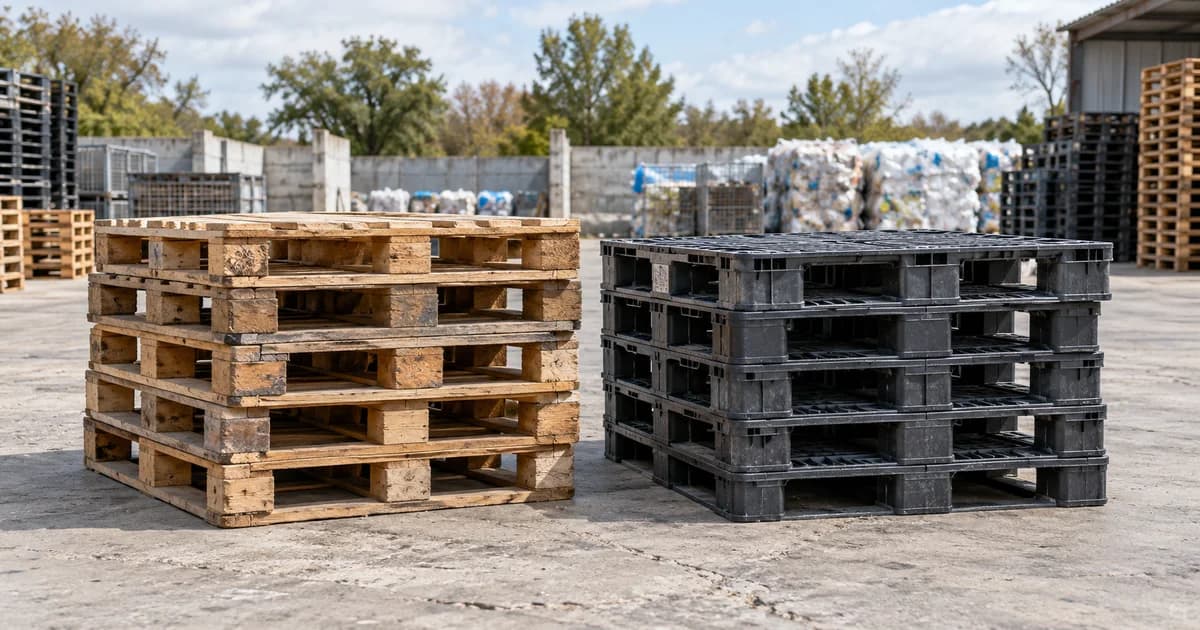
“Which pallet is more recyclable?” doesn't have a one-word answer, because wood and plastic are recovered through entirely different systems. Wood pallets ride a mature repair-and-grind network: recyclers fix them, resell them, and eventually grind the scrap into mulch or fuel. Plastic pallets last far longer in service but exit through a narrower door — they have to reach a resin recycler, not a curbside bin. Knowing each path tells you what actually happens to a pallet after you're done with it, and what it's worth on the way out.
Key takeaways
- Wood has the most developed recovery network in North America — pallet recyclers repair, remanufacture, and buy back cores, then grind true scrap into mulch, animal bedding, and biomass fuel.
- Plastic delivers far more reuse cycles per unit and is recyclable as HDPE or PP regrind, but only through specialized recyclers — it is not curbside-recyclable.
- Both have real end-of-life value: wood through the core/scrap market, plastic through scrap-resin pricing per pound.
- For closed-loop, in-house programs, plastic usually wins on lifecycle; for open, one-way distribution and easy local recovery, wood is hard to beat.
Wood pallets: repair first, grind last
The defining feature of the wood pallet world is the recycler. Tens of thousands of independent pallet companies across the U.S. exist specifically to keep wood pallets in circulation. A used pallet rarely goes straight to waste — it goes through a tiered process:
Repair — a cracked deck board or stringer is swapped out and the pallet returns to service. A standard 48″ × 40″ GMA pallet can be repaired and recirculated many times.
Remanufacture — usable boards from unrepairable pallets are combined into “remanufactured” or “combo” pallets, sold at a discount to new.
Grind — only when a pallet is truly spent do recyclers grind it. The output becomes landscape mulch, colored mulch, animal bedding, or biomass fuel and boiler feedstock.
Because of this, wood pallets carry a strong resale and core market. Recyclers actively buy used pallets — “cores” — by the truckload, and a clean, standard-size load has positive value rather than a disposal cost. The grind stage means even broken wood almost never reaches a landfill if a recycler can collect it economically.
Plastic pallets: more cycles, fewer doors out
Plastic pallets are molded from HDPE (high-density polyethylene) or PP (polypropylene). They don't splinter, absorb moisture, or shed nails, so a single plastic pallet typically survives many more trips than a wood pallet before it fails — which is the core of its sustainability argument. The trade-off is the end-of-life path.
When a plastic pallet finally cracks or warps, the material is fully recyclable: it's reground into resin flake and remolded, often back into new pallets in a genuine closed loop. But that only happens through a plastics recycler equipped to handle rigid HDPE/PP — most pallet manufacturers and many recyclers will take back their own product or buy mixed loads by the pound. What you cannot do is put a plastic pallet in a curbside or single-stream recycling bin.
Side by side: recycling & end of life
Wood | Plastic | |
|---|---|---|
Repair / refurbish | Routine — boards and stringers swapped by recyclers | Limited — usually regrind and remold rather than spot-repair |
Recycling path | Repair → remanufacture → grind (mulch, bedding, biomass) | Regrind to HDPE/PP flake → remold into new pallets |
Who recycles it | Widespread independent pallet recyclers | Specialized rigid-plastics / resin recyclers only — not curbside |
End-of-life value | Core/scrap market; ground wood has modest value | Higher residual scrap value per unit (clean resin sells by the pound) |
Reuse cycles | Many, with periodic repair | Significantly more — durable, no splintering or rot |
Export (ISPM-15) | Needs HT/fumigation stamp for international shipment | Exempt — no treatment required to cross borders |
Wood vs. plastic pallets through the recycling lens
What each is worth at end of life
The practical difference: wood's value is highest while the pallet is still usable (a repairable core is worth more than ground mulch), while plastic's value holds even when the pallet is destroyed, because the resin itself is the asset. That's why a fleet of damaged plastic pallets is still worth aggregating and selling, whereas a pile of splintered wood is mostly a grind-feedstock play.
Which to choose for recyclability
If your priority is a closed-loop, controlled program — a captive pool of pallets cycling within your own facilities or a fixed route with a return leg — plastic usually wins on lifecycle. You get many reuse cycles, predictable hygiene, and a clean resin stream you can sell or send back to the molder at the end.
If you run an open, one-way distribution model — pallets leaving your dock and not coming back — wood is typically the more recyclable choice in practice, because the receiving end almost always has a local pallet recycler who will repair or grind it. Plastic on a one-way trip can strand a high-value asset somewhere with no resin recycler nearby.
For a deeper buying comparison beyond recycling, see the plastic pallets buying guide and the complete pallet recycling guide. Current market pricing for both materials lives on the wood pallet price index and the plastic pallet price index.
Frequently asked questions
Can I recycle a plastic pallet at the curb?
No. A plastic pallet is rigid HDPE or PP, not a household container, and curbside and single-stream programs reject it as contamination. To recycle it, route it to a rigid-plastics or resin recycler, or use the manufacturer's buy-back program. Because the resin is clean and identifiable, that scrap carries positive per-pound value.
Are wood pallets actually recycled or just thrown away?
They are heavily recycled. Independent pallet recyclers repair and recirculate used wood pallets many times, remanufacture usable boards into combo pallets, and grind truly spent pallets into mulch, animal bedding, and biomass fuel. Clean standard-size used pallets have resale value, so recyclers pay to collect them rather than charge a disposal fee.
Which is more sustainable, wood or plastic pallets?
It depends on the model. Plastic lasts through many more reuse cycles and recycles into a closed loop, so it tends to win in captive, returnable pool programs. Wood is more reliably recovered in open, one-way distribution because almost any destination has a local pallet recycler. The most sustainable choice is the one whose end-of-life path your logistics actually support.
Does the ISPM-15 heat-treatment stamp affect recycling?
No. ISPM-15 (the HT or fumigation stamp) only governs international shipment of wood packaging. Domestic recyclers repair and grind treated and untreated wood the same way. Keep the stamp intact only if the pallet is headed overseas.