
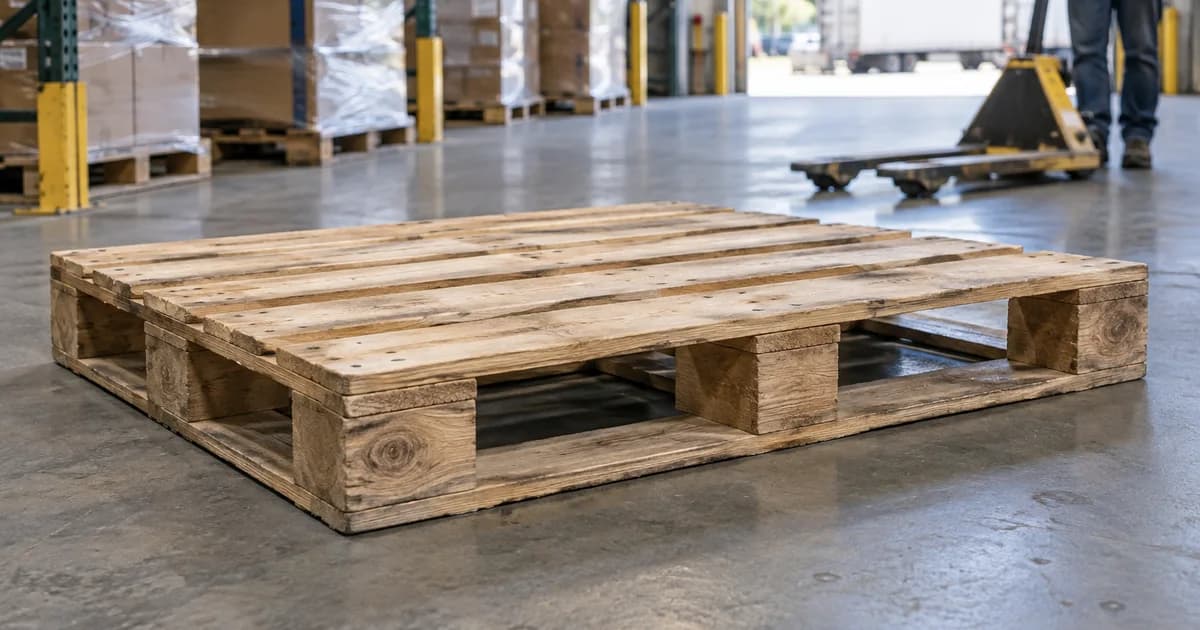
A pallet is a flat, rigid platform - usually wood - that holds goods together as one unit so a forklift or pallet jack can lift, move, stack and store them.
That simple platform is the basic unit of modern logistics. Warehouses count space in pallet positions, carriers quote freight per pallet, and buyers order packaging by the pallet and by the truckload. This guide explains what a pallet is, its parts, sizes and types, how pallets are used in shipping and warehousing, where they come from, what they cost - and links to our in-depth guides on each topic.
What is a pallet?
A pallet is a flat, rigid platform of minimum height that holds goods as a single unit load and is designed to be lifted by a forklift or pallet jack. It's used to assemble, store, stack, transport and display products.
That's close to how the international standard ISO 445 defines it: a rigid horizontal platform of minimum height, compatible with handling by pallet trucks and forklift trucks, used as a base for assembling, loading, storing, handling, stacking, transporting or displaying goods.
A pallet is not the same as:
A skid - a skid has a top deck on runners but no bottom deck. Technically it's a type of pallet; in everyday use the words are interchangeable. See skid vs. pallet.
A crate - a crate encloses the goods on all sides; a pallet is only the base. Crates are often built on a pallet or skid base.
A container - a shipping container is the steel box that pallets are loaded into for ocean or intermodal transport.
Parts of a pallet
Every pallet has a top deck for the load, a base the forks can get under, and usually a bottom deck that sits on the floor or rack.
Part | What it is |
|---|---|
Top deck boards | The boards that carry the load |
Lead (edge) boards | The outermost top and bottom deck boards; usually wider to take forklift impacts |
Bottom deck boards | The boards on the underside; spread the load on racks and on the load below |
Stringers | Long beams (on a 48 × 40, three 48″ stringers) that run between the decks - the frame of a stringer pallet |
Blocks | Solid or composite blocks (usually nine) that replace stringers on a block pallet |
Stringer boards | On a block pallet, the boards that tie the blocks together under the top deck |
Notches | Cutouts in stringers that let forks enter from the sides (partial four-way entry) |
Openings / entry | The spaces the forks go into - two-way, partial four-way or full four-way |
Fasteners | Nails or staples that hold it together |
For how these parts come together in different designs and materials, see types of pallets.
What are pallets used for?
Pallets are used to move and store goods as one unit instead of box by box. That makes handling faster, safer and cheaper:
Shipping freight - truckload, LTL, rail and ocean containers
Warehouse storage - on the floor or in pallet racking
Manufacturing - moving raw materials, work in progress and finished goods
Retail and grocery distribution - from DC to store, and on the sales floor as displays
E-commerce and 3PL fulfillment - inbound receiving and bulk storage
Export - as ISPM-15 treated packaging for international shipments
The idea behind it is the unit load: dozens of cases stacked, wrapped and strapped onto one pallet become a single item that one forklift driver moves in one trip. Grocery, beverage, building materials, chemicals, automotive parts, paper and consumer goods all run on it.
What is a pallet in shipping?
In shipping, a pallet is a handling unit: the unit a carrier picks up, moves and bills. LTL carriers price palletized freight by its weight, dimensions and freight class, and a bill of lading lists the number of pallets (or skids - carriers treat them the same). A full truckload in a 53′ trailer is 26 to 30 standard pallets on the floor. For how to prepare one for pickup, see how to ship a pallet.
What is a pallet in a warehouse?
In a warehouse, a pallet is the unit of storage. A pallet position is one pallet-sized slot, on the floor or in a rack bay, and warehouses measure capacity and charge for storage per pallet position. In US third-party warehouses, the 2025 average was about $20 per pallet position per month. For layout, stacking and fire-code limits, see how to store pallets safely.
What is one pallet?
"One pallet" can mean two things. As a quantity of goods, it's whatever fits on one pallet footprint up to the height and weight limits - for example, a full pallet of cases up to 60″ tall. As packaging, it's a single empty pallet. Empty pallets are usually bought and sold by the truckload - 480 to 680 empty 48 × 40 pallets in a 53′ trailer, depending on their height - but also in smaller lots.
Standard pallet sizes
The standard US pallet is 48 × 40 inches (1219 × 1016 mm) and about 5–6.5 inches tall. In Europe, the standard is the EUR pallet, 1200 × 800 mm.
Pallet | Size | Where used |
|---|---|---|
GMA pallet | 48 × 40 in | US and Canada - the default |
Square | 42 × 42 in | Telecom, paint |
Drum pallet | 48 × 48 in | Drums, chemicals |
EUR / EPAL 1 | 1200 × 800 mm (47.2 × 31.5 in) | Europe |
Asia standard | 1100 × 1100 mm (43.3 × 43.3 in) | Asia |
Full size chart, heights and how to measure a pallet: standard pallet sizes and dimensions.
What is a GMA pallet?
A GMA pallet is the standard 48 × 40 inch wood stringer pallet with partial four-way entry - named for the Grocery Manufacturers Association, which standardized the size for grocery distribution. It's the most common pallet in the US. See our GMA pallet guide for specs, grades and pricing.
How much does a pallet weigh and hold?
A standard 48 × 40 wood pallet weighs about 33–48 lbs empty (15–22 kg). It's typically rated for about 4,600 lbs of uniformly distributed load sitting on the floor (static), about 2,500 lbs when moved by a forklift (dynamic), and about 2,000–2,500 lbs in a rack.
Ratings vary widely with wood species, design and condition. Weights and capacities for wood, block, plastic, CHEP, PECO and EUR pallets: pallet weight and load capacity.
Types of pallets
Pallets differ by material and by design:
Wood - the vast majority of US pallets; 81% of new wood pallets are softwood (mostly pine), the rest hardwood. Cheap, repairable, recyclable.
Plastic - durable, washable, consistent weight; used in closed loops, food and pharma. Costs more than wood - roughly $25–80 new. See our plastic pallets buying guide and wood vs. plastic pallets.
Presswood (molded wood fiber) - light, nestable, ISPM-15 exempt; popular for one-way export.
Metal - steel or aluminum for heavy, high-temperature or hygienic uses.
Corrugated - lightweight, one-way shipments.
By design, most US pallets are stringer pallets (77% of new wood pallets in 2021) - cheaper, with forklift entry from the ends and notched sides. Block pallets (19%) sit on nine blocks and allow full four-way entry; CHEP, PECO and EUR pallets are block pallets. Pallets are also single-face or double-face, reversible or non-reversible.
Full comparison: types of pallets and how to choose one.
New, used and recycled pallets
Pallets don't have to be new. Most US pallets are used many times, repaired and resold:
New - built from new lumber, often to a customer's spec.
Grade A (#1) - used, like new, sturdy, minimal repairs.
Grade B (#2) - used, repaired with a companion stringer or plate, the workhorse of reuse.
Grade C / combo - heavier repairs or mixed components; for one-way or low-value loads.
Remanufactured - rebuilt from reclaimed components, sometimes in non-standard sizes.
Used pallets cost a fraction of new ones - on the Repackify pallet price index (October 1, 2026), average listings were $18.81 for a new 48 × 40, $7.90 for grade A and $6.00 for grade B. Grade definitions: pallet grades explained. Ready to buy? Buy pallets on Repackify or read the guide to buying a truckload of wooden pallets.
Heat treated pallets
Pallets that cross international borders must be treated against wood pests under the ISPM-15 standard - almost always by heat treatment (HT) - and stamped with the IPPC mark. Domestic pallets usually don't need it, and pallets are not pressure treated or, in most cases, chemically treated. See our ISPM-15 heat treated pallet guide.
Rented pallets: CHEP, PECO and iGPS
Not every pallet is owned by the shipper. Pooling companies rent pallets: CHEP (blue block pallets), PECO (red) and iGPS (plastic) own the pallets, charge the user for each trip or day, and collect them from the receiver. Pooled pallets are not for sale - if you end up with them, they must be returned, not sold or scrapped. Background: the history and evolution of pallet pooling and how CHEP pallet pooling works.
Where do pallets come from?
Pallets grew up with the forklift. Before them, goods moved on skids - runner platforms with no bottom deck - or were handled case by case. Key steps:
1924 - Hallowell's patent, one of the earliest pallet-type patents for use with lift trucks.
1939 - Raymond and House patented the double-deck pallet designed for forklift forks - the direct ancestor of today's pallet.
World War II - the US military adopted pallets and forklifts at massive scale to move supplies, and industry followed after the war.
1946 - pallet pooling began in Australia with CHEP; Brambles took it over in 1958, and CHEP entered the US in 1990.
1960s–70s - the Grocery Manufacturers Association standardized the 48 × 40 footprint for grocery distribution and later published the construction specification behind the "GMA pallet"; Canada adopted the same standard in 1968.
Today most US wood pallets are built at sawmill-linked pallet plants or local manufacturers: lumber is cut into stringers and deck boards, notched, and nailed together, often on automated nailing machines - then often heat treated. Recyclers collect used pallets, sort them by grade, repair them and put them back into circulation.
How much does it cost to build a pallet?
Material is the biggest cost. A 48 × 40 GMA-style pallet uses roughly 10–12 board feet of lumber, plus nails, labor, machine time, heat treatment if needed, and delivery. That's why new pallet prices track lumber prices closely. For current market prices of new and used pallets by grade and state, see the pallet price index.
The US pallet market in numbers
Figure | Value | Source |
|---|---|---|
Pallets in circulation | ~2.6 billion | Virginia Tech (2020) |
New wood pallets produced | 919 million (2021) - up 75% from 513 million (2016) | Hobbs, Horvath & Gething, BioResources (2025) |
Recovered (repaired/recycled) pallets | 280 million (2021) - down 14% from 326 million (2016) | Same study |
Share of 48 × 40 | 29% of new pallets (2021); 69% of recovered pallets (2016) | Same study / Virginia Tech |
Softwood share of new pallets | 81% | Virginia Tech |
Pallets recovered for reuse or recycling | ~95% (2018) | Virginia Tech / USDA / NWPCA |
The 2021 numbers tell a story: during the pandemic, companies held on to the pallets they had, recyclers ran short of used "cores," and manufacturers built a record number of new pallets to fill the gap.
Why are pallets so expensive?
Because lumber is. The Bureau of Labor Statistics producer price index for lumber more than doubled between April 2020 and May 2021. The BLS index for wood pallets and containers (series PCU321920321920) rose about 54% from late 2019 to its peak in April 2022, and in August 2026 (preliminary data) it was still about 28% above its December 2019 level. More on price trends in our pallet pricing report. Add the 2021 shortage of used cores, when recyclers couldn't get enough pallets to repair, plus higher labor and freight costs, and prices reset at a higher level.
Prices also vary a lot by region: on the Repackify price index, average used-pallet listings range from $4.98 in Florida to $8.40 in Iowa. Buying used instead of new is the simplest way to cut the cost - see our pallet pricing trends and the live price index.
Moving, storing and disposing of pallets
Loading trucks: a 53′ trailer holds 26 standard pallets loaded straight or 30 turned, and 480–680 stacked empties - see how many pallets fit in a 53-foot trailer.
Building a load: stack cases in a stable pattern, wrap and strap so the load stays together - see how to stack, wrap and strap a pallet.
Storing: empty wood pallets indoors are limited to 6 ft piles under standard sprinkler protection - see how to store pallets safely.
Disposing: don't landfill them - recyclers repair good pallets and grind broken ones into mulch and fuel, often paying for good stock - see our pallet recycling guide.
Buying and selling pallets
Pallets are an asset, not just a cost. If you use them, buying used grades instead of new can cut packaging costs by more than half. If you receive more than you ship, your surplus is inventory someone else will pay for.
Need pallets? Buy new and used pallets from vetted suppliers.
Have extra? Sell your pallets - see also who buys pallets and where to sell them.
Broken or mixed pallets? Recycle pallets with local recyclers.
Checking prices? Track the pallet price index by grade and state.
Frequently asked questions
What is a pallet?
A pallet is a flat, rigid platform - usually made of wood - that holds goods together as one unit so a forklift or pallet jack can lift, move, stack and store them. The standard US pallet is 48 × 40 inches.
What are pallets used for?
Pallets are used to ship freight, store goods in warehouses, move materials in factories, deliver goods to retail stores and display products on the sales floor. They turn many cases into one unit load that a forklift moves in one trip.
What is a pallet in shipping?
In shipping, a pallet is a handling unit - the unit a carrier picks up, moves and bills. LTL freight is priced by the pallet's weight, dimensions and freight class; a 53′ truckload holds 26–30 standard pallets on the floor.
What is one pallet?
It's either one pallet-load of goods - whatever fits on one pallet up to its height and weight limits - or one empty pallet as packaging. Empty pallets are usually sold by the truckload of 480–680.
What is a GMA pallet?
A GMA pallet is the standard 48 × 40 inch wood stringer pallet with partial four-way entry, named for the Grocery Manufacturers Association, which standardized the size for grocery distribution. It's the most common pallet in the US.
Where do pallets come from?
Pallets evolved from skids alongside the forklift: the double-deck pallet for forklift forks was patented in 1939 and spread during World War II. Today most US pallets are made from softwood lumber at pallet plants or are recovered and repaired by recyclers.
Why are pallets so expensive?
Mainly because of lumber costs. Lumber prices spiked during the pandemic, pallet prices peaked in 2022 and remain well above pre-pandemic levels, and a 2021 shortage of used pallets pushed demand for new ones. Used pallets are a cheaper alternative.
What is the difference between a pallet and a skid?
A skid has a top deck on runners but no bottom deck; a pallet has both. In everyday shipping the two words are used interchangeably, and carriers treat them the same way.