
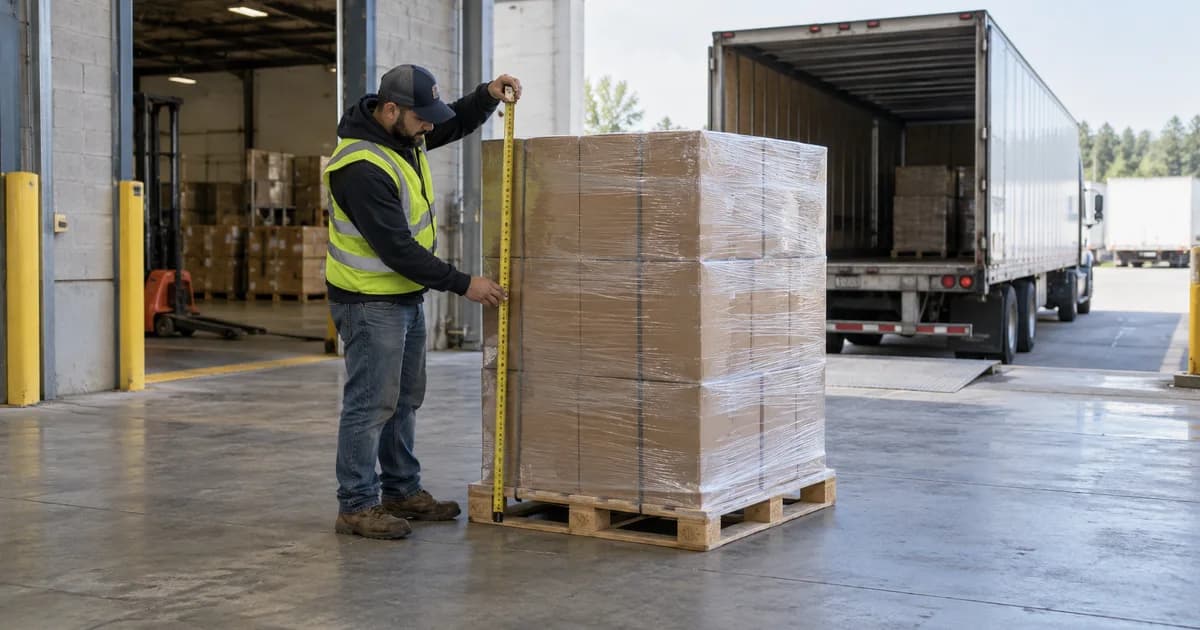
To ship a pallet, you measure and weigh it, wrap and label it, get LTL (less-than-truckload) quotes, book a pickup with a bill of lading, and track it to delivery. One to six pallets almost always ship LTL: you pay for your share of a truck that carries freight for many shippers.
The price depends on four things - distance, weight, freight class and extra services at pickup or delivery - and the freight class rules changed in July 2025, when the NMFC moved most freight to a density-based system. This guide walks through each step, explains how freight class and pricing work now, and shows how to avoid the reweigh, reclass and accessorial charges that turn a cheap quote into an expensive invoice.
Key takeaways
- LTL is the default for 1–6 pallets; bigger shipments move to volume LTL or a full truckload.
- Freight class now follows density for most goods: pounds per cubic foot, measured at the outermost points of the pallet, including overhang.
- Accessorials add up fast: a liftgate or residential delivery can cost more than $200 on its own at some carriers.
- Accurate numbers are the cheapest option: reweigh and reclass corrections are billed back to you.
- USPS doesn't ship pallet freight; pallets ship through LTL carriers such as FedEx Freight.
How to ship a pallet, step by step
Measure the loaded pallet at its outermost points - length, width and height, including the pallet and any overhang.
Weigh it, pallet and packaging included.
Wrap, strap and label the load so it holds together as one unit.
Get quotes from LTL carriers, a freight broker or an online freight marketplace, using accurate dimensions, weight, class and accessorials.
Book the shipment and prepare the bill of lading (BOL).
Hand it over - schedule a pickup, or drop the pallet at the carrier's terminal.
Track it and sign for delivery - the receiver checks the freight and notes any damage on the delivery receipt.
Step 1: Measure the pallet
Measure length, width and height at the widest and tallest points - the pallet plus anything hanging over its edges, including stretch wrap bulges. Round each measurement up to the next whole inch. Carriers measure your freight, often with automatic dimensioners at the terminal, and bill on what they find.
Step 2: Weigh it
Weigh the complete unit: product, packaging, stretch wrap and the pallet itself. A standard 48 × 40 wood pallet adds 33–48 lbs. If you don't have a floor scale, use a pallet jack scale or a certified public scale. See how much does a pallet weigh for pallet weights by type.
Step 3: Wrap, strap and label
Stack cartons square and inside the pallet's edges, stretch-wrap the load to the pallet, add corner boards and straps for heavy or tall loads, and put a label with the shipper, consignee and BOL or PRO number on at least two sides. Mark "Do not stack" only if it truly can't be stacked - it can raise the price. Full instructions: how to stack, wrap and strap a pallet.
Step 4: Get quotes
Quote the same shipment details with several options:
LTL carriers directly - FedEx Freight, Old Dominion (ODFL), Estes, XPO, Saia and regional carriers all quote online.
A freight broker - compares many carriers and books for you; useful if you ship occasionally.
An online freight marketplace or calculator - instant rates from multiple carriers.
Include every accessorial you'll need (liftgate, residential, appointment) in the quote, or it will show up on the invoice later. Get an instant quote with the Repackify freight calculator.
Step 5: Book and create the bill of lading
The BOL is the contract with the carrier and the receipt for your freight. It lists the shipper and consignee, number of handling units (pallets), weight, dimensions, freight class or NMFC item, a description of the goods and any accessorials. Errors on the BOL are the main source of billing corrections.
Step 6: Pickup or terminal drop-off
Most carriers pick up from a business dock. If you don't have a dock or forklift, request a liftgate pickup - or drive the pallet to the carrier's local terminal yourself, which avoids the pickup accessorials. Call the terminal first to confirm hours and that they accept drop-offs.
Step 7: Track and receive
Track the shipment with the PRO number the carrier assigns. At delivery, the receiver should count the pallets and inspect the wrap before signing. Any damage or shortage must be written on the delivery receipt (proof of delivery, POD); a clean signature makes a later claim much harder.
Shipping options for one or a few pallets
Option | Typical size | When it makes sense |
|---|---|---|
LTL | 1–6 pallets, up to about 12 linear feet of trailer and 10,000–15,000 lbs | The default for single pallets and small shipments |
Volume LTL / partial truckload | ~6–20 pallets, up to ~20,000 lbs | Too big for standard LTL, too small for a full truck |
Full truckload (FTL) | 20–30 pallets or most of a 53′ trailer | Large shipments, fragile freight you don't want handled at terminals |
Expedited / guaranteed LTL | Any size | Deadlines - at a premium |
Freight broker or marketplace | Any size | Comparing carriers without separate accounts |
3PL | Recurring shipments | Outsourcing warehousing and shipping together |
For how many pallets fit on a full truck and when a shipment tips from LTL to truckload, see how many pallets fit in a 53-foot trailer.
Can I ship a pallet with FedEx or UPS?
Pallets go through FedEx Freight, the LTL carrier that FedEx spun off as an independent public company on June 1, 2026 (NYSE: FDXF) - not through FedEx Ground or Express parcel service. UPS's former LTL division now operates as TForce Freight. Book either like any LTL carrier: with dimensions, weight, class and pickup details.
Does USPS ship pallets?
No. USPS doesn't offer pallet freight shipping. Pallets appear in USPS operations only for bulk mailers, who prepare large mailings on pallets for postal processing - not for shipping goods. Use an LTL carrier.
How much does it cost to ship a pallet?
There's no single price: LTL rates are quoted per shipment, and the same pallet can cost very different amounts depending on the lane, the carrier and the week. What sets the price:
Distance and lane. Cross-country costs more than regional; lanes into busy markets are often cheaper than lanes into remote areas.
Weight. LTL rates are quoted per hundredweight (cwt = 100 lbs), with a minimum charge per shipment.
Freight class. Lower class (denser freight) = lower rate per cwt.
Accessorials. Extra services at pickup or delivery, billed on top.
Fuel surcharge. A percentage added to the line-haul rate, changing weekly with diesel prices.
Timing. Guaranteed or expedited service costs more.
Accessorial charges
Accessorials are the charges most likely to surprise you. Examples from carriers' published rules tariffs (2025–2026):
Accessorial | When you need it | Example charges |
|---|---|---|
Liftgate | No dock at pickup or delivery | FedEx Freight: $13.96 per cwt, minimum $207; other carriers charge per cwt with a minimum |
Residential delivery or pickup | Home or home-based business | FedEx Freight: $243 flat; Estes: $8.50 per cwt, minimum $75 |
Limited access | Locations such as schools, construction sites or storage units - each carrier defines its own list | Flat fee - check the carrier's tariff |
Inside delivery | Freight carried past the door | Per cwt or flat fee |
Delivery appointment / notify | Receiver requires a call or time window | Flat fee |
Reweigh / reclass | The carrier finds different weight, dimensions or class | Rate correction plus an inspection fee at many carriers |
Rates change - always check the carrier's current rules tariff or ask for all-in pricing.
Example: a 400-lb pallet delivered by FedEx Freight to a home without a dock picks up the $207 liftgate minimum and the $243 residential charge - $450 before the freight itself.
How to ship a pallet across the country
Cross-country LTL moves through a chain of terminals: your pallet is picked up, sorted at the origin terminal, carried line-haul to a hub or destination terminal, then delivered locally. That means several business days in transit and several forklift handlings - so the priorities change:
Choose a carrier with its own coast-to-coast network, or one with a clear interline partner. Freight handed between carriers takes longer and is handled more.
Ask for transit time on the quote. Carriers publish transit-time maps by lane; the cheapest quote may be several days slower.
Package for handling, not just for the road. Corner boards, straps and a pallet in good condition (grade A or new) matter more over 2,000+ miles.
Get the class and dimensions right. A reclass at the destination terminal on a long-haul shipment is expensive.
Insure high-value freight. Carrier liability is limited - often by weight and class - and rarely covers the full value of goods. Buy cargo insurance for valuable shipments.
For 6+ pallets, get a volume LTL or truckload quote too. A dedicated truck can be faster and not much more expensive.
What freight class is a pallet?
A pallet doesn't have its own freight class. The class depends on what's on it - and since July 19, 2025, the National Motor Freight Classification (NMFC) classifies most freight by density, in pounds per cubic foot (pcf). The change (NMFC Docket 2025-1) created a 13-tier density scale, including two new classes: 55 (35–50 pcf) and 50 (50 pcf and over).
Density (lbs per cubic foot) | Freight class |
|---|---|
Less than 1 | 400 |
1 to less than 2 | 300 |
2 to less than 4 | 250 |
4 to less than 6 | 175 |
6 to less than 8 | 125 |
8 to less than 10 | 100 |
10 to less than 12 | 92.5 |
12 to less than 15 | 85 |
15 to less than 22.5 | 70 |
22.5 to less than 30 | 65 |
30 to less than 35 | 60 |
35 to less than 50 | 55 |
50 and over | 50 |
NMFC 13-subprovision density scale under Docket 2025-1 (NMFTA Disposition Bulletin 1371). Each range includes its lower bound ("1 but less than 2"). Some commodities keep a specific class; check the NMFC item for your product with your carrier or the NMFTA.
How to calculate it:
Multiply length × width × height in inches.
Divide by 1,728 to get cubic feet.
Divide the weight in pounds by cubic feet to get the density (pcf).
Find the class in the table.
Example: a 48 × 40 × 60 in pallet weighing 1,000 lbs. 48 × 40 × 60 = 115,200 in³ ÷ 1,728 = 66.7 ft³. 1,000 ÷ 66.7 = 15.0 pcf = class 70.
Same pallet with 1″ of overhang on every side: 50 × 42 × 60 = 126,000 in³ ÷ 1,728 = 72.9 ft³. 1,000 ÷ 72.9 = 13.7 pcf = class 85. Two inches of overhang moved it up a class - that's why you stack inside the pallet's edges.
Freight class for multiple pallets
If all pallets carry the same product, calculate density for the whole shipment (total weight ÷ total cubic feet). If they carry different products, each line on the BOL gets its own class based on its own density or NMFC item. Some carriers allow an FAK ("freight all kinds") agreement that bills mixed freight at one negotiated class - ask if you ship mixed loads regularly.
What freight class are empty pallets?
Empty pallets ship under NMFC item 150400 (pallets, platforms, skids or shipping racks, NOI), classed by density. The older material-based codes were cancelled. A stack of empty wood pallets is dense, so its class is usually low; a stack of light plastic nestable pallets will be higher. Calculate it the same way.
How to measure and weigh a pallet for shipping
Include everything: the pallet, the product, overhang, wrap bulges and anything sticking up from the top.
Measure at the outermost points and round up to the next inch.
Measure height from the floor, including the pallet's own 5–6.5″.
Weigh the whole unit on a calibrated scale.
Record it on the BOL exactly as measured.
If the carrier's numbers differ from yours, it will reweigh or reclass the shipment and bill the difference - often with an inspection fee. Carriers use dimensioners and scales at terminals, so small errors get caught. For standard pallet dimensions, see standard pallet sizes.
How to prepare a pallet for shipping
Use a sound pallet: a 48 × 40 in good condition (grade A or new for long hauls or heavy loads).
Stack cartons in a stable pattern, heaviest at the bottom, with no overhang.
Stretch-wrap the load to the pallet, not just around the cartons.
Add corner boards and straps for tall or heavy loads.
Cover or remove old labels; label the new unit on at least two sides.
Full guide: how to stack, wrap and strap a pallet.
How to build a pallet for shipping
If your goods aren't on a pallet yet, start with the right one:
Size: a standard 48 × 40 fits every LTL network and dock. Match the pallet to your carton footprint so nothing overhangs.
Condition: grade A used or new for heavy or long-haul freight; grade B works for light regional loads.
Type: block pallets allow pallet-jack entry from all four sides, which helps at docks with tight access.
Export: wood pallets must be ISPM-15 heat treated and stamped.
Need a few pallets or a truckload? Buy pallets on Repackify, including heat treated stock, with delivery - see freight and delivery.
How to ship a pallet cheaper
Ship dock to dock. Business addresses with a loading dock avoid liftgate and residential charges.
Drop it off at the terminal instead of paying for pickup.
Be flexible on dates. Guaranteed and appointment deliveries cost more.
Build dense, square pallets. No overhang, no wasted height - higher density means a lower class.
Declare accurate class, weight and dimensions to avoid reclass and reweigh fees.
Consolidate. Two pallets on one BOL usually cost less than two separate shipments.
Compare quotes from several carriers or a broker - rates for the same lane can differ a lot.
Use lighter pallets for light freight. A lighter pallet reduces billed weight; a pallet that's too weak for the load costs more in damage.
Shipping a pallet internationally
US to Canada: ships by LTL or truckload with a commercial invoice and a customs broker for clearance. Wood packaging made from continental US wood is exempt from ISPM-15 for Canada, but you need to be able to document its origin; HT pallets avoid the question.
US to Mexico: ISPM-15 treated and stamped wood packaging is required. Shipments often transfer to a Mexican carrier at the border; use a customs broker.
US to UK / EU: single pallets ship by LCL (less-than-container-load) ocean freight or air. LCL is charged by weight or measure (W/M): 1 cubic meter or 1,000 kg, whichever is greater. Wood pallets must be ISPM-15 compliant.
From China and other origins: LCL for a few pallets, a full container (FCL) for larger volumes; a freight forwarder books the ocean leg and a customs broker clears it into the US.
A freight forwarder arranges the international transport; a customs broker files the customs entry. Many companies do both. For container loads, see how many pallets fit in a shipping container, and for stamp and country rules, our ISPM-15 heat treated pallet guide.
Pallet shipping terms
Term | Meaning |
|---|---|
Pallet shipping / pallet delivery | Moving goods on pallets by freight carrier (LTL or truckload) rather than as parcels |
Handling unit | Each piece the carrier handles - usually one pallet; skids and pallets count the same |
BOL (bill of lading) | The shipping contract and receipt listing the freight, class and parties |
PRO number | The carrier's tracking number for the shipment |
POD (proof of delivery) | The signed delivery receipt; note any damage here |
Accessorial | A charge for extra service: liftgate, residential, appointment, inside delivery |
Pallet charge | A fee per pallet - used for storage (per pallet position), handling at a 3PL, or pallet exchange |
3PL pallet | A pallet stored or handled by a third-party logistics provider, usually billed per pallet per month |
FAK (freight all kinds) | A negotiated single class for mixed freight |
Freight class / NMFC | The classification that sets the rate basis, now density-based for most goods |
Cwt (hundredweight) | 100 lbs - the unit LTL rates are quoted in |
Frequently asked questions
How do I ship a pallet?
Measure and weigh the loaded pallet, wrap and label it, get LTL quotes with accurate dimensions, weight, class and accessorials, book the shipment with a bill of lading, then hand it to the carrier at pickup or its terminal and track it to delivery.
How much does it cost to ship a pallet?
It depends on distance, weight, freight class and accessorials, so get a quote for your exact shipment. Extra services add up: at FedEx Freight, a liftgate costs at least $207 and residential delivery $243. Shipping dock to dock is the cheapest.
What freight class is a pallet?
A pallet has no class of its own - the class depends on the freight's density. Since July 19, 2025, most freight is classed on a 13-tier density scale from class 400 (under 1 lb per cubic foot) to class 50 (50+ lbs per cubic foot). Empty pallets ship under NMFC 150400, also classed by density.
Can I ship a pallet with FedEx or UPS?
Through the LTL carriers linked to them: FedEx Freight (spun off from FedEx in June 2026) and TForce Freight, UPS's former LTL division. Parcel services don't take pallets.
Does USPS ship pallets?
No. USPS doesn't offer pallet freight shipping; pallets are only used by bulk mailers to prepare large mailings. Use an LTL carrier.
What is the cheapest way to ship a pallet?
LTL, dock to dock, with flexible dates, accurate class and dimensions, and quotes from several carriers or a broker. Dropping the pallet at the carrier's terminal saves the pickup charges.
How do I measure a pallet for shipping?
Measure length, width and height at the outermost points, including the pallet and any overhang, and round up to the next inch. Weigh the whole unit, pallet included.
How long does it take to ship a pallet across the country?
Cross-country LTL usually takes several business days, because freight moves through multiple terminals. Ask each carrier for the transit time on your lane; guaranteed and expedited service is faster at a higher price.