
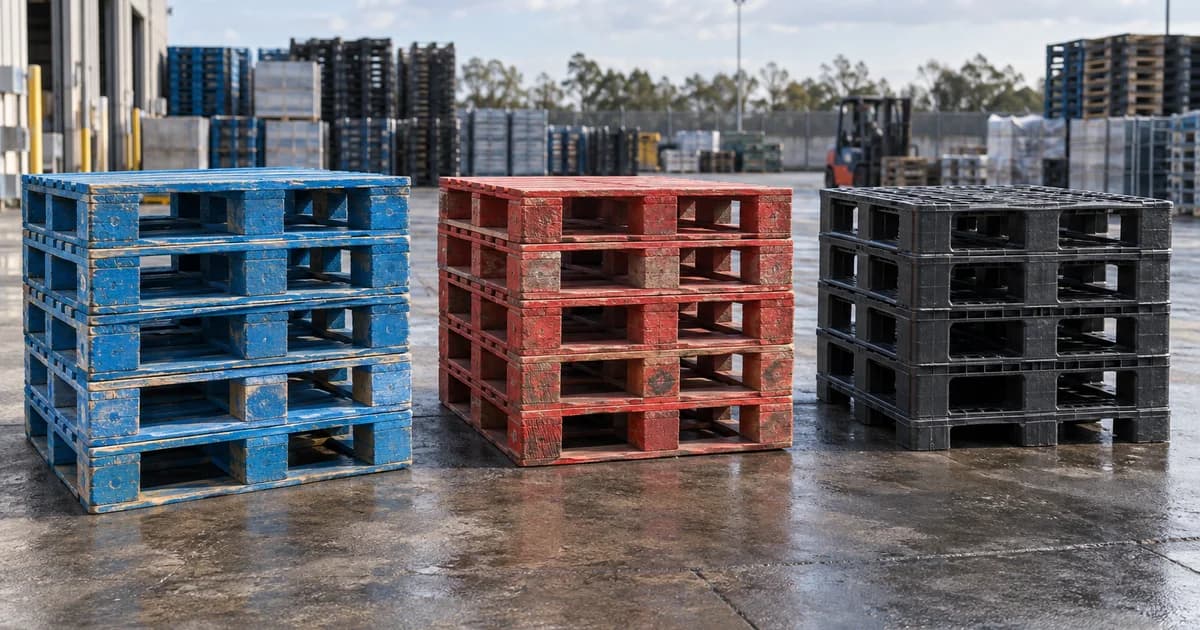
CHEP pallets are rented, not bought. CHEP owns every blue pallet, rents it to manufacturers, and collects it back from the retailers and distributors who receive the goods. You can't legally buy or sell one - if CHEP pallets end up at your dock, you return them.
The same is true of red PECO pallets and black plastic iGPS pallets. Together they make up the pallet pools that move a large share of US grocery and consumer goods. This guide explains how pooling works, what it costs the shipper, how to tell a pooled pallet from one you can sell, how to return them - and when buying your own white wood pallets is the better deal.
Key takeaways
- Blue = CHEP, red = PECO, black plastic = iGPS. All three are rental pools; the pallets stay the pooler's property wherever they end up.
- Manufacturers rent, retailers receive, the pooler collects. Fees are charged to the renter per issue, per day and on transfer - actual rates are negotiated.
- You can't sell pooled pallets. In California, junk dealers and recyclers may not buy marked pallets from anyone but the owner (Bus. & Prof. Code § 21609.7).
- Return, don't resell: CHEP recovers its pallets through its own network and recycler partners; PECO collects full loads; iGPS takes pickup requests online.
- White wood pallets are the alternative when you ship one-way, export, run a closed loop or don't have a retailer requiring pooled pallets.
How do CHEP pallets work?
CHEP runs a rental pool. It issues pallets to a manufacturer, the manufacturer ships product on them to a retailer or distributor, and CHEP collects the empty pallets from there, inspects and repairs them at a service center, and issues them again. The manufacturer pays for the time the pallets are in its account; it never owns them.
The cycle, step by step:
Issue. CHEP delivers pallets from a service center to the manufacturer. The pallets now sit in the manufacturer's account.
Load and ship. The manufacturer ships product on CHEP pallets to a retailer or distributor that participates in the CHEP program.
Transfer. The manufacturer declares the shipment to CHEP, which moves the pallets from its account to the receiver's (or ends its responsibility for them). Pallets that are never declared keep costing the manufacturer.
Collection. When the retailer's DC unloads the product, it stacks the empty pallets for CHEP pickup.
Repair and reissue. CHEP inspects, repairs and returns the pallets to the pool.
The model works because the same pallet makes many trips, and the pooler - not each shipper - carries the cost of owning, tracking and repairing it. It breaks down when pallets leak out of the loop: to a recycler, a small customer outside the program, a yard behind a store.
CHEP is part of Brambles, the Australian logistics company. The pool began in 1946, when the Australian government set up the Commonwealth Handling Equipment Pool using equipment left by the US military; Brambles bought it in 1958 and launched CHEP USA in September 1990. Brambles reports 348 million assets - pallets, crates and containers - shared and reused in its global pool (FY2025 annual report). For the full history, see the history and evolution of pallet pooling.
What pallet pooling costs
Pooling fees are negotiated between the pooler and each customer, and neither CHEP nor PECO publishes a price list. The structure is similar across poolers:
Fee | What it covers | Industry estimates* |
|---|---|---|
Issue fee | Each pallet delivered to you | ~$3–5 per pallet |
Daily hire | Each day a pallet is in your account | ~$0.035–0.20 per pallet per day |
Transfer fee | Moving pallets out of your account when you ship them on | ~$1–3.50 per pallet |
Lost pallet fee | Pallets that can't be accounted for | ~$50–55 per pallet |
\*Estimates vary widely between sources and contracts; use them only for a rough comparison and get an actual quote.
Example - 1,000 pallets a month. If each pallet sits in your account for 20 days and ships to a participating retailer, one trip costs roughly:
Low end: $3 issue + 20 × $0.035 hire + $1 transfer ≈ $4.70 per pallet
High end: $5 issue + 20 × $0.20 hire + $3.50 transfer ≈ $12.50 per pallet
That's roughly $4,700–12,500 a month - before any lost-pallet charges. The two biggest levers are days in account (ship fast, declare transfers promptly) and losses (pallets that go to receivers outside the pool).
For comparison, the Repackify pallet price index on October 1, 2026 showed average listings of $6.00 for a used grade B 48 × 40, $7.90 for grade A and $18.81 for new. More on the trade-off below.
Who owns blue pallets?
CHEP (Brambles) owns blue pallets. CHEP's blue is a registered trademark, and its pallets carry the CHEP logo, "Property of CHEP" markings and unique IDs. Red pallets belong to PECO; black plastic pallets with RFID tags belong to iGPS.
CHEP | PECO | iGPS | |
|---|---|---|---|
Color | Blue | Red | Black |
Material and design | Wood (kiln-dried Southern Yellow Pine), block, 4-way | Wood, block, 4-way | HDPE plastic, 4-way |
Size | 48 × 40 in | 48 × 40 in | 48 × 40 in |
Height | 5.6″ | 5.56″ | - |
Rack load | 2,800 lbs | 2,800 lbs (edge-racked) | 2,800 lbs |
Empty weight | Not published by CHEP | 65–68 lbs | Under 50 lbs |
Markings / tracking | Blue trademark, logo, "Property of CHEP", unique IDs; RFID / BLE trackers | Red paint, PECO markings | RFID tags |
Return pickup | Through CHEP (see below) | Online request once a full load has accumulated | Online pickup request; no minimum published |
For weights and load ratings in detail, see how much does a CHEP pallet weigh.
Who owns red pallets?
PECO Pallet owns red pallets. Like CHEP, PECO rents its pallets to manufacturers and collects them from retailers; the pallets remain PECO's property. PECO's 48 × 40 is a wood block pallet weighing 65–68 lbs.
What about black plastic pallets?
Black plastic pallets with embedded RFID tags are usually iGPS pallets - a pool of plastic pallets rented on the same principle. They're lighter than pooled wood (under 50 lbs) and rated for 2,800 lbs in a rack.
What are CHEP pallets made of, and how big are they?
A US CHEP pallet is a 48 × 40 inch block pallet made of kiln-dried Southern Yellow Pine, 5.6 inches tall, with four-way forklift entry. It's rated for 2,800 lbs in a rack and 10,000 lbs block-stacked on the floor.
Are all blue pallets CHEP?
Most blue 48 × 40 block pallets in US grocery and retail supply chains are CHEP - but don't go by color alone. Check the markings before you decide what to do with them:
CHEP markings: the CHEP name or logo, "Property of CHEP" branding and a unique ID on the blocks or boards.
Design: CHEP's US pallet is a 48 × 40 block pallet, not a stringer pallet.
Paint: CHEP blue is a specific trademarked color, applied to the whole pallet - not a stripe or partial paint.
If it has CHEP markings, it's CHEP's - no matter where you found it or how worn it is. The same logic applies to red PECO pallets and black iGPS pallets. If a blue or red pallet has no pooler markings at all, it may be a company-owned pallet; the owner's name is usually stenciled on it.
Can you sell CHEP pallets?
No. CHEP pallets remain CHEP's property wherever they are, so selling, buying, repairing for resale, dismantling or grinding them means dealing in someone else's property. The poolers enforce this: CHEP has taken pallet companies to court over pooled pallets - for example, in CHEP USA v. SCC Pallets (E.D. Cal., No. 2:24-cv-02121), where on September 21, 2026 the court granted CHEP's motion to dismiss SCC's counterclaims.
Some states write it into law. In California, Business and Professions Code § 21609.7 prohibits junk dealers and recyclers from buying or receiving pallets marked with an "indicia of ownership" - an owner's name, logo or trademark - from anyone other than the owner.
So who buys blue pallets? Legitimately, nobody - except CHEP itself, through its recovery program. How much are blue pallets worth to you? What CHEP pays to recover them (below), not a resale price.
Is taking pallets illegal?
Taking pallets that don't belong to you can be theft, even if they look abandoned behind a store. Pallets stacked outside a retailer are usually waiting for pickup by the pooler or a recycler under contract. Pooled pallets are marked property of their owner, and some states specifically regulate dealing in marked pallets. Ask the business before taking any pallets, and leave blue, red and black pooled pallets alone.
Does CHEP pay for returned pallets?
There's no public price list. CHEP runs an Asset Recovery Program (ARP) with pallet recyclers, which collect CHEP pallets and hand them back to CHEP. Compensation terms are set in CHEP's agreements with recyclers and aren't published - recyclers should contact CHEP directly.
If you're a warehouse or retailer with CHEP pallets that aren't part of a regular pickup, contact CHEP to arrange collection. The recovery payments go to recyclers and pallet companies in the program; the point for everyone else is to get the pallets back into the pool.
How to return CHEP, PECO and iGPS pallets
Sort them out. Pull all pooled pallets - blue, red, black plastic - out of your own stock and stack them separately by pooler.
Count them. Poolers schedule pickups by volume.
Contact the owner:
CHEP: contact CHEP through its US website or customer service to report the pallets and arrange collection.
PECO: request a pickup through PECO's website once you've accumulated a full load.
iGPS: request a pickup through iGPS's website with the number of pallets you have; iGPS doesn't publish a minimum, so confirm it when they contact you.
Keep them dry and accessible for forklift loading until pickup.
Don't mix them into loads you sell or recycle. A recycler shouldn't take them, and in some states can't.
Recyclers that collect pooled pallets from customers can return them through CHEP's ARP. For everything else - your own white wood pallets, broken or odd sizes - use a recycler: recycle pallets, or see our pallet recycling guide.
How does pallet exchange work?
Pallet exchange is a one-for-one swap at the dock: the carrier or shipper delivers a load on 20 pallets and takes 20 empty pallets back from the receiver. The exchange is noted on the shipping paperwork, so the carrier, shipper and receiver know who owes how many pallets.
The problem is quality. Everyone in an exchange has a reason to send out their worst pallets and keep the best. That's what happened to the grocery industry's GMA exchange pool: through the 1970s pallets were built thinner and from lower-grade wood, the pool degraded, and an attempt by the NWPCA to organize a Grocery Pallet Council failed in the early 1980s. CHEP entered the US in 1990 into exactly that gap - offering a pallet that someone owned, maintained and tracked.
Exchange still exists, especially in LTL and regional delivery, but many shippers and carriers avoid it: drivers wait at the dock, counts get disputed, and the returned pallets are often worth less than the ones delivered. Alternatives are pooling, one-way white wood pallets, or drop-trailer programs where a recycler leaves a trailer on site and hauls pallets away when it's full - see how pallet drop-trailer programs work.
Pooling vs. buying white wood pallets
Pooling isn't automatically cheaper or more expensive than buying your own pallets - it depends on how your pallets travel.
Pooled (CHEP/PECO/iGPS) | Buy used white wood (grade A/B) | Buy new white wood | |
|---|---|---|---|
Cost per trip | ~$4.70–12.50 (estimate, see above) | $6.00–7.90 average listing, once | $18.81 average listing, once |
After the trip | Pooler collects | Yours - reuse, resell or recycle | Yours - reuse, resell or recycle |
Quality | Consistent block pallet | Varies by grade | Consistent, built to spec |
Paperwork | Transfer declarations, account reconciliation | None | None |
Risk | Lost-pallet charges | Pallet may not come back | Pallet may not come back |
Export | Check the pooler's rules before exporting | Buy ISPM-15 HT stock | Buy ISPM-15 HT stock |
White wood prices: Repackify price index, October 1, 2026, average single-pallet listings for 48 × 40. Truckload pricing is usually lower per pallet.
Pooling usually makes sense when:
your customers are large retailers or grocery chains that require or prefer pooled pallets;
you ship high volumes into DCs that participate in the pool;
you want consistent block pallets without managing your own inventory.
Buying white wood usually makes sense when:
shipments are one-way to receivers outside the pool (small retailers, e-commerce, industrial customers);
you run a closed loop between your own sites and can reuse your pallets many times;
you export - buy ISPM-15 heat treated pallets for international lanes (see our ISPM-15 guide);
your volumes are small or irregular, so daily hire and account management outweigh the savings.
Many shippers use both: pooled pallets for their big retail accounts, white wood for everything else. Setting up a pool of your own? See our pallet pooling setup guide.
Buying white wood? Buy new and used pallets from vetted suppliers and check current prices on the pallet price index. Have surplus white wood pallets? Sell them.
Do CHEP pallets have trackers?
Some do. CHEP uses RFID and Bluetooth Low Energy (BLE) trackers to follow pallets and loads through its network, and each pallet carries a unique ID. iGPS plastic pallets have RFID tags built in. Tracking helps poolers find where pallets pile up or leak out of the loop - one more reason not to treat pooled pallets as your own.
Pools are also managing supply more actively: Brambles management has discussed roughly 4 million surplus pallets in the US pool, a sharp change from the pallet shortages of the pandemic years.
Frequently asked questions
How do CHEP pallets work?
CHEP rents pallets to manufacturers, which ship products on them to retailers and distributors. CHEP then collects the empty pallets, repairs them and issues them again. The manufacturer pays fees for the time pallets are in its account but never owns them.
Are all blue pallets CHEP?
Most blue 48 × 40 block pallets in US retail supply chains are CHEP, but not all. Look for the CHEP logo, "Property of CHEP" markings and a unique ID. Don't go by color alone - if there are no CHEP markings, look for another owner's name.
Who owns blue pallets?
CHEP, part of the Australian company Brambles. Blue CHEP pallets remain CHEP's property wherever they are. Red pallets belong to PECO, and black plastic pallets usually belong to iGPS.
Can I sell CHEP pallets?
No. CHEP pallets are CHEP's property, so selling, buying, repairing for resale or scrapping them isn't legal. In California, junk dealers and recyclers are prohibited from buying marked pallets from anyone other than the owner. Return them to CHEP instead.
Does CHEP pay for returned pallets?
CHEP works with pallet recyclers through its Asset Recovery Program; the compensation terms aren't published. Businesses that simply hold CHEP pallets should contact CHEP to have them collected.
Where can I buy CHEP pallets?
You can't - CHEP doesn't sell its pallets; it rents them. If you need pallets you own, buy new or used white wood 48 × 40 pallets, including block pallets, from pallet suppliers.
What is a PECO pallet?
A PECO pallet is a red wood block pallet rented by PECO Pallet, a pooling company that works like CHEP. The standard 48 × 40 PECO pallet weighs 65–68 lbs and remains PECO's property.
Are CHEP pallets heat treated?
Not all of them. CHEP says its pallets can be heat treated - HT is available, not standard for the whole pool. For export, ask CHEP for ISPM-15-compliant pallets and check the stamp. See our ISPM-15 heat treated pallet guide.