
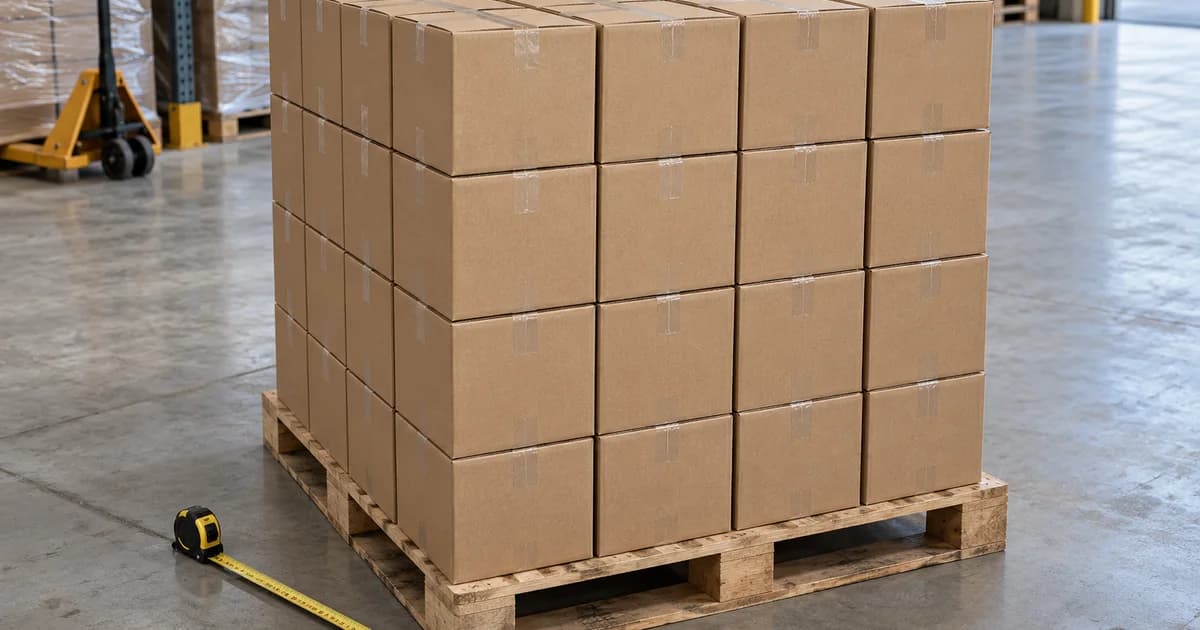
It depends on the box size and how high you can stack. A standard 48 × 40 pallet loaded to 60″ tall - pallet included - takes up about 66.7 cubic feet (1.89 CBM). With 12 × 12 × 12 in boxes, that's 12 boxes per layer and 4 layers: 48 boxes; at 72″, 5 layers and 60 boxes.
The method is always the same: work out how many boxes fit in one layer, how many layers fit under your height limit, then check the weight. This guide walks through it with a ready-made table for common box sizes, explains ti-hi and pallet count, and shows how to calculate a pallet's cubic feet and CBM.
How many boxes fit on a pallet?
Three steps:
Boxes per layer. Fit the box footprint onto the pallet deck (48 × 40 for a standard pallet), trying both orientations - and a mix of the two, which often fits one or two more boxes. No box should hang over the edge.
Number of layers. Subtract the pallet's height (about 5–6″ for a 48 × 40) from your maximum load height, divide by the box height and round down.
Weight check. Boxes × box weight + the pallet (33–48 lbs for wood) must stay within the pallet's rating, the carrier's limits and the receiver's limits.
Boxes per pallet = boxes per layer × layers - if the weight allows it.
Cheat sheet: boxes on a 48 × 40 pallet
Box size (L × W × H, in) | Per layer | Layers at 60″ | Boxes at 60″ | Layers at 72″ | Boxes at 72″ |
|---|---|---|---|---|---|
12 × 12 × 12 | 12 | 4 | 48 | 5 | 60 |
16 × 12 × 12 | 10 | 4 | 40 | 5 | 50 |
18 × 12 × 12 | 8 | 4 | 32 | 5 | 40 |
18 × 14 × 12 | 6 | 4 | 24 | 5 | 30 |
20 × 20 × 20 | 4 | 2 | 8 | 3 | 12 |
24 × 16 × 12 | 5 | 4 | 20 | 5 | 25 |
24 × 18 × 18 | 4 | 3 | 12 | 3 | 12 |
Bankers Box 703 (16.3 × 12.5 × 10.5 outside) | 8 | 5 | 40 | 6 | 48 |
14 × 10 × 5 (shoe-box size) | 13 | 10 | 130 | 13 | 169 |
*Assumes a 5.5″ pallet, no overhang, and mixed orientation where it adds boxes. Max height includes the pallet. Always use the box's outside dimensions - a Bankers Box 703 is 12 × 15 × 10″ inside but 12.5 × 16.3 × 10.5″ outside.*
Mixed orientation is why a 16 × 12 box gets 10 per layer instead of 9: six boxes run one way across 48 × 24″ of the deck, and four boxes run the other way in the remaining 48 × 16″. A calculator checks all the combinations for you.
For specific products - cases of beverages, bags of concrete, bricks - use the manufacturer's ti-hi; it reflects the product's weight and how it's actually stacked.
What is ti-hi?
Ti-hi (also "tie-high") describes how cases are stacked on a pallet: ti is the number of cases per layer (tier), hi is the number of layers high. A ti-hi of 10 × 6 means 10 cases per layer, 6 layers: 60 cases per pallet.
Manufacturers and retailers publish a ti-hi for each item, so every pallet of that product is built the same way and fits the receiver's racking and height limits. When a supplier's spec says "Ti: 12, Hi: 5," expect 60 cases per full pallet.
Stacking patterns: column vs. interlocking
Column stacking - every box directly on top of the one below, corner on corner. It keeps the boxes' full compression strength, which matters for heavy loads and double-stacked pallets.
Interlocking (brick) stacking - each layer rotated or offset so boxes bridge the seams below. It's more stable, but reduces stacking strength - by more than 10% in Virginia Tech tests and by up to 50% according to the Fibre Box Association.
Pinwheel - boxes arranged around the center and rotated each layer; useful when the box doesn't divide the deck evenly.
The pattern doesn't change the number of boxes per layer much, but it changes how strong and stable the load is. Step-by-step stacking, wrapping and strapping: how to stack, wrap and strap a pallet.
Why overhang costs you
Squeezing in extra boxes by letting them hang over the pallet's edge backfires twice:
Weaker boxes. As little as ½ inch of overhang can cost a box up to 30% of its compression strength (Fibre Box Association), because its corners - where most of its strength is - hang unsupported.
Higher freight class. LTL carriers measure your pallet at its outermost points. Overhang adds cubic feet without adding weight, so density drops and the class goes up. A 1,000-lb, 48 × 40 × 60″ pallet is class 70; the same pallet with 1″ of overhang on every side becomes class 85. See how to ship a pallet for the freight class table.
If your boxes don't fit the pallet well, change the box size or the pallet size - not the overhang.
How many cubic feet is a pallet?
A standard 48 × 40 pallet loaded to 60″ tall is 66.7 cubic feet; at 48″ it's 53.3 ft³, and at 72″, 80 ft³. The formula: length × width × height in inches ÷ 1,728, where height includes the pallet and all dimensions are taken at the outermost points.
Pallet | 48″ tall | 60″ tall | 72″ tall | 96″ tall |
|---|---|---|---|---|
48 × 40 (standard) | 53.3 ft³ | 66.7 ft³ | 80.0 ft³ | 106.7 ft³ |
48 × 48 | 64.0 ft³ | 80.0 ft³ | 96.0 ft³ | 128.0 ft³ |
42 × 42 | 49.0 ft³ | 61.3 ft³ | 73.5 ft³ | 98.0 ft³ |
EUR 1200 × 800 mm (47.2 × 31.5 in) | 41.3 ft³ | 51.7 ft³ | 62.0 ft³ | 82.7 ft³ |
Example: 48 × 40 × 60 = 115,200 cubic inches ÷ 1,728 = 66.7 ft³.
Carriers use this number, with the weight, to calculate density and freight class - so measure the real load, overhang included.
How many CBM is a pallet?
A standard 48 × 40 pallet loaded to 60″ is about 1.89 cubic meters (CBM). The formula: length × width × height in meters - or, from inches, L × W × H × 0.0000164.
Pallet | 48″ (1.22 m) | 60″ (1.52 m) | 72″ (1.83 m) | 96″ (2.44 m) |
|---|---|---|---|---|
48 × 40 (1.219 × 1.016 m) | 1.51 m³ | 1.89 m³ | 2.27 m³ | 3.02 m³ |
48 × 48 (1.219 × 1.219 m) | 1.81 m³ | 2.27 m³ | 2.72 m³ | 3.62 m³ |
42 × 42 (1.067 × 1.067 m) | 1.39 m³ | 1.73 m³ | 2.08 m³ | 2.78 m³ |
EUR (1.2 × 0.8 m) | 1.17 m³ | 1.46 m³ | 1.76 m³ | 2.34 m³ |
CBM matters most for ocean freight. LCL (less-than-container-load) shipments are charged by weight or measure (W/M) - per cubic meter or per 1,000 kg, whichever is greater - so a 60″ pallet of light goods is billed as about 1.9 CBM, no matter how much empty space is inside the cartons. For full containers, see how many pallets fit in a shipping container.
How much space does a pallet take up?
On the floor: a 48 × 40 pallet covers 1,920 square inches - 13.3 square feet (1.24 m²). In practice it uses more, because pallets need gaps and aisles for forklifts.
In a warehouse: space is counted in pallet positions - one pallet-sized slot on the floor or in a rack. Third-party warehouses bill storage per pallet position per month, not per cubic foot: about $20.17 per pallet position per month on average in 2025, with most warehouses charging $18–25 and climate-controlled space $25–50.
That's why a half-empty pallet costs as much to store as a full one - building full, tall pallets within the height limit saves storage money.
For every pallet footprint, see standard pallet sizes and dimensions.
What is pallet count?
"Pallet count" means two different things:
The number of pallets in a shipment. On a bill of lading (such as the standard VICS BOL), this is the number of handling units - "4 pallets" - that the carrier picks up and delivers. It's what the driver counts and signs for.
The number of units on one pallet. In a product spec or warehouse system, pallet count (or case count) is how many cases or items make up a full pallet - for example, 60 cases per pallet for a ti-hi of 10 × 6.
When a supplier quotes "pallet count 60," they mean the second; when a carrier asks for the pallet count, they mean the first.
How many is a pallet?
A "pallet" of product isn't a fixed quantity - it's whatever that product's ti-hi gives. A pallet of 12 × 12 × 12 boxes stacked to 60″ is 48 boxes; a pallet of shoe-box-sized cartons can be well over 100. Ask the supplier for the pallet count or ti-hi of the specific item.
How to count boxes on a pallet
Count one layer - that's the ti.
Count the layers - that's the hi.
Multiply ti × hi, then subtract any gaps in a partial top layer.
Compare with the paperwork - the ASN (advance ship notice) or packing slip.
If the count doesn't match, or the wrap is torn and the pattern disturbed, count by hand before signing the delivery receipt - and note any shortage on it. Hidden gaps inside the load can't be seen from the outside, so partial pallets should be recounted.
Weight check: the limit you hit before height
Heavy boxes often fill a pallet's weight limit long before its height limit. Check:
The pallet's rating. A standard 48 × 40 wood pallet is typically rated about 2,500 lbs dynamic (on a forklift) and 2,000–2,500 lbs in a rack. See pallet weight and load capacity.
The receiver's limits. Amazon: 72″ and 1,500 lbs; Walmart: 72″ and 2,100 lbs; Costco: 58″ and 2,500 lbs.
The carrier and trailer. Total weight counts toward the truck's payload.
Example: 50-lb boxes, 12 × 12 × 12, 12 per layer. Five layers (72″) = 60 boxes = 3,000 lbs - over a wood pallet's dynamic rating and every retailer's limit. Four layers = 2,400 lbs, still too heavy for Amazon or Walmart. For a 1,500-lb Amazon limit, stop at 2 layers (24 boxes, 1,200 lbs + pallet).
Once your pallets are built, see how many fit on a truck with the pallet loading calculator. Need pallets to build them on? Buy 48 × 40 pallets - grade A, new or heat treated for export.
Frequently asked questions
How many boxes fit on a pallet?
It depends on box size and height. On a standard 48 × 40 pallet stacked to 60″, 12 × 12 × 12 boxes fit 12 per layer and 4 layers high - 48 boxes. Multiply boxes per layer by the number of layers, then check the weight.
How many cases on a pallet?
Cases per layer (ti) × layers (hi). Suppliers publish a ti-hi for each product - for example, 10 × 6 = 60 cases per pallet.
How many cubic feet is a standard pallet?
A 48 × 40 pallet loaded to 60″ is 66.7 cubic feet; at 48″ it's 53.3 ft³ and at 72″ it's 80 ft³. Use L × W × H in inches ÷ 1,728, including the pallet's height.
How many CBM is a pallet?
A 48 × 40 pallet loaded to 60″ is about 1.89 CBM; at 48″, about 1.51 CBM. A euro pallet at 60″ is about 1.46 CBM.
What does ti-hi mean?
Ti is the number of cases per layer, hi is the number of layers. A ti-hi of 12 × 5 means 12 cases per layer, 5 layers high - 60 cases per pallet.
What is pallet count?
Either the number of pallets (handling units) in a shipment, as on a bill of lading, or the number of cases or units on one full pallet, as in a supplier's product spec.
How tall can I stack boxes on a pallet?
Usually 48–60″ including the pallet for LTL freight. Amazon and Walmart accept up to 72″, Costco 58″. Stay within the box strength and the pallet's weight rating too.
Can boxes hang over the edge of a pallet?
They shouldn't. Even ½ inch of overhang can cost a box up to 30% of its compression strength, and carriers measure overhang, which can raise your freight class.