
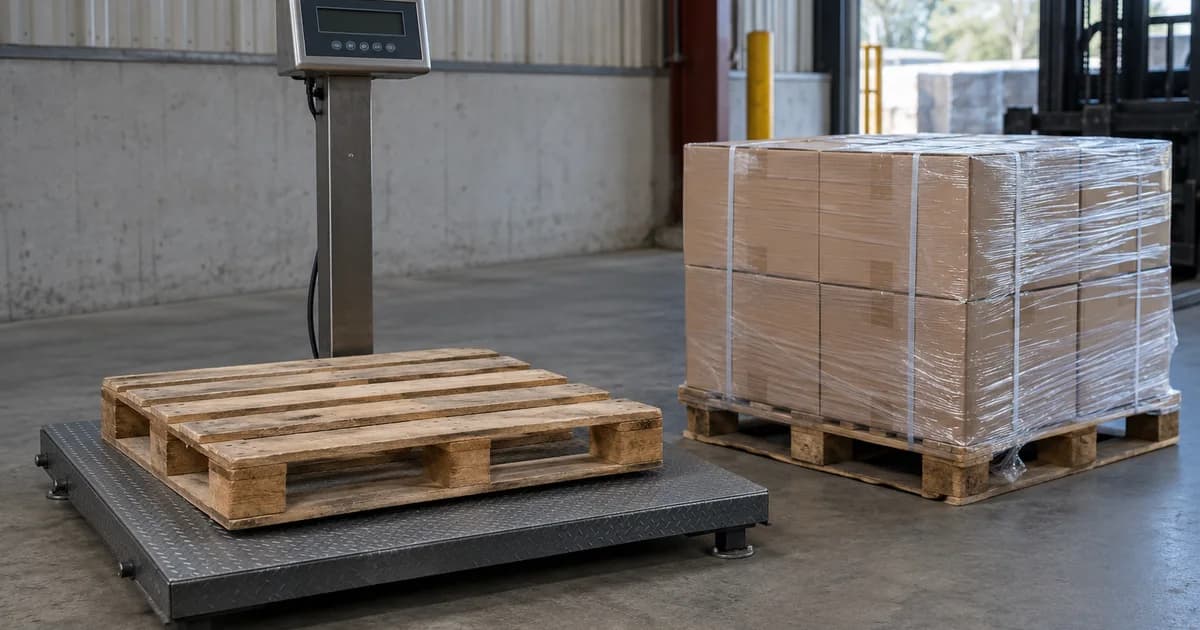
A standard 48 × 40 wood pallet weighs about 33–48 lbs (15–22 kg) empty - softwood pallets at the low end, hardwood at the high end. A new one is typically rated for about 4,600 lbs sitting on the floor, 2,500 lbs on a forklift and 2,000–2,500 lbs spanning rack beams. The exact numbers depend on wood species, grade and how the load is spread across the deck.
This guide gives you empty weights for every common pallet type (wood, block, CHEP, PECO, plastic, EUR, presswood) in pounds and kilograms, explains the three load ratings and why they differ, and shows how to check whether a pallet will hold your load before it fails on a forklift or in a rack.
Key takeaways
- Empty weight, 48 × 40 wood: 33–40 lbs (15–18 kg) for new softwood, 40–48 lbs (18–22 kg) for new hardwood, 30–48 lbs for recycled.
- Load capacity, new 48 × 40 stringer pallet: ~4,600 lbs static, ~2,500 lbs dynamic, ~2,000–2,500 lbs racked.
- Pooled block pallets are heavier: PECO's 48 × 40 weighs 65–68 lbs; iGPS plastic pallets weigh under 50 lbs.
- Plastic ranges widely: light nestable export pallets weigh 10–15 lbs; rackable models run about 40–55 lbs and can out-carry wood.
- The racked rating is the one that fails dramatically. If you only remember one number, remember that one.
33–48 lbs | ~4,600 lbs | ~2,500 lbs | ~2,000–2,500 lbs |
|---|---|---|---|
Empty weight, new 48 × 40 wood | Static load (on the floor) | Dynamic load (on a forklift) | Racked load (across beams) |
How much does a pallet weigh?
An empty 48 × 40 wood pallet - the standard size in the US - weighs 33 to 48 lbs. New pallets built from softwood such as Southern Yellow Pine weigh about 33–40 lbs (15–18 kg). Hardwood versions in oak or mixed hardwood weigh about 40–48 lbs (18–22 kg). Most new pallets today are softwood: 81% of the lumber used in new US pallets in 2021 was softwood, up from 55% in 2016 (Virginia Tech study published in BioResources, 2025).
Used pallets fall in a similar 30–48 lb range. A recycled Grade A pallet averages around 38–42 lbs. Two things move the number: moisture (a pallet left in the rain can gain several pounds) and repairs (companion stringers and replaced boards add wood).
Empty pallet weight by type (lbs and kg)
Pallet type | Footprint | Empty weight | Notes |
|---|---|---|---|
Wood 48 × 40 stringer, new softwood | 48″ × 40″ | 33–40 lbs (15–18 kg) | Southern Yellow Pine, SPF |
Wood 48 × 40 stringer, new hardwood | 48″ × 40″ | 40–48 lbs (18–22 kg) | Oak, mixed hardwood |
Wood 48 × 40 stringer, recycled Grade A/B | 48″ × 40″ | 30–48 lbs (13–22 kg) | Grade A averages 38–42 lbs |
Wood 42 × 42 stringer, new | 42″ × 42″ | ~36 lbs (~16 kg) | Paint, telecom, chemicals |
Wood 48 × 48 stringer, new | 48″ × 48″ | ~37 lbs (~17 kg) | Light-duty; drum pallets are built heavier |
Wood 36 × 36 stringer, new | 36″ × 36″ | ~32 lbs (~15 kg) | Beverage |
PECO 48 × 40 block (red) | 48″ × 40″ | 65–68 lbs (29.5–30.8 kg) | Pooled, rented |
CHEP 48 × 40 block (blue) | 48″ × 40″ | Not published by CHEP | Comparable to PECO |
iGPS 48 × 40 plastic | 48″ × 40″ | Under 50 lbs (under 23 kg) | Pooled, RFID-tagged |
EUR / EPAL 1 | 1200 × 800 mm | ~25 kg (~55 lbs) | European standard |
Plastic, nestable (export) | 48″ × 40″ | 10–15 lbs (4.5–7 kg), up to ~30 lbs | Not for racking |
Plastic, rackable | 48″ × 40″ | 40–55 lbs (18–25 kg) | Some lightweight rackables weigh 21–22 lbs |
Presswood (Litco Inca), medium to extra-heavy | 48″ × 40″ | 34–41 lbs (15–19 kg) | Nestable, ISPM-15 exempt |
Sources: manufacturer and pooler spec sheets (PECO, iGPS, Litco, Kamps, CABKA), EPAL. Weights are typical; your supplier's spec sheet is the final word.
Sizes are written stringer length first, so a 40 × 48 pallet is the same footprint as a 48 × 40 and weighs the same. For every common footprint, see our standard pallet sizes guide.
How much does a CHEP, PECO or iGPS pallet weigh?
Pooled pallets - the blue, red and black pallets you rent rather than buy - are heavier or lighter than a standard stringer pallet depending on material:
Pooled pallet | Material and construction | Empty weight | Height | Rack load |
|---|---|---|---|---|
CHEP 48 × 40 (blue) | Kiln-dried Southern Yellow Pine, block, 4-way | Not published | 5.6″ | 2,800 lbs |
PECO 48 × 40 (red) | Wood, block, 4-way | 65–68 lbs | 5.56″ | 2,800 lbs (edge-racked) |
iGPS 48 × 40 (black) | HDPE plastic, 4-way, RFID | Under 50 lbs | - | 2,800 lbs |
Wood block pallets weigh more than stringer pallets because they use nine solid blocks and full top and bottom decks instead of three stringers. CHEP doesn't publish an empty weight because it varies with moisture content; plan on something close to PECO's 65–68 lbs.
These pallets belong to the pooling company, not to whoever has them on the dock. For how pooling works and what to do with pallets you don't own, see how CHEP pallet pooling works.
How much does a plastic pallet weigh?
It depends on the job the pallet was built for. Nestable export pallets - light, one-way pallets that stack inside each other - weigh as little as 10–15 lbs. Rackable plastic pallets, reinforced to span rack beams, typically weigh 40–55 lbs, though some engineered designs get down to about 21–22 lbs. Heavy-duty closed-loop pallets like iGPS sit just under 50 lbs. For a full comparison, read wood vs. plastic pallets and our plastic pallets buying guide.
Pallet weight in kg
Pallet | Empty weight (kg) |
|---|---|
48 × 40 wood stringer, new | 15–22 kg |
48 × 40 wood stringer, recycled | 13–22 kg |
PECO 48 × 40 block | 29.5–30.8 kg |
EUR / EPAL 1 (1200 × 800 mm) | ~25 kg |
iGPS 48 × 40 plastic | under 23 kg |
Plastic nestable | 4.5–7 kg |
The three load ratings, explained
Every pallet has three load capacities, because the pallet is stressed differently in each situation:
Rating | What it means | When it applies | What happens if you exceed it |
|---|---|---|---|
Static load | Maximum weight while the pallet sits still on a flat, level floor | Floor storage, block stacking | Deckboards crush, the pallet compresses or splinters |
Dynamic load | Maximum weight while the pallet is moved by forklift, pallet jack or conveyor | Docks, in-warehouse moves, truck loading | Stringers crack mid-lift, boards pop, the load shifts |
Racked load | Maximum weight when the pallet spans two rack beams with nothing under the middle | Selective, drive-in and push-back racking | The pallet sags or breaks between beams and the load falls from height |
The order is consistent across construction types: static > dynamic > racked. On the floor, the whole bottom deck is supported. On forks, the load bears on two narrow points and moves. In a rack, only the edges rest on beams while the middle spans open air - the pallet is in bending, which is where wood is weakest.
Rated vs. tested capacity
The capacity number on a spec sheet comes from one of two places.
Rated capacity is calculated. Most US wood pallets are designed with the NWPCA's Pallet Design System (PDS), engineering software that predicts how a given combination of wood, fasteners and dimensions will perform - without building and breaking samples.
Tested capacity comes from physically loading pallets to failure, following ASTM D1185 or Virginia Tech's FasTrack simulation of real handling. In the ASTM rack test, a pallet fails if it sags more than 1.9% of the span after a sustained load - about 0.68 inches across a 36-inch rack opening (Virginia Tech Center for Unit Load Design).
When you compare quotes, ask which one you're looking at. A PDS rating for new hardwood and a "typical" number from a website aren't the same thing, and neither describes a pallet that has been through five trips and two repairs.
How much weight can a pallet hold?
A new standard 48 × 40 wood pallet can typically hold about 4,600 lbs on the floor, 2,500 lbs on a forklift and 2,000–2,500 lbs across rack beams. Block pallets and reinforced plastic pallets carry considerably more; light nestable plastic and presswood pallets carry less.
Pallet type | Static | Dynamic | Racked | Basis |
|---|---|---|---|---|
Wood 48 × 40 stringer (GMA), new | ~4,600 lbs (2,090 kg) | ~2,500 lbs (1,130 kg) | ~2,000–2,500 lbs | Typical manufacturer rating (Kamps); no single industry standard |
CHEP 48 × 40 block | 10,000 lbs (block-stacked up to 5 high) | - | 2,800 lbs | CHEP North America spec |
PECO 48 × 40 block | - | - | 2,800 lbs (edge-racked) | PECO spec |
iGPS 48 × 40 plastic | 30,000 lbs | 5,000 lbs | 2,800 lbs | iGPS spec |
EUR / EPAL 1 | 4,000 kg (8,800 lbs); up to 5,500 kg for the bottom pallet in a stack | 1,500 kg (3,300 lbs) | 1,000 kg (2,200 lbs) | EPAL data sheet |
Presswood, Litco Inca Medium | 4,500 lbs | 1,500 lbs | Not rack-rated | Litco |
Presswood, Litco Inca Heavy | 6,000 lbs | 2,000 lbs | Not rack-rated | Litco |
Presswood, Litco Inca Extra Heavy | 7,500 lbs | 2,500 lbs | Not rack-rated | Litco |
Plastic, heavy-duty rackable (e.g. Rehrig) | up to 30,000 lbs | up to 5,000 lbs | Varies by model | Manufacturer spec |
Unlike the EUR pallet, the 48 × 40 "GMA" pallet has no single licensed standard, so ratings vary by manufacturer. Always design racking around your supplier's spec sheet, not a rule of thumb.
How much weight can a wooden pallet hold?
About 4,600 lbs (2,090 kg) static and 2,500 lbs (1,130 kg) dynamic for a new 48 × 40 stringer pallet. Hardwood pallets and pallets with thicker boards or a fourth stringer carry more; a pallet built to a light spec to save cost carries less. Condition matters as much as design. A Grade B pallet with plugged stringers or replaced boards is still a working pallet, but it shouldn't be loaded to a new pallet's rating - and a pallet with a cracked stringer or missing lead board shouldn't be loaded at all. For how grades differ, see pallet grades explained and our GMA pallet guide.
How much weight can a plastic pallet hold - and are plastic pallets stronger than wood?
Reinforced rackable plastic pallets are stronger than wood on every rating. Heavy-duty models are rated up to 30,000 lbs static and 5,000 lbs dynamic - double a wood pallet's forklift rating. The common belief that plastic is weaker in motion is true only for light nestable export pallets, which carry far less than wood and are not made for racking.
Plastic type | Empty weight | Dynamic | Rack use |
|---|---|---|---|
Nestable (export, one-way) | 10–15 lbs | Light loads only | No |
Rackable (reinforced) | 40–55 lbs | 2,800–5,000 lbs | Yes |
Wood 48 × 40 stringer, for comparison | 33–48 lbs | ~2,500 lbs | Yes |
How much weight can a euro pallet hold?
An EPAL euro pallet (1200 × 800 mm) is rated for 1,500 kg (3,300 lbs) on forks with an evenly spread load, 4,000 kg (8,800 lbs) on a flat floor, and 1,000 kg (2,200 lbs) in a rack. When loaded pallets are stacked on a solid floor, the bottom pallet may carry up to 5,500 kg. Because EPAL licenses production, these numbers are the same for every genuine EPAL pallet.
How much weight can a pallet hold in kg?
A new 48 × 40 wood pallet holds about 2,090 kg static, 1,130 kg dynamic and 900–1,130 kg racked. A euro pallet holds 4,000 / 1,500 / 1,000 kg.
How loaded pallet weight breaks down
A loaded pallet is the empty pallet plus its cargo. For freight quotes, bills of lading and trailer axle limits, what counts is the total.
Cargo | How heavy it runs | Notes |
|---|---|---|
Cased beverages (soda, beer, water) | Heavy | Can reach or exceed a wood pallet's ~2,500 lb dynamic rating - use a strong pallet |
Cased food (canned, dry goods) | Medium to heavy | The grocery default |
Paper, cardboard, light packaging | Light | Runs out of space before weight |
Building materials (drywall, tile) | Very heavy | Among the heaviest pallet loads - check the pallet's rating |
Plastic resin in bags | Heavy | Dense and stable |
Steel parts and castings | Very heavy | Check the pallet's rating first |
Four filled 55-gallon drums on a 48 × 48 | ~2,000 lbs | Four drums of water-weight liquid (~55 × 8.34 lbs each) plus drums and pallet |
A stack of 20 empty 48 × 40 wood pallets | ~660–960 lbs | 20 × 33–48 lbs |
Loaded weights vary widely with the product and how it's packed - weigh your own loads.
How much does a full pallet weigh?
There's no single figure: a full pallet can weigh a few hundred pounds of light packaging or several thousand pounds of dense goods. Beverages, building materials and metal can exceed the ~2,500 lb forklift (dynamic) rating of a standard wood pallet - weigh the load and compare it with the pallet's rating.
Does gross weight include the pallet?
Yes. Gross weight is cargo plus pallet plus packaging. Carriers use gross weight on the bill of lading and for freight class, and trailer axle limits count everything on board. The pallet adds 33–48 lbs for a standard wood pallet and 65–68 lbs for a pooled block pallet - small per pallet, but 26 pallets of PECO block weigh over 1,700 lbs before you load anything on them.
Trailer math
A 53-foot dry van can legally carry roughly 44,000–46,800 lbs of cargo. That's the federal 80,000 lb gross vehicle limit minus a tractor and trailer that weigh about 33,000–36,000 lbs empty. Axles have their own federal limits: 20,000 lbs on a single axle and 34,000 lbs on a tandem (23 CFR 658.17).
With 26 standard pallets on the floor, that's an average of about 1,730 lbs per pallet before the trailer hits its weight limit. Light freight fills the trailer's space first ("cubes out"); heavy freight hits the weight limit with floor space to spare ("weighs out") - a load of building materials or drums may stop at 18–22 pallets. For pallet counts by trailer and loading pattern, see how many pallets fit in a 53-foot trailer, or run the numbers in our truck loading calculator.
What changes pallet load capacity
Wood species. Hardwood pallets carry more than softwood pallets of the same design - and weigh more.
Moisture. Wood above 19% moisture content counts as "wet service" in US lumber design standards, and its bending strength is derated (by a factor of 0.85 under the NDS). A pallet that has sat out in the rain is weaker than the same pallet dry.
Board thickness and count. Thicker deckboards and more of them spread the load and stiffen the deck. A stiffer top deck also protects your cargo: Virginia Tech research found that corrugated boxes on a stiff pallet deck held 27–37% more compression load than the same boxes on a flexible deck.
Stringers and blocks. A standard 48 × 40 has three stringers. Four-stringer and block designs carry more without sagging. Notches cut for fork entry are also the pallet's weak points - they're where stringers crack under repeated forklift impact.
How the load sits. Ratings assume an evenly spread load. A concentrated load in the middle of the deck - a machine, a steel casting - bends the pallet far more than the same weight spread edge to edge.
Condition. Every repair, split board and missing nail takes capacity away. Inspect before you load near the rating.
How to calculate pallet load capacity
Get the rating from your supplier's spec sheet or a PDS report - static, dynamic and racked.
Pick the scenario that matches how the pallet will actually be used. If it will be racked at any point, the racked rating is your limit, even if it spends most of its life on the floor.
Adjust for the load. Concentrated or uneven loads, wet pallets and repaired pallets all mean staying well under the rating.
Compare with your gross weight - cargo plus packaging - and keep a margin. If the load is close to the limit, step up to a stronger pallet.
Pallet rack capacity vs. pallet capacity
Two different ratings often get confused, and the lower one is your real limit:
Rating | What it limits |
|---|---|
Pallet racked capacity | How much one pallet can carry while spanning the beams |
Rack beam capacity | How much a pair of beams can carry, across every pallet on that level |
Upright (frame) capacity | How much the frames can carry across all beam levels |
If a pallet is rated 2,500 lbs racked and the beam pair is rated for 4,000 lbs, two 2,000 lb loads fit - two 2,500 lb loads don't. Check both, and post rack capacity labels where operators can see them.
How high can you stack pallets?
OSHA doesn't set a number. The warehousing standard, 29 CFR 1910.176(b), requires stored material to be "stacked, blocked, interlocked and limited in height so that they are stable and secure against sliding or collapse." The often-quoted "OSHA allows 15 feet" is a myth - 15–20 ft is common industry practice for forklift-handled stacks, not a regulation.
The hard numbers come from the fire code and your customers:
Empty pallets indoors: NFPA 13 limits idle wood pallets on the floor to 6 ft (plastic: 4 ft) under standard sprinkler protection, unless the building has sprinklers designed for pallet storage. See how to store pallets safely.
Loaded pallets: most receivers cap height. Amazon accepts pallets up to 72″ including the pallet and 1,500 lbs; Walmart up to 72″ and 2,100 lbs; Costco up to 58″ and 2,500 lbs. For building a stable load, see how to stack, wrap and strap a pallet.
How to weigh a pallet
Floor scale: the most accurate option - drive the pallet on with a jack or forklift.
Pallet jack with a built-in scale: weighs as you move, good for docks without a floor scale.
Forklift scale: load cells on the forks or carriage.
Weigh the pallet loaded and wrapped - that's the gross weight the carrier needs. Round up, not down. LTL carriers reweigh freight, and if the scale disagrees with your bill of lading, you'll pay a reweigh fee and possibly a higher freight class.
Frequently asked questions
How much does a pallet weigh?
An empty 48 × 40 wood pallet weighs 33–48 lbs (15–22 kg): about 33–40 lbs in softwood and 40–48 lbs in hardwood. Pooled block pallets such as PECO weigh 65–68 lbs, and plastic pallets range from 10 to 55 lbs.
How much does a wooden pallet weigh?
A new wooden 48 × 40 stringer pallet weighs 33–48 lbs. A recycled Grade A pallet averages 38–42 lbs. Wet pallets weigh more.
How much weight can a pallet hold?
A new 48 × 40 wood pallet typically holds about 4,600 lbs on the floor, 2,500 lbs on a forklift and 2,000–2,500 lbs across rack beams. Block and reinforced plastic pallets hold more.
How much does a CHEP pallet weigh?
CHEP doesn't publish an empty weight for its blue 48 × 40 block pallet. It's comparable to a PECO block pallet, which weighs 65–68 lbs. CHEP's pallet is 5.6″ tall and rated for 2,800 lbs in a rack.
How much does a plastic pallet weigh?
From 10–15 lbs for a light nestable export pallet to 40–55 lbs for a rackable one. iGPS pooled plastic pallets weigh under 50 lbs.
How much weight can a pallet hold in kg?
A new 48 × 40 wood pallet holds about 2,090 kg static, 1,130 kg dynamic and 900–1,130 kg racked. A euro pallet holds 4,000 kg static, 1,500 kg dynamic and 1,000 kg racked.
What's the difference between dynamic and static load?
Static load is the most a pallet can carry sitting still on a flat floor. Dynamic load is the most it can carry while being moved by forklift or pallet jack. Static is always higher because the floor supports the whole pallet.
What's the racked load capacity of a wooden pallet?
About 2,000–2,500 lbs for a new 48 × 40 stringer pallet. Pooled block pallets from CHEP and PECO are rated 2,800 lbs racked. Nestable plastic pallets aren't rated for racking.
Why is the racked load lower than dynamic or static?
In a rack, only the pallet's edges rest on the beams and the middle spans open space. That puts the pallet in bending, which is where wood pallets are weakest.
Can plastic pallets carry more weight than wood?
Reinforced rackable plastic pallets can - up to 30,000 lbs static and 5,000 lbs dynamic, more than wood on both. Light nestable plastic pallets carry much less than wood.
Does gross weight include the pallet?
Yes. Gross weight is cargo plus pallet plus packaging, and it's what carriers use for the bill of lading, freight class and trailer weight limits.
How much does a full pallet weigh?
It depends on the product - from a few hundred pounds for light packaging to several thousand for dense goods such as beverages, building materials and metal parts. Weigh the load and check it against the pallet's rating.
Are pallets heavy to lift by hand?
A standard wood pallet (33–48 lbs) is manageable for one person with good technique. Block pallets at 65–68 lbs are over the 51 lb load constant that the NIOSH lifting equation treats as the maximum under ideal conditions - use two people or a pallet jack.
How does pallet condition affect load capacity?
Every repair and defect reduces capacity. Load repaired Grade B pallets well below a new pallet's rating, and take pallets with cracked stringers, missing boards or loose nails out of service.
Bottom line
A standard 48 × 40 wood pallet weighs 33–48 lbs and is typically rated around 4,600 lbs static, 2,500 lbs dynamic and 2,000–2,500 lbs racked. Those numbers assume a new pallet, an evenly spread load and dry wood. In practice, match the pallet to the heaviest way it will be used - usually the rack - leave a margin for condition and handling, and when your load sits close to the limit, step up to a stronger pallet.
Need pallets rated for your load? Get a delivered quote on wood pallets, or compare plastic pallets. Have surplus pallets taking up space? Sell them or arrange a pickup.